

with a migration of a carbon atom and a s bond, but do not have ionic
intermediates. More specifically, these reactions involve methyl shifts at
4n+3 positions in a suprafacial fashion with inversion of stereochemistry.
Alkyl shift is evident in the Cope rearrangement. A Cope rearrangement
is a [3,3] sigmatropic rearrangement of a 1,5-diene. This reaction leads to
the formation of a six-membered ring transition state. As [3,3] sigmatropic
rearrangements involve three pairs of electrons, they take place by a
suprafacial pathway under thermal conditions.
Ph
Ph
Heat
Claisen rearrangement
Sigmatropic rearrangements involving the cleavage of a s bond at an
oxygen atom are called Claisen rearrangement. A Claisen rearrangement
is a [3,3] sigmatropic rearrangement of an allyl vinyl ether to produce a g,
d-unsaturated carbonyl compound. Like Cope rearrangement, this reaction
also forms a six-membered ring transition state. This reaction is exothermic
and occurs by a suprafacial pathway under thermal conditions.
O
Ph
O
Ph
Heat
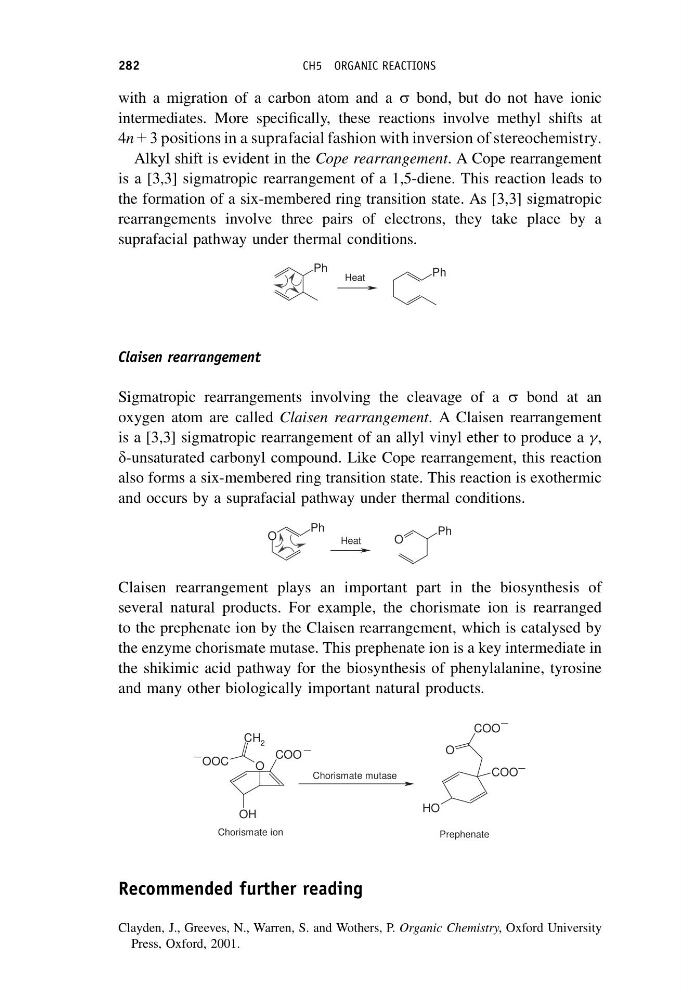
Claisen rearrangement plays an important part in the biosynthesis of
several natural products. For example, the chorismate ion is rearranged
to the prephenate ion by the Claisen rearrangement, which is catalysed by
the enzyme chorismate mutase. This prephenate ion is a key intermediate in
the shikimic acid pathway for the biosynthesis of phenylalanine, tyrosine
and many other biologically important natural products.
OH
O
COO
CH 2
OOC
O
H
COO
O
COO
_
_
Chorismate ion
Chorismate mutase
_
_
Prephenate
Recommended further reading
Clayden, J., Greeves, N., Warren, S. and Wothers, P. Organic Chemistry, Oxford University
Press, Oxford, 2001.
282
CH5 ORGANIC REACTIONS
intermediates. More specifically, these reactions involve methyl shifts at
4n+3 positions in a suprafacial fashion with inversion of stereochemistry.
Alkyl shift is evident in the Cope rearrangement. A Cope rearrangement
is a [3,3] sigmatropic rearrangement of a 1,5-diene. This reaction leads to
the formation of a six-membered ring transition state. As [3,3] sigmatropic
rearrangements involve three pairs of electrons, they take place by a
suprafacial pathway under thermal conditions.
Ph
Ph
Heat
Claisen rearrangement
Sigmatropic rearrangements involving the cleavage of a s bond at an
oxygen atom are called Claisen rearrangement. A Claisen rearrangement
is a [3,3] sigmatropic rearrangement of an allyl vinyl ether to produce a g,
d-unsaturated carbonyl compound. Like Cope rearrangement, this reaction
also forms a six-membered ring transition state. This reaction is exothermic
and occurs by a suprafacial pathway under thermal conditions.
O
Ph
O
Ph
Heat
Claisen rearrangement plays an important part in the biosynthesis of
several natural products. For example, the chorismate ion is rearranged
to the prephenate ion by the Claisen rearrangement, which is catalysed by
the enzyme chorismate mutase. This prephenate ion is a key intermediate in
the shikimic acid pathway for the biosynthesis of phenylalanine, tyrosine
and many other biologically important natural products.
OH
O
COO
CH 2
OOC
O
H
COO
O
COO
_
_
Chorismate ion
Chorismate mutase
_
_
Prephenate
Recommended further reading
Clayden, J., Greeves, N., Warren, S. and Wothers, P. Organic Chemistry, Oxford University
Press, Oxford, 2001.
282
CH5 ORGANIC REACTIONS