

Cyclic conjugated dienes that are s-cis conformation, e.g. cyclopentadiene
and 1,3-cyclohexadiene, are highly reactive in Diels–Alder reactions. In
fact, cyclopentadiene is reactive both as a diene and as a dienophile, and
forms dicyclopentadiene at room temperature. When dicyclopentadiene is
heated to 170
C, a reverse Diels–Alder reaction takes place and reforms the
cyclopentadiene.
H
H
+
Diene Dienophile
Room
temperature
170 o C
Dicyclopentadiene
=
Stereochemistry of Diels–Alder reaction
The Diels–Alder reaction is stereospecific. The stereochemistry of the
dienophile is retained in the product; i.e., cis and trans dienophiles
produce different diastereoisomers in the product. For example,
freshly distilled cyclopentadiene, having s-cis configuration, reacts
with maleic anhydride to give cis-norbornene-5,6-endo-dicarboxylic
anhydride.
O
O
O
O
O
O
H
H
+
Cyclopentadiene Maleic anhydride
Few minutes
0 o C
cis-norbornene-5,6endo-dicarboxylic anhydride
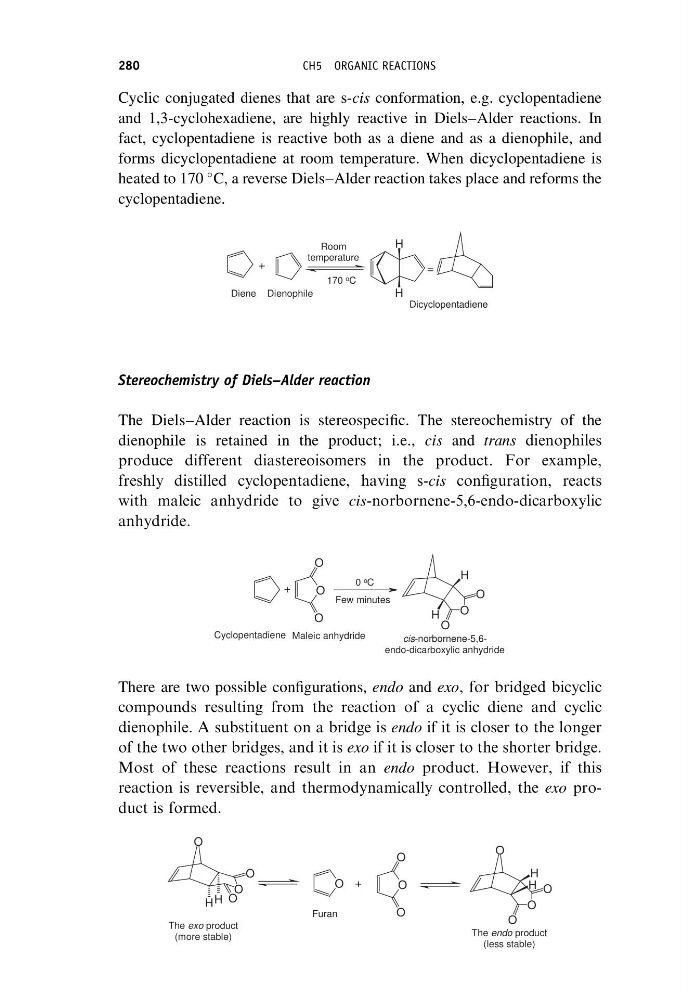
There are two possible configurations, endo and exo, for bridged bicyclic
compounds resulting from the reaction of a cyclic diene and cyclic
dienophile. A substituent on a bridge is endo if it is closer to the longer
of the two other bridges, and it is exo if it is closer to the shorter bridge.
Most of these reactions result in an endo product. However, if this
reaction is reversible, and thermodynamically controlled, the exo product is formed.
O
O
O
O
O
O
O
O
H
H
O
O
O
O
H
H
+
Furan
The endo product
(less stable)
The exo product
(more stable)
280
CH5 ORGANIC REACTIONS
and 1,3-cyclohexadiene, are highly reactive in Diels–Alder reactions. In
fact, cyclopentadiene is reactive both as a diene and as a dienophile, and
forms dicyclopentadiene at room temperature. When dicyclopentadiene is
heated to 170
C, a reverse Diels–Alder reaction takes place and reforms the
cyclopentadiene.
H
H
+
Diene Dienophile
Room
temperature
170 o C
Dicyclopentadiene
=
Stereochemistry of Diels–Alder reaction
The Diels–Alder reaction is stereospecific. The stereochemistry of the
dienophile is retained in the product; i.e., cis and trans dienophiles
produce different diastereoisomers in the product. For example,
freshly distilled cyclopentadiene, having s-cis configuration, reacts
with maleic anhydride to give cis-norbornene-5,6-endo-dicarboxylic
anhydride.
O
O
O
O
O
O
H
H
+
Cyclopentadiene Maleic anhydride
Few minutes
0 o C
cis-norbornene-5,6endo-dicarboxylic anhydride
There are two possible configurations, endo and exo, for bridged bicyclic
compounds resulting from the reaction of a cyclic diene and cyclic
dienophile. A substituent on a bridge is endo if it is closer to the longer
of the two other bridges, and it is exo if it is closer to the shorter bridge.
Most of these reactions result in an endo product. However, if this
reaction is reversible, and thermodynamically controlled, the exo product is formed.
O
O
O
O
O
O
O
O
H
H
O
O
O
O
H
H
+
Furan
The endo product
(less stable)
The exo product
(more stable)
280
CH5 ORGANIC REACTIONS