

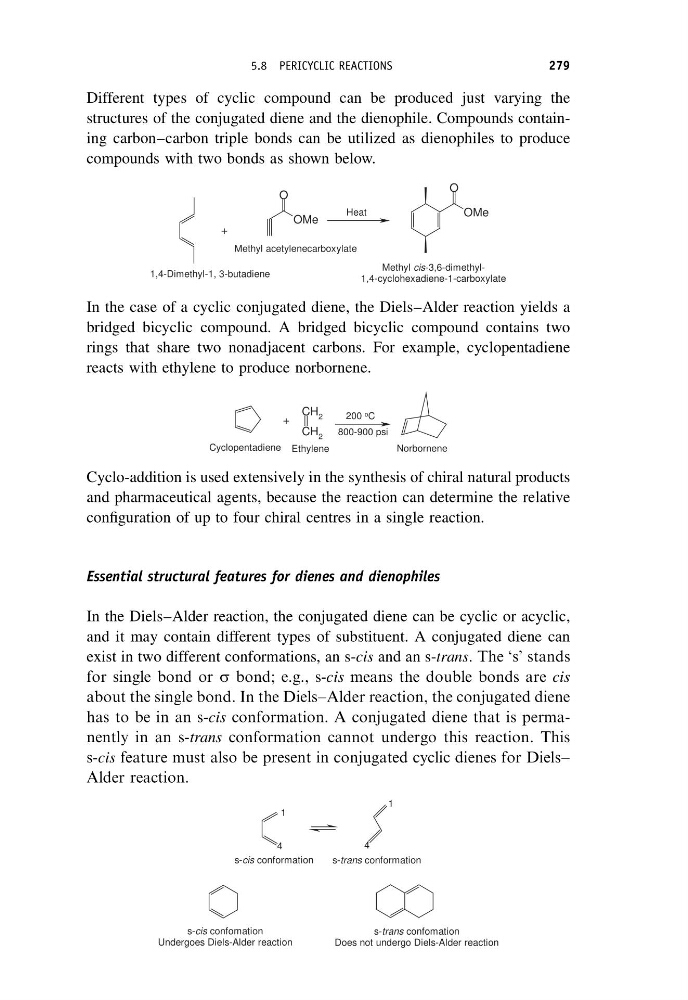
Different types of cyclic compound can be produced just varying the
structures of the conjugated diene and the dienophile. Compounds containing carbon–carbon triple bonds can be utilized as dienophiles to produce
compounds with two bonds as shown below.
O
OMe
O
OMe
+
1,4-Dimethyl-1, 3-butadiene
Methyl acetylenecarboxylate
Heat
Methyl cis-3,6-dimethyl1,4-cyclohexadiene-1-carboxylate
In the case of a cyclic conjugated diene, the Diels–Alder reaction yields a
bridged bicyclic compound. A bridged bicyclic compound contains two
rings that share two nonadjacent carbons. For example, cyclopentadiene
reacts with ethylene to produce norbornene.
CH 2
CH 2
+
Cyclopentadiene Ethylene
200 o C
800-900 psi
Norbornene
Cyclo-addition is used extensively in the synthesis of chiral natural products
and pharmaceutical agents, because the reaction can determine the relative
configuration of up to four chiral centres in a single reaction.
Essential structural features for dienes and dienophiles
In the Diels–Alder reaction, the conjugated diene can be cyclic or acyclic,
and it may contain different types of substituent. A conjugated diene can
exist in two different conformations, an s-cis and an s-trans. The ‘s’ stands
for single bond or s bond; e.g., s-cis means the double bonds are cis
about the single bond. In the Diels–Alder reaction, the conjugated diene
has to be in an s-cis conformation. A conjugated diene that is permanently in an s-trans conformation cannot undergo this reaction. This
s-cis feature must also be present in conjugated cyclic dienes for Diels–
Alder reaction.
s-cis conformation
s-trans conformation
1
4
1
4
s-cis confomation
Undergoes Diels-Alder reaction
s-trans confomation
Does not undergo Diels-Alder reaction
5.8 PERICYCLIC REACTIONS
279
structures of the conjugated diene and the dienophile. Compounds containing carbon–carbon triple bonds can be utilized as dienophiles to produce
compounds with two bonds as shown below.
O
OMe
O
OMe
+
1,4-Dimethyl-1, 3-butadiene
Methyl acetylenecarboxylate
Heat
Methyl cis-3,6-dimethyl1,4-cyclohexadiene-1-carboxylate
In the case of a cyclic conjugated diene, the Diels–Alder reaction yields a
bridged bicyclic compound. A bridged bicyclic compound contains two
rings that share two nonadjacent carbons. For example, cyclopentadiene
reacts with ethylene to produce norbornene.
CH 2
CH 2
+
Cyclopentadiene Ethylene
200 o C
800-900 psi
Norbornene
Cyclo-addition is used extensively in the synthesis of chiral natural products
and pharmaceutical agents, because the reaction can determine the relative
configuration of up to four chiral centres in a single reaction.
Essential structural features for dienes and dienophiles
In the Diels–Alder reaction, the conjugated diene can be cyclic or acyclic,
and it may contain different types of substituent. A conjugated diene can
exist in two different conformations, an s-cis and an s-trans. The ‘s’ stands
for single bond or s bond; e.g., s-cis means the double bonds are cis
about the single bond. In the Diels–Alder reaction, the conjugated diene
has to be in an s-cis conformation. A conjugated diene that is permanently in an s-trans conformation cannot undergo this reaction. This
s-cis feature must also be present in conjugated cyclic dienes for Diels–
Alder reaction.
s-cis conformation
s-trans conformation
1
4
1
4
s-cis confomation
Undergoes Diels-Alder reaction
s-trans confomation
Does not undergo Diels-Alder reaction
5.8 PERICYCLIC REACTIONS
279