

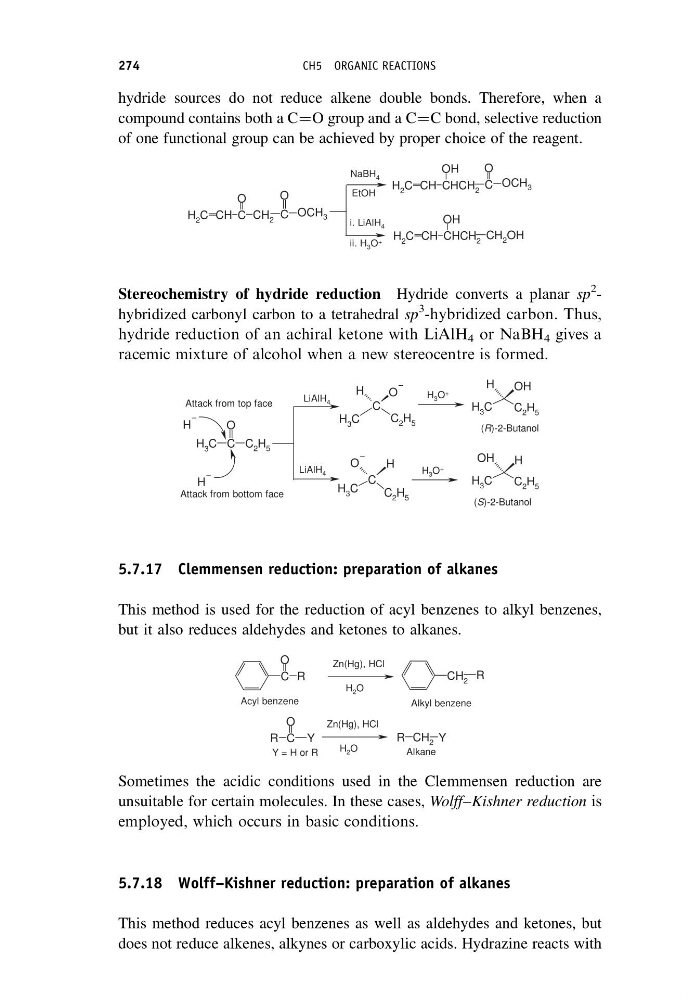
hydride sources do not reduce alkene double bonds. Therefore, when a
compound contains both a C À À
À À O group and a C À À
À À C bond, selective reduction
of one functional group can be achieved by proper choice of the reagent.
CH C CH 2
O
C
O
C
H 2
CH CHCH 2 C
O
C
H 2
OH
CH CHCH 2 CH 2 OH
C
H 2
OH
NaBH 4
i. LiAlH 4
ii. H 3 O +
OCH 3
EtOH
OCH 3
Stereochemistry of hydride reduction Hydride converts a planar sp
2
-
hybridized carbonyl carbon to a tetrahedral sp
3 -hybridized carbon. Thus,
hydride reduction of an achiral ketone with LiAlH 4 or NaBH 4 gives a
racemic mixture of alcohol when a new stereocentre is formed.
C
O
C 2 H 5
C
H 3
C
C
H 3
C 2 H 5
O
H
C
C
H 3
C 2 H 5
H
O
C
H 3
C 2 H 5
OH
H
C
H 3
C 2 H 5
H
OH
H
H
Attack from bottom face
Attack from top face
(R)-2-Butanol
(S)-2-Butanol
LiAlH 4
LiAlH 4
H 3 O +
H 3 O +
5.7.17 Clemmensen reduction: preparation of alkanes
This method is used for the reduction of acyl benzenes to alkyl benzenes,
but it also reduces aldehydes and ketones to alkanes.
C R
O
CH 2 R
Zn(Hg), HCl
Acyl benzene
Alkyl benzene
H 2 O
C Y
R
O
Y
CH 2
R
Y = H or R
Alkane
Zn(Hg), HCl
H 2 O
Sometimes the acidic conditions used in the Clemmensen reduction are
unsuitable for certain molecules. In these cases, Wolff–Kishner reduction is
employed, which occurs in basic conditions.
5.7.18 Wolff–Kishner reduction: preparation of alkanes
This method reduces acyl benzenes as well as aldehydes and ketones, but
does not reduce alkenes, alkynes or carboxylic acids. Hydrazine reacts with
274
CH5 ORGANIC REACTIONS
compound contains both a C À À
À À O group and a C À À
À À C bond, selective reduction
of one functional group can be achieved by proper choice of the reagent.
CH C CH 2
O
C
O
C
H 2
CH CHCH 2 C
O
C
H 2
OH
CH CHCH 2 CH 2 OH
C
H 2
OH
NaBH 4
i. LiAlH 4
ii. H 3 O +
OCH 3
EtOH
OCH 3
Stereochemistry of hydride reduction Hydride converts a planar sp
2
-
hybridized carbonyl carbon to a tetrahedral sp
3 -hybridized carbon. Thus,
hydride reduction of an achiral ketone with LiAlH 4 or NaBH 4 gives a
racemic mixture of alcohol when a new stereocentre is formed.
C
O
C 2 H 5
C
H 3
C
C
H 3
C 2 H 5
O
H
C
C
H 3
C 2 H 5
H
O
C
H 3
C 2 H 5
OH
H
C
H 3
C 2 H 5
H
OH
H
H
Attack from bottom face
Attack from top face
(R)-2-Butanol
(S)-2-Butanol
LiAlH 4
LiAlH 4
H 3 O +
H 3 O +
5.7.17 Clemmensen reduction: preparation of alkanes
This method is used for the reduction of acyl benzenes to alkyl benzenes,
but it also reduces aldehydes and ketones to alkanes.
C R
O
CH 2 R
Zn(Hg), HCl
Acyl benzene
Alkyl benzene
H 2 O
C Y
R
O
Y
CH 2
R
Y = H or R
Alkane
Zn(Hg), HCl
H 2 O
Sometimes the acidic conditions used in the Clemmensen reduction are
unsuitable for certain molecules. In these cases, Wolff–Kishner reduction is
employed, which occurs in basic conditions.
5.7.18 Wolff–Kishner reduction: preparation of alkanes
This method reduces acyl benzenes as well as aldehydes and ketones, but
does not reduce alkenes, alkynes or carboxylic acids. Hydrazine reacts with
274
CH5 ORGANIC REACTIONS