

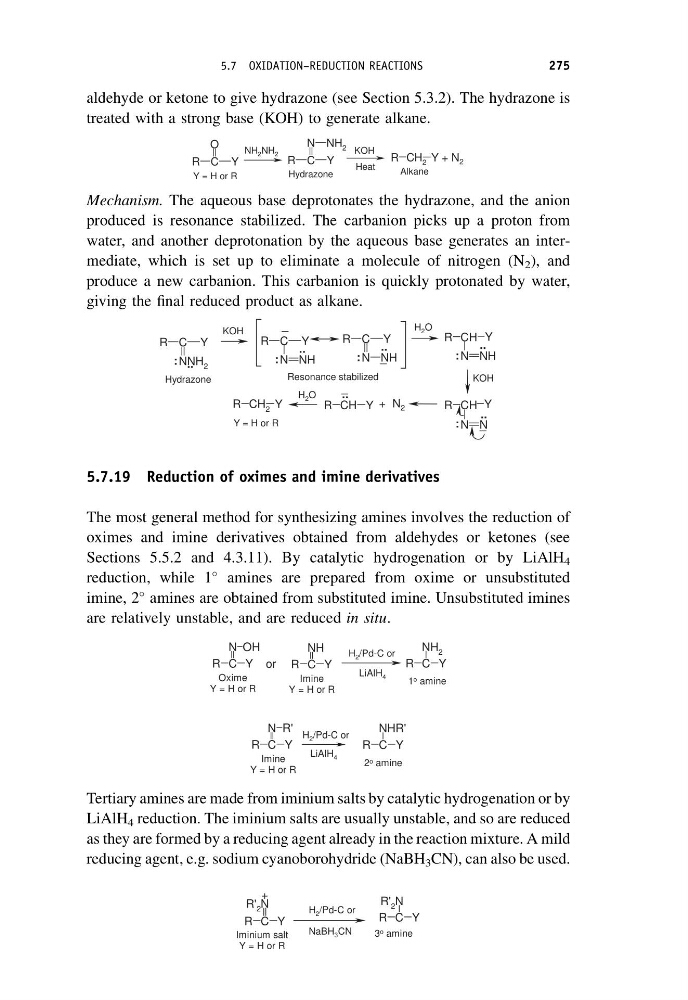
aldehyde or ketone to give hydrazone (see Section 5.3.2). The hydrazone is
treated with a strong base (KOH) to generate alkane.
C Y
O
R
N NH 2
C Y
R
Y + N 2
CH 2
R
NH 2 NH 2
Heat
KOH
Y = H or R
Hydrazone
Alkane
Mechanism. The aqueous base deprotonates the hydrazone, and the anion
produced is resonance stabilized. The carbanion picks up a proton from
water, and another deprotonation by the aqueous base generates an intermediate, which is set up to eliminate a molecule of nitrogen (N 2 ), and
produce a new carbanion. This carbanion is quickly protonated by water,
giving the final reduced product as alkane.
C Y
R
N NH
C Y
R
N NH
C Y
R
NNH 2
CH
N NH
R
Y
CH
N N
R
Y
Y
CH 2
R
Y
CH
R
_
H 2 O
Hydrazone
KOH
Resonance stabilized
: ..
:
..
_
:
..
H 2 O
_
_
+ N 2
Y = H or R
KOH
..
:
..
:
..
5.7.19 Reduction of oximes and imine derivatives
The most general method for synthesizing amines involves the reduction of
oximes and imine derivatives obtained from aldehydes or ketones (see
Sections 5.5.2 and 4.3.11). By catalytic hydrogenation or by LiAlH 4
reduction, while 1
amines are prepared from oxime or unsubstituted
imine, 2
amines are obtained from substituted imine. Unsubstituted imines
are relatively unstable, and are reduced in situ.
C
NH
Y
R
R C
NH 2
Y
C
N
Y
OH
R
Imine
Y = H or R
1 o amine
H 2 /Pd-C or
LiAlH 4
Oxime
Y = H or R
or
C
N
Y
R'
R
R C
NHR'
Y
2 o amine
H 2 /Pd-C or
LiAlH 4
Imine
Y = H or R
Tertiary amines are made from iminium salts by catalytic hydrogenation or by
LiAlH 4 reduction. The iminium salts are usually unstable, and so are reduced
as they are formed by a reducing agent already in the reaction mixture. A mild
reducing agent, e.g. sodium cyanoborohydride (NaBH 3 CN), can also be used.
C
R' 2 N
Y
R
R C
R' 2 N
Y
3 o amine
H 2 /Pd-C or
NaBH 3 CN
Iminium salt
Y = H or R
+
5.7 OXIDATION–REDUCTION REACTIONS
275
treated with a strong base (KOH) to generate alkane.
C Y
O
R
N NH 2
C Y
R
Y + N 2
CH 2
R
NH 2 NH 2
Heat
KOH
Y = H or R
Hydrazone
Alkane
Mechanism. The aqueous base deprotonates the hydrazone, and the anion
produced is resonance stabilized. The carbanion picks up a proton from
water, and another deprotonation by the aqueous base generates an intermediate, which is set up to eliminate a molecule of nitrogen (N 2 ), and
produce a new carbanion. This carbanion is quickly protonated by water,
giving the final reduced product as alkane.
C Y
R
N NH
C Y
R
N NH
C Y
R
NNH 2
CH
N NH
R
Y
CH
N N
R
Y
Y
CH 2
R
Y
CH
R
_
H 2 O
Hydrazone
KOH
Resonance stabilized
: ..
:
..
_
:
..
H 2 O
_
_
+ N 2
Y = H or R
KOH
..
:
..
:
..
5.7.19 Reduction of oximes and imine derivatives
The most general method for synthesizing amines involves the reduction of
oximes and imine derivatives obtained from aldehydes or ketones (see
Sections 5.5.2 and 4.3.11). By catalytic hydrogenation or by LiAlH 4
reduction, while 1
amines are prepared from oxime or unsubstituted
imine, 2
amines are obtained from substituted imine. Unsubstituted imines
are relatively unstable, and are reduced in situ.
C
NH
Y
R
R C
NH 2
Y
C
N
Y
OH
R
Imine
Y = H or R
1 o amine
H 2 /Pd-C or
LiAlH 4
Oxime
Y = H or R
or
C
N
Y
R'
R
R C
NHR'
Y
2 o amine
H 2 /Pd-C or
LiAlH 4
Imine
Y = H or R
Tertiary amines are made from iminium salts by catalytic hydrogenation or by
LiAlH 4 reduction. The iminium salts are usually unstable, and so are reduced
as they are formed by a reducing agent already in the reaction mixture. A mild
reducing agent, e.g. sodium cyanoborohydride (NaBH 3 CN), can also be used.
C
R' 2 N
Y
R
R C
R' 2 N
Y
3 o amine
H 2 /Pd-C or
NaBH 3 CN
Iminium salt
Y = H or R
+
5.7 OXIDATION–REDUCTION REACTIONS
275