

Preparation of alcohols: catalytic hydrogenation
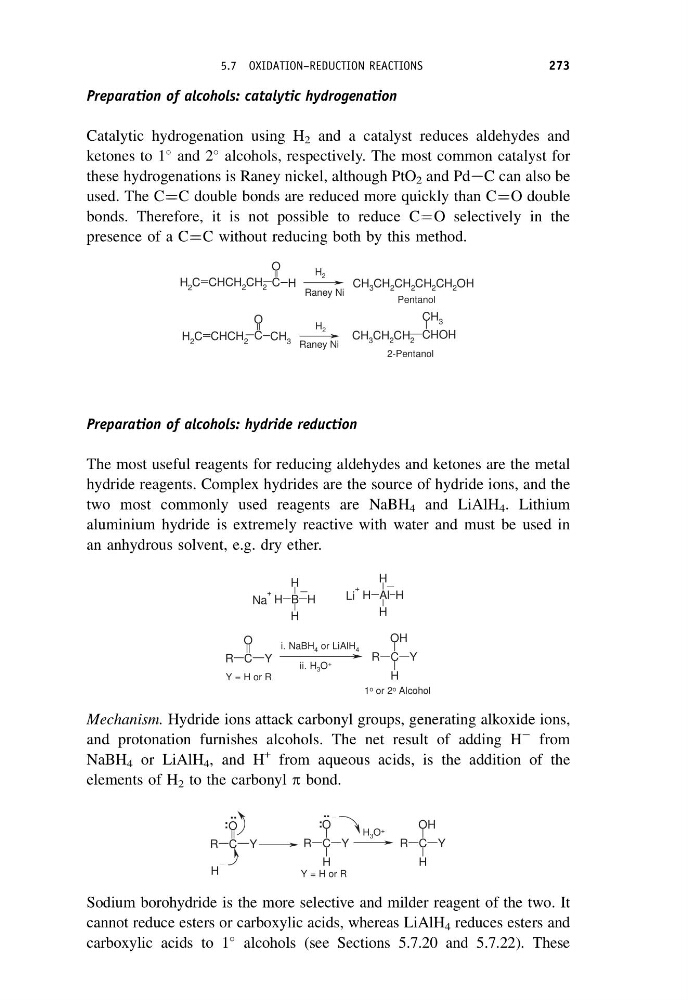
Catalytic hydrogenation using H 2 and a catalyst reduces aldehydes and
ketones to 1
and 2
alcohols, respectively. The most common catalyst for
these hydrogenations is Raney nickel, although PtO 2 and PdÀ ÀC can also be
used. The C À À
À À C double bonds are reduced more quickly than C À À
À À O double
bonds. Therefore, it is not possible to reduce C À À
À À O selectively in the
presence of a C À À
À À C without reducing both by this method.
C
H 2 CHCH 2 CH 2 C H
O
C
H 2 CHCH 2 C CH 3
O
CHOH
CH 3
CH 3 CH 2 CH 2
H 2
Raney Ni
CH 3 CH 2 CH 2 CH 2 CH 2 OH
H 2
Raney Ni
Pentanol
2-Pentanol
Preparation of alcohols: hydride reduction
The most useful reagents for reducing aldehydes and ketones are the metal
hydride reagents. Complex hydrides are the source of hydride ions, and the
two most commonly used reagents are NaBH 4 and LiAlH 4 . Lithium
aluminium hydride is extremely reactive with water and must be used in
an anhydrous solvent, e.g. dry ether.
H B
H
H
H
Na
+
H Al
H
H
H
Li
+
_
_
C Y
O
R
C Y
R
OH
H
ii. H 3 O +
1 o or 2 o Alcohol
Y = H or R
i. NaBH 4 or LiAlH 4
Mechanism. Hydride ions attack carbonyl groups, generating alkoxide ions,
and protonation furnishes alcohols. The net result of adding H
À from
NaBH 4 or LiAlH 4 , and H
+ from aqueous acids, is the addition of the
elements of H 2 to the carbonyl p bond.
C Y
O
R
C Y
R
O
H
C Y
R
OH
H
H
H 3 O +
Y = H or R
:
:
..
..
Sodium borohydride is the more selective and milder reagent of the two. It
cannot reduce esters or carboxylic acids, whereas LiAlH 4 reduces esters and
carboxylic acids to 1
alcohols (see Sections 5.7.20 and 5.7.22). These
5.7 OXIDATION–REDUCTION REACTIONS
273
Catalytic hydrogenation using H 2 and a catalyst reduces aldehydes and
ketones to 1
and 2
alcohols, respectively. The most common catalyst for
these hydrogenations is Raney nickel, although PtO 2 and PdÀ ÀC can also be
used. The C À À
À À C double bonds are reduced more quickly than C À À
À À O double
bonds. Therefore, it is not possible to reduce C À À
À À O selectively in the
presence of a C À À
À À C without reducing both by this method.
C
H 2 CHCH 2 CH 2 C H
O
C
H 2 CHCH 2 C CH 3
O
CHOH
CH 3
CH 3 CH 2 CH 2
H 2
Raney Ni
CH 3 CH 2 CH 2 CH 2 CH 2 OH
H 2
Raney Ni
Pentanol
2-Pentanol
Preparation of alcohols: hydride reduction
The most useful reagents for reducing aldehydes and ketones are the metal
hydride reagents. Complex hydrides are the source of hydride ions, and the
two most commonly used reagents are NaBH 4 and LiAlH 4 . Lithium
aluminium hydride is extremely reactive with water and must be used in
an anhydrous solvent, e.g. dry ether.
H B
H
H
H
Na
+
H Al
H
H
H
Li
+
_
_
C Y
O
R
C Y
R
OH
H
ii. H 3 O +
1 o or 2 o Alcohol
Y = H or R
i. NaBH 4 or LiAlH 4
Mechanism. Hydride ions attack carbonyl groups, generating alkoxide ions,
and protonation furnishes alcohols. The net result of adding H
À from
NaBH 4 or LiAlH 4 , and H
+ from aqueous acids, is the addition of the
elements of H 2 to the carbonyl p bond.
C Y
O
R
C Y
R
O
H
C Y
R
OH
H
H
H 3 O +
Y = H or R
:
:
..
..
Sodium borohydride is the more selective and milder reagent of the two. It
cannot reduce esters or carboxylic acids, whereas LiAlH 4 reduces esters and
carboxylic acids to 1
alcohols (see Sections 5.7.20 and 5.7.22). These
5.7 OXIDATION–REDUCTION REACTIONS
273