

LiAlH 4
O S
O
O
CH 3
OH
Ts-Cl
Cyclopentyl tosylate
Py
Cyclopentanol
THF
Cyclopentane
5.7.14 Reduction of alkyl halides: preparation of alkanes
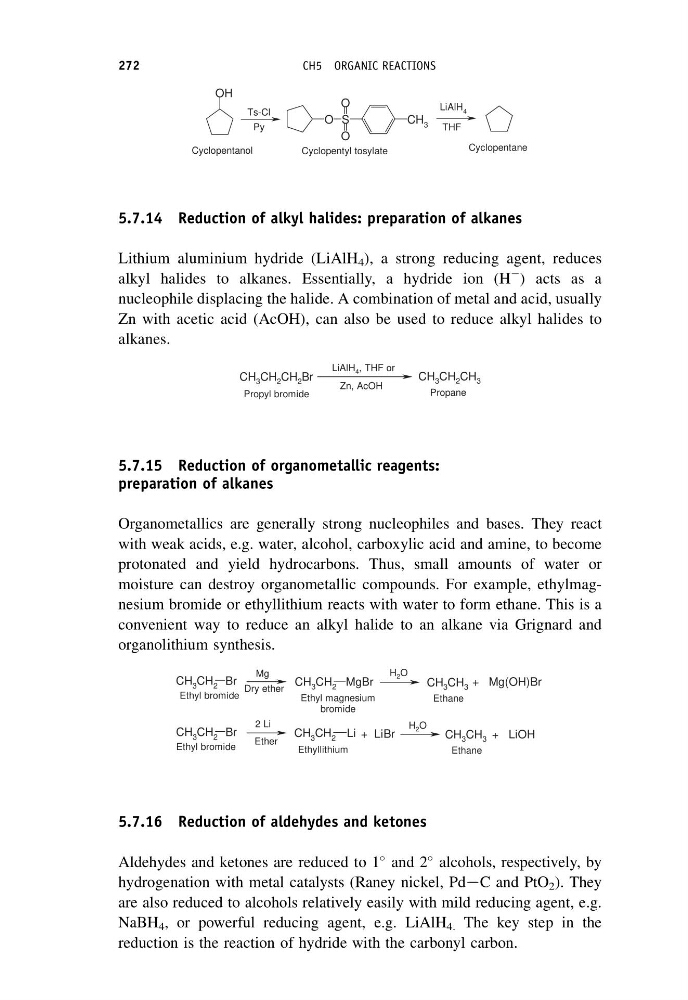
Lithium aluminium hydride (LiAlH 4 ), a strong reducing agent, reduces
alkyl halides to alkanes. Essentially, a hydride ion (H
À ) acts as a
nucleophile displacing the halide. A combination of metal and acid, usually
Zn with acetic acid (AcOH), can also be used to reduce alkyl halides to
alkanes.
LiAlH 4 , THF or
Zn, AcOH
Propyl bromide
Propane
CH 3 CH 2 CH 2 Br
CH 3 CH 2 CH 3
5.7.15 Reduction of organometallic reagents:
preparation of alkanes
Organometallics are generally strong nucleophiles and bases. They react
with weak acids, e.g. water, alcohol, carboxylic acid and amine, to become
protonated and yield hydrocarbons. Thus, small amounts of water or
moisture can destroy organometallic compounds. For example, ethylmagnesium bromide or ethyllithium reacts with water to form ethane. This is a
convenient way to reduce an alkyl halide to an alkane via Grignard and
organolithium synthesis.
CH 3 CH 2 Br
CH 3 CH 2 MgBr
CH 3 CH 2 Br
CH 3 CH 2 Li
+ LiOH
+ Mg(OH)Br
H 2 O
Ethane
Ethyl bromide
Ethyllithium
Ethyl magnesium
bromide
Mg
Dry ether
CH 3 CH 3
H 2 O
Ethane
Ethyl bromide
2 Li
Ether
CH 3 CH 3
+ LiBr
5.7.16 Reduction of aldehydes and ketones
Aldehydes and ketones are reduced to 1
and 2
alcohols, respectively, by
hydrogenation with metal catalysts (Raney nickel, PdÀ ÀC and PtO 2 ). They
are also reduced to alcohols relatively easily with mild reducing agent, e.g.
NaBH 4 , or powerful reducing agent, e.g. LiAlH 4. The key step in the
reduction is the reaction of hydride with the carbonyl carbon.
272
CH5 ORGANIC REACTIONS
O S
O
O
CH 3
OH
Ts-Cl
Cyclopentyl tosylate
Py
Cyclopentanol
THF
Cyclopentane
5.7.14 Reduction of alkyl halides: preparation of alkanes
Lithium aluminium hydride (LiAlH 4 ), a strong reducing agent, reduces
alkyl halides to alkanes. Essentially, a hydride ion (H
À ) acts as a
nucleophile displacing the halide. A combination of metal and acid, usually
Zn with acetic acid (AcOH), can also be used to reduce alkyl halides to
alkanes.
LiAlH 4 , THF or
Zn, AcOH
Propyl bromide
Propane
CH 3 CH 2 CH 2 Br
CH 3 CH 2 CH 3
5.7.15 Reduction of organometallic reagents:
preparation of alkanes
Organometallics are generally strong nucleophiles and bases. They react
with weak acids, e.g. water, alcohol, carboxylic acid and amine, to become
protonated and yield hydrocarbons. Thus, small amounts of water or
moisture can destroy organometallic compounds. For example, ethylmagnesium bromide or ethyllithium reacts with water to form ethane. This is a
convenient way to reduce an alkyl halide to an alkane via Grignard and
organolithium synthesis.
CH 3 CH 2 Br
CH 3 CH 2 MgBr
CH 3 CH 2 Br
CH 3 CH 2 Li
+ LiOH
+ Mg(OH)Br
H 2 O
Ethane
Ethyl bromide
Ethyllithium
Ethyl magnesium
bromide
Mg
Dry ether
CH 3 CH 3
H 2 O
Ethane
Ethyl bromide
2 Li
Ether
CH 3 CH 3
+ LiBr
5.7.16 Reduction of aldehydes and ketones
Aldehydes and ketones are reduced to 1
and 2
alcohols, respectively, by
hydrogenation with metal catalysts (Raney nickel, PdÀ ÀC and PtO 2 ). They
are also reduced to alcohols relatively easily with mild reducing agent, e.g.
NaBH 4 , or powerful reducing agent, e.g. LiAlH 4. The key step in the
reduction is the reaction of hydride with the carbonyl carbon.
272
CH5 ORGANIC REACTIONS