

R C H
O
R C OH
O
[O]
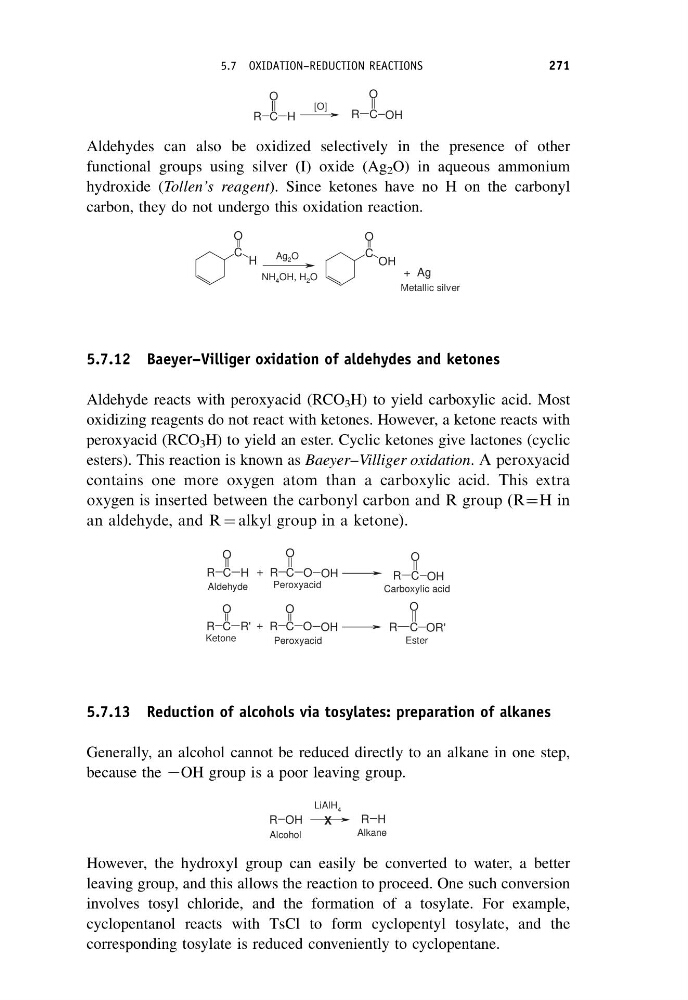
Aldehydes can also be oxidized selectively in the presence of other
functional groups using silver (I) oxide (Ag 2 O) in aqueous ammonium
hydroxide (Tollen’s reagent). Since ketones have no H on the carbonyl
carbon, they do not undergo this oxidation reaction.
C
O
H
C
O
OH
NH 4 OH, H 2 O
+ Ag
Ag 2 O
Metallic silver
5.7.12 Baeyer–Villiger oxidation of aldehydes and ketones
Aldehyde reacts with peroxyacid (RCO 3 H) to yield carboxylic acid. Most
oxidizing reagents do not react with ketones. However, a ketone reacts with
peroxyacid (RCO 3 H) to yield an ester. Cyclic ketones give lactones (cyclic
esters). This reaction is known as Baeyer–Villiger oxidation. A peroxyacid
contains one more oxygen atom than a carboxylic acid. This extra
oxygen is inserted between the carbonyl carbon and R group (R À À
À À H in
an aldehyde, and R ¼ alkyl group in a ketone).
R C H
O
R C OH
O
R C O
O
OH
R C R'
O
R C OR'
O
R C O
O
OH
+
Peroxyacid
Aldehyde
Carboxylic acid
+
Peroxyacid
Ester
Ketone
5.7.13 Reduction of alcohols via tosylates: preparation of alkanes
Generally, an alcohol cannot be reduced directly to an alkane in one step,
because the À ÀOH group is a poor leaving group.
LiAlH 4
X
R OH
R H
Alcohol
Alkane
However, the hydroxyl group can easily be converted to water, a better
leaving group, and this allows the reaction to proceed. One such conversion
involves tosyl chloride, and the formation of a tosylate. For example,
cyclopentanol reacts with TsCl to form cyclopentyl tosylate, and the
corresponding tosylate is reduced conveniently to cyclopentane.
5.7 OXIDATION–REDUCTION REACTIONS
271
O
R C OH
O
[O]
Aldehydes can also be oxidized selectively in the presence of other
functional groups using silver (I) oxide (Ag 2 O) in aqueous ammonium
hydroxide (Tollen’s reagent). Since ketones have no H on the carbonyl
carbon, they do not undergo this oxidation reaction.
C
O
H
C
O
OH
NH 4 OH, H 2 O
+ Ag
Ag 2 O
Metallic silver
5.7.12 Baeyer–Villiger oxidation of aldehydes and ketones
Aldehyde reacts with peroxyacid (RCO 3 H) to yield carboxylic acid. Most
oxidizing reagents do not react with ketones. However, a ketone reacts with
peroxyacid (RCO 3 H) to yield an ester. Cyclic ketones give lactones (cyclic
esters). This reaction is known as Baeyer–Villiger oxidation. A peroxyacid
contains one more oxygen atom than a carboxylic acid. This extra
oxygen is inserted between the carbonyl carbon and R group (R À À
À À H in
an aldehyde, and R ¼ alkyl group in a ketone).
R C H
O
R C OH
O
R C O
O
OH
R C R'
O
R C OR'
O
R C O
O
OH
+
Peroxyacid
Aldehyde
Carboxylic acid
+
Peroxyacid
Ester
Ketone
5.7.13 Reduction of alcohols via tosylates: preparation of alkanes
Generally, an alcohol cannot be reduced directly to an alkane in one step,
because the À ÀOH group is a poor leaving group.
LiAlH 4
X
R OH
R H
Alcohol
Alkane
However, the hydroxyl group can easily be converted to water, a better
leaving group, and this allows the reaction to proceed. One such conversion
involves tosyl chloride, and the formation of a tosylate. For example,
cyclopentanol reacts with TsCl to form cyclopentyl tosylate, and the
corresponding tosylate is reduced conveniently to cyclopentane.
5.7 OXIDATION–REDUCTION REACTIONS
271