

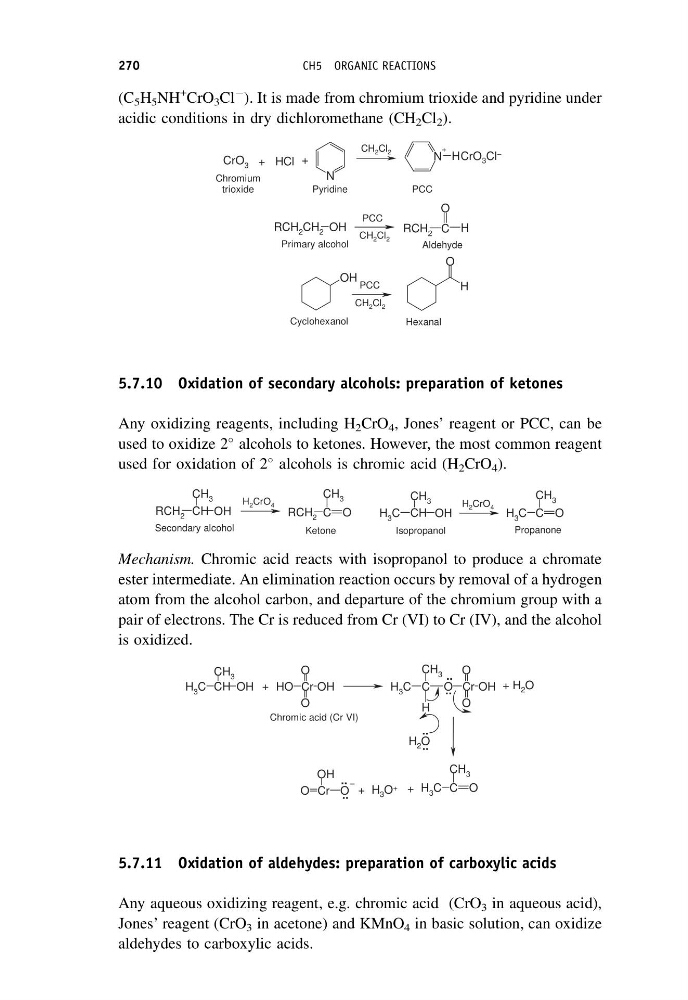
(C 5 H 5 NH
+ CrO 3 Cl
À ). It is made from chromium trioxide and pyridine under
acidic conditions in dry dichloromethane (CH 2 Cl 2 ).
N
+
CrO 3
N
H
PCC
RCH 2 CH 2 OH
RCH 2 C H
O
PCC
OH
O
H
PCC
+ HCl +
Chromium
trioxide
Pyridine
CrO 3 Cl −
Primary alcohol
Aldehyde
CH 2 Cl 2
CH 2 Cl 2
Cyclohexanol
Hexanal
CH 2 Cl 2
5.7.10 Oxidation of secondary alcohols: preparation of ketones
Any oxidizing reagents, including H 2 CrO 4 , Jones’ reagent or PCC, can be
used to oxidize 2
alcohols to ketones. However, the most common reagent
used for oxidation of 2
alcohols is chromic acid (H 2 CrO 4 ).
CH
CH 3
RCH 2
C
RCH 2
O
CH 3
OH
CH
CH 3
C
H 3
C
C
H 3
O
CH 3
OH
Secondary alcohol
Ketone
H 2 CrO 4
Propanone
Isopropanol
H 2 CrO 4
Mechanism. Chromic acid reacts with isopropanol to produce a chromate
ester intermediate. An elimination reaction occurs by removal of a hydrogen
atom from the alcohol carbon, and departure of the chromium group with a
pair of electrons. The Cr is reduced from Cr (VI) to Cr (IV), and the alcohol
is oxidized.
O
H Cr
O
O
OH
Cr
O
O
OH
C
CH 3
C
H 3
O
H
O Cr
OH
O
CH
CH 3
C
H 3
C
C
H 3
O
CH 3
OH +
Chromic acid (Cr VI)
+ H 2 O
+
+ H 3 O +
..
..
..
..
..
..
H 2 O
5.7.11 Oxidation of aldehydes: preparation of carboxylic acids
Any aqueous oxidizing reagent, e.g. chromic acid (CrO 3 in aqueous acid),
Jones’ reagent (CrO 3 in acetone) and KMnO 4 in basic solution, can oxidize
aldehydes to carboxylic acids.
270
CH5 ORGANIC REACTIONS
+ CrO 3 Cl
À ). It is made from chromium trioxide and pyridine under
acidic conditions in dry dichloromethane (CH 2 Cl 2 ).
N
+
CrO 3
N
H
PCC
RCH 2 CH 2 OH
RCH 2 C H
O
PCC
OH
O
H
PCC
+ HCl +
Chromium
trioxide
Pyridine
CrO 3 Cl −
Primary alcohol
Aldehyde
CH 2 Cl 2
CH 2 Cl 2
Cyclohexanol
Hexanal
CH 2 Cl 2
5.7.10 Oxidation of secondary alcohols: preparation of ketones
Any oxidizing reagents, including H 2 CrO 4 , Jones’ reagent or PCC, can be
used to oxidize 2
alcohols to ketones. However, the most common reagent
used for oxidation of 2
alcohols is chromic acid (H 2 CrO 4 ).
CH
CH 3
RCH 2
C
RCH 2
O
CH 3
OH
CH
CH 3
C
H 3
C
C
H 3
O
CH 3
OH
Secondary alcohol
Ketone
H 2 CrO 4
Propanone
Isopropanol
H 2 CrO 4
Mechanism. Chromic acid reacts with isopropanol to produce a chromate
ester intermediate. An elimination reaction occurs by removal of a hydrogen
atom from the alcohol carbon, and departure of the chromium group with a
pair of electrons. The Cr is reduced from Cr (VI) to Cr (IV), and the alcohol
is oxidized.
O
H Cr
O
O
OH
Cr
O
O
OH
C
CH 3
C
H 3
O
H
O Cr
OH
O
CH
CH 3
C
H 3
C
C
H 3
O
CH 3
OH +
Chromic acid (Cr VI)
+ H 2 O
+
+ H 3 O +
..
..
..
..
..
..
H 2 O
5.7.11 Oxidation of aldehydes: preparation of carboxylic acids
Any aqueous oxidizing reagent, e.g. chromic acid (CrO 3 in aqueous acid),
Jones’ reagent (CrO 3 in acetone) and KMnO 4 in basic solution, can oxidize
aldehydes to carboxylic acids.
270
CH5 ORGANIC REACTIONS