

C 2 H 5 C CH
C 2 H 5 C
O
OH
i. O 3 , -78 o C
ii. H 2 O
1-Butyne
+ CO 2
Propionic acid
5.7.9 Oxidation of primary alcohols
Primary alcohols are oxidized either to aldehydes or to carboxylic acids,
depending on the oxidizing reagents and conditions used.
Preparation of carboxylic acids
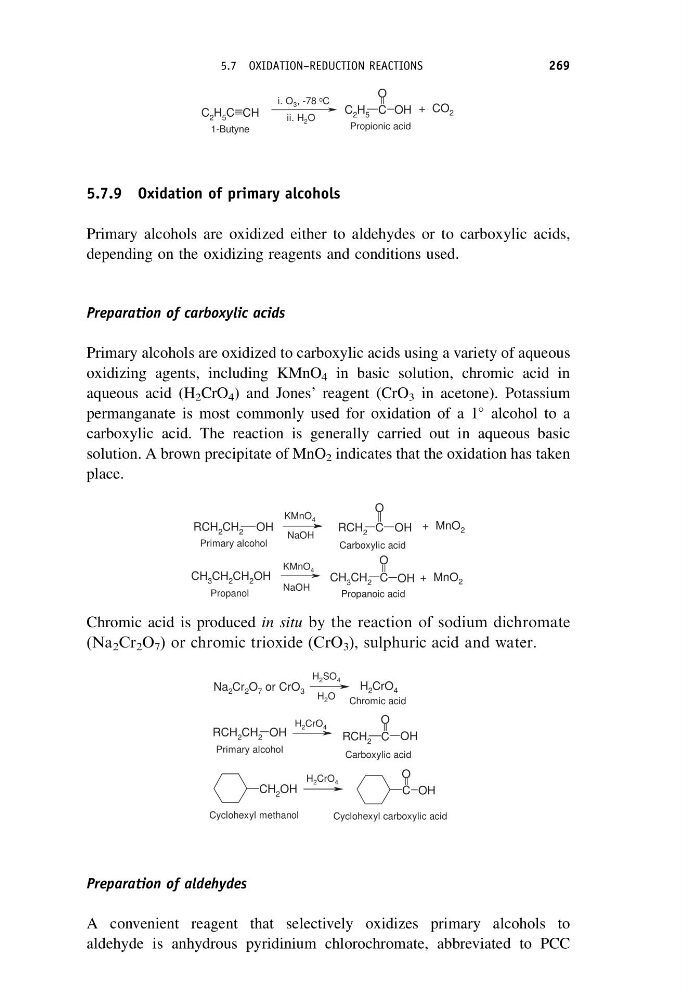
Primary alcohols are oxidized to carboxylic acids using a variety of aqueous
oxidizing agents, including KMnO 4 in basic solution, chromic acid in
aqueous acid (H 2 CrO 4 ) and Jones’ reagent (CrO 3 in acetone). Potassium
permanganate is most commonly used for oxidation of a 1
alcohol to a
carboxylic acid. The reaction is generally carried out in aqueous basic
solution. A brown precipitate of MnO 2 indicates that the oxidation has taken
place.
RCH 2 CH 2 OH
RCH 2 C OH
O
CH 3 CH 2 CH 2 OH
CH 3 CH 2 C
O
OH
NaOH
Carboxylic acid
KMnO 4
+ MnO 2
Primary alcohol
NaOH
Propanol
Propanoic acid
KMnO 4
+ MnO 2
Chromic acid is produced in situ by the reaction of sodium dichromate
(Na 2 Cr 2 O 7 ) or chromic trioxide (CrO 3 ), sulphuric acid and water.
RCH 2 CH 2 OH
RCH 2 C OH
O
CH 2 OH
C OH
O
Carboxylic acid
Primary alcohol
Cyclohexyl methanol
Cyclohexyl carboxylic acid
H 2 CrO 4
H 2 CrO 4
Na 2 Cr 2 O 7 or CrO 3
H 2 SO 4
H 2 CrO 4
H 2 O Chromic acid
Preparation of aldehydes
A convenient reagent that selectively oxidizes primary alcohols to
aldehyde is anhydrous pyridinium chlorochromate, abbreviated to PCC
5.7 OXIDATION–REDUCTION REACTIONS
269
C 2 H 5 C
O
OH
i. O 3 , -78 o C
ii. H 2 O
1-Butyne
+ CO 2
Propionic acid
5.7.9 Oxidation of primary alcohols
Primary alcohols are oxidized either to aldehydes or to carboxylic acids,
depending on the oxidizing reagents and conditions used.
Preparation of carboxylic acids
Primary alcohols are oxidized to carboxylic acids using a variety of aqueous
oxidizing agents, including KMnO 4 in basic solution, chromic acid in
aqueous acid (H 2 CrO 4 ) and Jones’ reagent (CrO 3 in acetone). Potassium
permanganate is most commonly used for oxidation of a 1
alcohol to a
carboxylic acid. The reaction is generally carried out in aqueous basic
solution. A brown precipitate of MnO 2 indicates that the oxidation has taken
place.
RCH 2 CH 2 OH
RCH 2 C OH
O
CH 3 CH 2 CH 2 OH
CH 3 CH 2 C
O
OH
NaOH
Carboxylic acid
KMnO 4
+ MnO 2
Primary alcohol
NaOH
Propanol
Propanoic acid
KMnO 4
+ MnO 2
Chromic acid is produced in situ by the reaction of sodium dichromate
(Na 2 Cr 2 O 7 ) or chromic trioxide (CrO 3 ), sulphuric acid and water.
RCH 2 CH 2 OH
RCH 2 C OH
O
CH 2 OH
C OH
O
Carboxylic acid
Primary alcohol
Cyclohexyl methanol
Cyclohexyl carboxylic acid
H 2 CrO 4
H 2 CrO 4
Na 2 Cr 2 O 7 or CrO 3
H 2 SO 4
H 2 CrO 4
H 2 O Chromic acid
Preparation of aldehydes
A convenient reagent that selectively oxidizes primary alcohols to
aldehyde is anhydrous pyridinium chlorochromate, abbreviated to PCC
5.7 OXIDATION–REDUCTION REACTIONS
269