

5.7.1 Oxidizing and reducing agents
Oxidizing agents are reagents that seek electrons, and are electron-deficient
species, e.g. chromic acid (H 2 CrO 4 ), potassium permanganate (KMnO 4 ) and
osmium tetroxide (OsO 4 ). Therefore, oxidizing agents are classified as
electrophiles. In the process of gaining electrons, oxidizing agents
become reduced. Oxidation results in an increase in the number of
CÀ ÀO bonds or a decrease in the number of CÀ ÀH bonds.
On the other hand, reducing agents are reagents that give up electrons,
and are electron-rich species, e.g. sodium borohydride (NaBH 4 ), lithium
aluminium hydride (LiAlH 4 ). Therefore, reducing agents are classified as
nucleophiles. In the process of giving up electrons, reducing agents
become oxidized. Reduction results in an increase in the number of
CÀ ÀH bonds or a decrease in the number of CÀ ÀO bonds.
5.7.2 Oxidation of alkenes
Preparation of epoxides
Alkenes undergo a number of oxidation reactions in which the C À À
À À C is
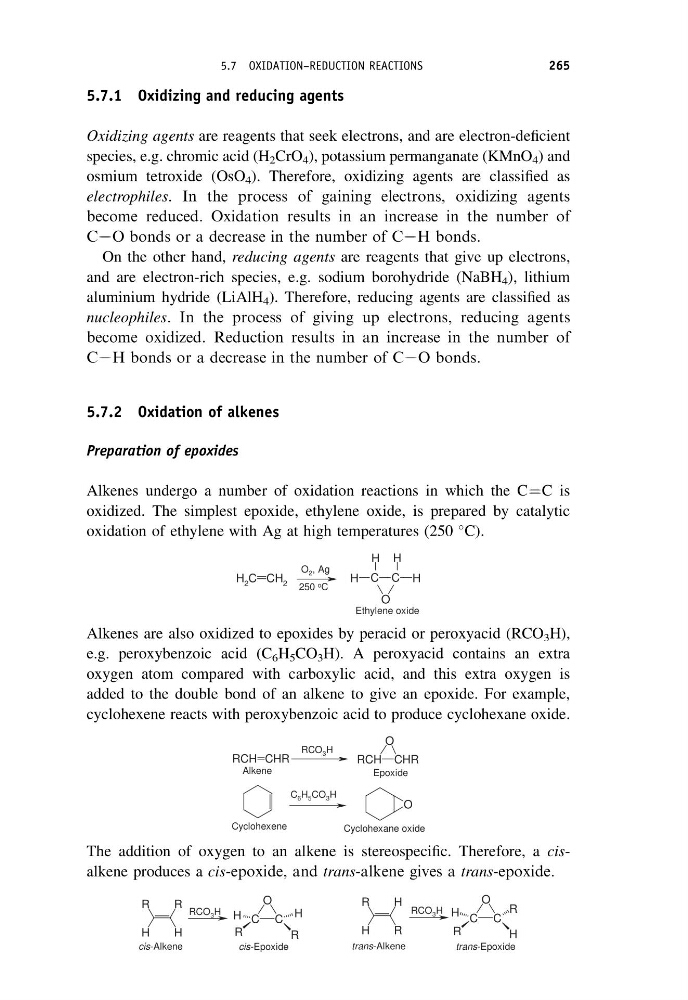
oxidized. The simplest epoxide, ethylene oxide, is prepared by catalytic
oxidation of ethylene with Ag at high temperatures (250
C).
H
H
O
H H
C
H 2
CH 2
Ethylene oxide
C C
O 2 , Ag
250 o C
Alkenes are also oxidized to epoxides by peracid or peroxyacid (RCO 3 H),
e.g. peroxybenzoic acid (C 6 H 5 CO 3 H). A peroxyacid contains an extra
oxygen atom compared with carboxylic acid, and this extra oxygen is
added to the double bond of an alkene to give an epoxide. For example,
cyclohexene reacts with peroxybenzoic acid to produce cyclohexane oxide.
O
RCH CHR
RCH CHR
O
C 6 H 5 CO 3 H
Cyclohexene
Cyclohexane oxide
Alkene
RCO 3 H
Epoxide
The addition of oxygen to an alkene is stereospecific. Therefore, a cisalkene produces a cis-epoxide, and trans-alkene gives a trans-epoxide.
C C
O
R
R
H
H
C C
O
R
H
R
H
R
R
H
H
R
H
H
R
trans-Alkene
cis-Alkene
RCO 3 H
RCO 3 H
cis-Epoxide
trans-Epoxide
5.7 OXIDATION–REDUCTION REACTIONS
265
Oxidizing agents are reagents that seek electrons, and are electron-deficient
species, e.g. chromic acid (H 2 CrO 4 ), potassium permanganate (KMnO 4 ) and
osmium tetroxide (OsO 4 ). Therefore, oxidizing agents are classified as
electrophiles. In the process of gaining electrons, oxidizing agents
become reduced. Oxidation results in an increase in the number of
CÀ ÀO bonds or a decrease in the number of CÀ ÀH bonds.
On the other hand, reducing agents are reagents that give up electrons,
and are electron-rich species, e.g. sodium borohydride (NaBH 4 ), lithium
aluminium hydride (LiAlH 4 ). Therefore, reducing agents are classified as
nucleophiles. In the process of giving up electrons, reducing agents
become oxidized. Reduction results in an increase in the number of
CÀ ÀH bonds or a decrease in the number of CÀ ÀO bonds.
5.7.2 Oxidation of alkenes
Preparation of epoxides
Alkenes undergo a number of oxidation reactions in which the C À À
À À C is
oxidized. The simplest epoxide, ethylene oxide, is prepared by catalytic
oxidation of ethylene with Ag at high temperatures (250
C).
H
H
O
H H
C
H 2
CH 2
Ethylene oxide
C C
O 2 , Ag
250 o C
Alkenes are also oxidized to epoxides by peracid or peroxyacid (RCO 3 H),
e.g. peroxybenzoic acid (C 6 H 5 CO 3 H). A peroxyacid contains an extra
oxygen atom compared with carboxylic acid, and this extra oxygen is
added to the double bond of an alkene to give an epoxide. For example,
cyclohexene reacts with peroxybenzoic acid to produce cyclohexane oxide.
O
RCH CHR
RCH CHR
O
C 6 H 5 CO 3 H
Cyclohexene
Cyclohexane oxide
Alkene
RCO 3 H
Epoxide
The addition of oxygen to an alkene is stereospecific. Therefore, a cisalkene produces a cis-epoxide, and trans-alkene gives a trans-epoxide.
C C
O
R
R
H
H
C C
O
R
H
R
H
R
R
H
H
R
H
H
R
trans-Alkene
cis-Alkene
RCO 3 H
RCO 3 H
cis-Epoxide
trans-Epoxide
5.7 OXIDATION–REDUCTION REACTIONS
265