

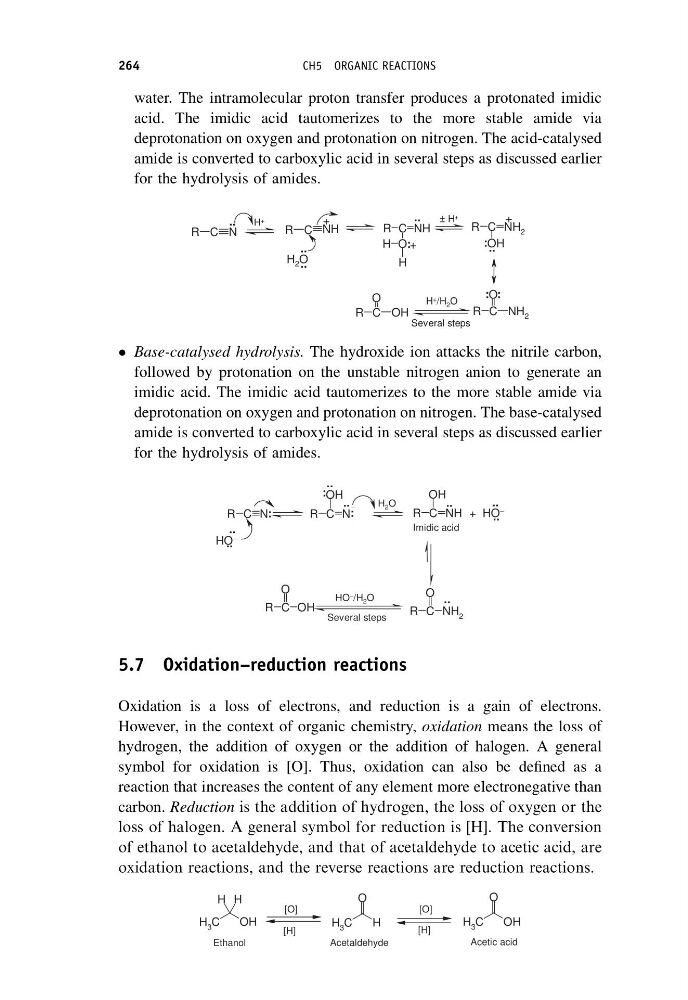
water. The intramolecular proton transfer produces a protonated imidic
acid. The imidic acid tautomerizes to the more stable amide via
deprotonation on oxygen and protonation on nitrogen. The acid-catalysed
amide is converted to carboxylic acid in several steps as discussed earlier
for the hydrolysis of amides.
R C N
R C NH
R C NH
O
H
H
R C NH 2
OH
R C
O
NH 2
R C OH
O
H 2 O
+
+
..
:
..
H +
± H +
..
:
+
..
..
H + /H 2 O
:
:
Several steps
Base-catalysed hydrolysis. The hydroxide ion attacks the nitrile carbon,
followed by protonation on the unstable nitrogen anion to generate an
imidic acid. The imidic acid tautomerizes to the more stable amide via
deprotonation on oxygen and protonation on nitrogen. The base-catalysed
amide is converted to carboxylic acid in several steps as discussed earlier
for the hydrolysis of amides.
R C N
R C N
OH
R C NH
OH
R C NH 2
O
R C OH
O
H 2 O
..
..
..
:
Imidic acid
+ HO −
..
:
:
..
HO − /H 2 O
Several steps
..
HO −
..
..
5.7 Oxidation–reduction reactions
Oxidation is a loss of electrons, and reduction is a gain of electrons.
However, in the context of organic chemistry, oxidation means the loss of
hydrogen, the addition of oxygen or the addition of halogen. A general
symbol for oxidation is [O]. Thus, oxidation can also be defined as a
reaction that increases the content of any element more electronegative than
carbon. Reduction is the addition of hydrogen, the loss of oxygen or the
loss of halogen. A general symbol for reduction is [H]. The conversion
of ethanol to acetaldehyde, and that of acetaldehyde to acetic acid, are
oxidation reactions, and the reverse reactions are reduction reactions.
C
H 3
OH
H H
C
H 3
O
H
C
H 3
O
OH
Ethanol
[O]
Acetaldehyde
Acetic acid
[O]
[H]
[H]
264
CH5 ORGANIC REACTIONS
acid. The imidic acid tautomerizes to the more stable amide via
deprotonation on oxygen and protonation on nitrogen. The acid-catalysed
amide is converted to carboxylic acid in several steps as discussed earlier
for the hydrolysis of amides.
R C N
R C NH
R C NH
O
H
H
R C NH 2
OH
R C
O
NH 2
R C OH
O
H 2 O
+
+
..
:
..
H +
± H +
..
:
+
..
..
H + /H 2 O
:
:
Several steps
Base-catalysed hydrolysis. The hydroxide ion attacks the nitrile carbon,
followed by protonation on the unstable nitrogen anion to generate an
imidic acid. The imidic acid tautomerizes to the more stable amide via
deprotonation on oxygen and protonation on nitrogen. The base-catalysed
amide is converted to carboxylic acid in several steps as discussed earlier
for the hydrolysis of amides.
R C N
R C N
OH
R C NH
OH
R C NH 2
O
R C OH
O
H 2 O
..
..
..
:
Imidic acid
+ HO −
..
:
:
..
HO − /H 2 O
Several steps
..
HO −
..
..
5.7 Oxidation–reduction reactions
Oxidation is a loss of electrons, and reduction is a gain of electrons.
However, in the context of organic chemistry, oxidation means the loss of
hydrogen, the addition of oxygen or the addition of halogen. A general
symbol for oxidation is [O]. Thus, oxidation can also be defined as a
reaction that increases the content of any element more electronegative than
carbon. Reduction is the addition of hydrogen, the loss of oxygen or the
loss of halogen. A general symbol for reduction is [H]. The conversion
of ethanol to acetaldehyde, and that of acetaldehyde to acetic acid, are
oxidation reactions, and the reverse reactions are reduction reactions.
C
H 3
OH
H H
C
H 3
O
H
C
H 3
O
OH
Ethanol
[O]
Acetaldehyde
Acetic acid
[O]
[H]
[H]
264
CH5 ORGANIC REACTIONS