

R C NH 2
O
R C NH 2
OH
R C
OH
NH 2
O H
H
R C
O
NH 3
OH
H
R C OH
O
H 2 O
+
+
..
:
..
:
..
H +
± H +
..
..
:
:
+
..
..
..
..
H 2 O
..
..
H 3 O + + NH 3 +
..
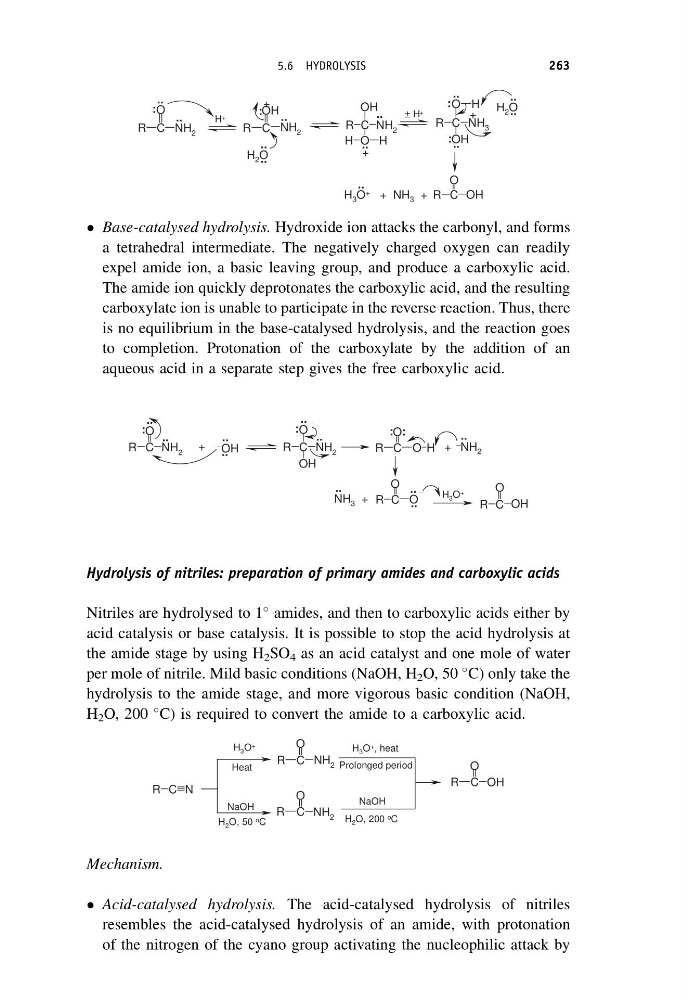
Base-catalysed hydrolysis. Hydroxide ion attacks the carbonyl, and forms
a tetrahedral intermediate. The negatively charged oxygen can readily
expel amide ion, a basic leaving group, and produce a carboxylic acid.
The amide ion quickly deprotonates the carboxylic acid, and the resulting
carboxylate ion is unable to participate in the reverse reaction. Thus, there
is no equilibrium in the base-catalysed hydrolysis, and the reaction goes
to completion. Protonation of the carboxylate by the addition of an
aqueous acid in a separate step gives the free carboxylic acid.
R C O
O
R C NH 2
O
R C
O
NH 2
OH
R C O
O
H
R C OH
O
..
..
+ − OH ..
..
..
..
..
..
..
:
:
..
:
+ − NH 2
NH 3 +
:
H 3 O +
Hydrolysis of nitriles: preparation of primary amides and carboxylic acids
Nitriles are hydrolysed to 1
amides, and then to carboxylic acids either by
acid catalysis or base catalysis. It is possible to stop the acid hydrolysis at
the amide stage by using H 2 SO 4 as an acid catalyst and one mole of water
per mole of nitrile. Mild basic conditions (NaOH, H 2 O, 50
C) only take the
hydrolysis to the amide stage, and more vigorous basic condition (NaOH,
H 2 O, 200
C) is required to convert the amide to a carboxylic acid.
R C NH 2
O
R C N
R C NH 2
O
R C OH
O
H 2 O, 50 o C
Heat
H 2 O, 200 o C
NaOH
NaOH
H 3 O +
H 3 O + , heat
Prolonged period
Mechanism.
Acid-catalysed hydrolysis. The acid-catalysed hydrolysis of nitriles
resembles the acid-catalysed hydrolysis of an amide, with protonation
of the nitrogen of the cyano group activating the nucleophilic attack by
5.6 HYDROLYSIS
263
O
R C NH 2
OH
R C
OH
NH 2
O H
H
R C
O
NH 3
OH
H
R C OH
O
H 2 O
+
+
..
:
..
:
..
H +
± H +
..
..
:
:
+
..
..
..
..
H 2 O
..
..
H 3 O + + NH 3 +
..
Base-catalysed hydrolysis. Hydroxide ion attacks the carbonyl, and forms
a tetrahedral intermediate. The negatively charged oxygen can readily
expel amide ion, a basic leaving group, and produce a carboxylic acid.
The amide ion quickly deprotonates the carboxylic acid, and the resulting
carboxylate ion is unable to participate in the reverse reaction. Thus, there
is no equilibrium in the base-catalysed hydrolysis, and the reaction goes
to completion. Protonation of the carboxylate by the addition of an
aqueous acid in a separate step gives the free carboxylic acid.
R C O
O
R C NH 2
O
R C
O
NH 2
OH
R C O
O
H
R C OH
O
..
..
+ − OH ..
..
..
..
..
..
..
:
:
..
:
+ − NH 2
NH 3 +
:
H 3 O +
Hydrolysis of nitriles: preparation of primary amides and carboxylic acids
Nitriles are hydrolysed to 1
amides, and then to carboxylic acids either by
acid catalysis or base catalysis. It is possible to stop the acid hydrolysis at
the amide stage by using H 2 SO 4 as an acid catalyst and one mole of water
per mole of nitrile. Mild basic conditions (NaOH, H 2 O, 50
C) only take the
hydrolysis to the amide stage, and more vigorous basic condition (NaOH,
H 2 O, 200
C) is required to convert the amide to a carboxylic acid.
R C NH 2
O
R C N
R C NH 2
O
R C OH
O
H 2 O, 50 o C
Heat
H 2 O, 200 o C
NaOH
NaOH
H 3 O +
H 3 O + , heat
Prolonged period
Mechanism.
Acid-catalysed hydrolysis. The acid-catalysed hydrolysis of nitriles
resembles the acid-catalysed hydrolysis of an amide, with protonation
of the nitrogen of the cyano group activating the nucleophilic attack by
5.6 HYDROLYSIS
263