

R C
OH
OR'
O H
H
R' C O
O
OH H
R'
H
R C OR'
OH
R C OR'
O
R C OH
O
H 2 O ..
..
..
..
R'OH +
:
+
:
..
:
..
:
H +
+
+
:
:
..
H 3 O + +
H 2 O ..
..
± H +
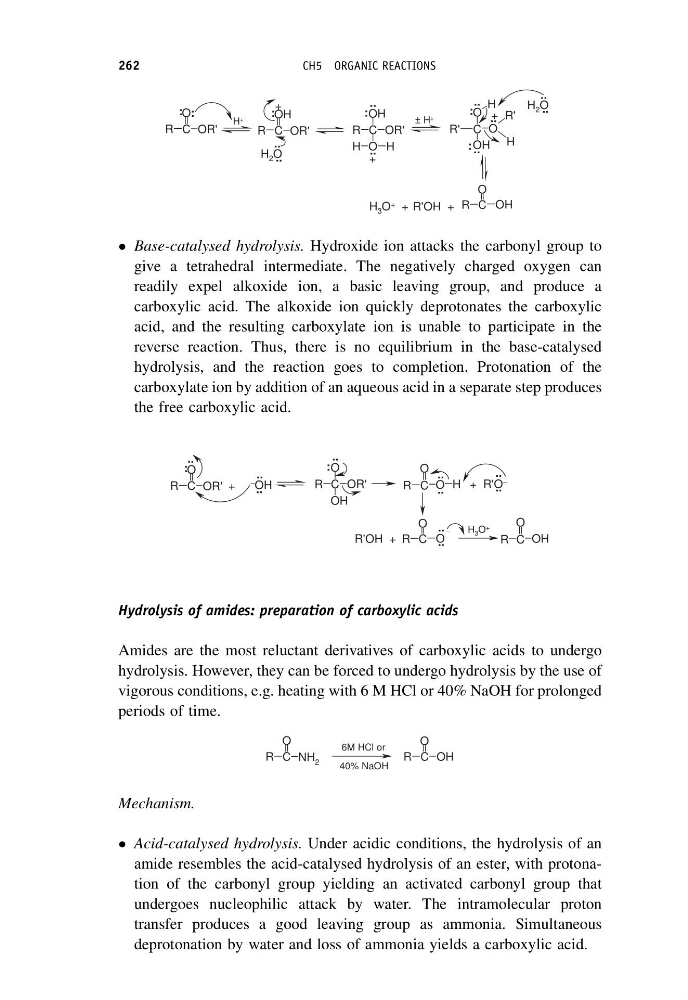
Base-catalysed hydrolysis. Hydroxide ion attacks the carbonyl group to
give a tetrahedral intermediate. The negatively charged oxygen can
readily expel alkoxide ion, a basic leaving group, and produce a
carboxylic acid. The alkoxide ion quickly deprotonates the carboxylic
acid, and the resulting carboxylate ion is unable to participate in the
reverse reaction. Thus, there is no equilibrium in the base-catalysed
hydrolysis, and the reaction goes to completion. Protonation of the
carboxylate ion by addition of an aqueous acid in a separate step produces
the free carboxylic acid.
R C
O
OR'
OH
R C O
O
H
R C O
O
R C OR'
O
R C OH
O
− OH ..
..
..
..
:
..
+
:
..
..
..
H 3 O +
+ R'O −
..
..
R'OH +
Hydrolysis of amides: preparation of carboxylic acids
Amides are the most reluctant derivatives of carboxylic acids to undergo
hydrolysis. However, they can be forced to undergo hydrolysis by the use of
vigorous conditions, e.g. heating with 6 M HCl or 40% NaOH for prolonged
periods of time.
R C NH 2
O
R C OH
O
6M HCl or
40% NaOH
Mechanism.
Acid-catalysed hydrolysis. Under acidic conditions, the hydrolysis of an
amide resembles the acid-catalysed hydrolysis of an ester, with protonation of the carbonyl group yielding an activated carbonyl group that
undergoes nucleophilic attack by water. The intramolecular proton
transfer produces a good leaving group as ammonia. Simultaneous
deprotonation by water and loss of ammonia yields a carboxylic acid.
262
CH5 ORGANIC REACTIONS
OH
OR'
O H
H
R' C O
O
OH H
R'
H
R C OR'
OH
R C OR'
O
R C OH
O
H 2 O ..
..
..
..
R'OH +
:
+
:
..
:
..
:
H +
+
+
:
:
..
H 3 O + +
H 2 O ..
..
± H +
Base-catalysed hydrolysis. Hydroxide ion attacks the carbonyl group to
give a tetrahedral intermediate. The negatively charged oxygen can
readily expel alkoxide ion, a basic leaving group, and produce a
carboxylic acid. The alkoxide ion quickly deprotonates the carboxylic
acid, and the resulting carboxylate ion is unable to participate in the
reverse reaction. Thus, there is no equilibrium in the base-catalysed
hydrolysis, and the reaction goes to completion. Protonation of the
carboxylate ion by addition of an aqueous acid in a separate step produces
the free carboxylic acid.
R C
O
OR'
OH
R C O
O
H
R C O
O
R C OR'
O
R C OH
O
− OH ..
..
..
..
:
..
+
:
..
..
..
H 3 O +
+ R'O −
..
..
R'OH +
Hydrolysis of amides: preparation of carboxylic acids
Amides are the most reluctant derivatives of carboxylic acids to undergo
hydrolysis. However, they can be forced to undergo hydrolysis by the use of
vigorous conditions, e.g. heating with 6 M HCl or 40% NaOH for prolonged
periods of time.
R C NH 2
O
R C OH
O
6M HCl or
40% NaOH
Mechanism.
Acid-catalysed hydrolysis. Under acidic conditions, the hydrolysis of an
amide resembles the acid-catalysed hydrolysis of an ester, with protonation of the carbonyl group yielding an activated carbonyl group that
undergoes nucleophilic attack by water. The intramolecular proton
transfer produces a good leaving group as ammonia. Simultaneous
deprotonation by water and loss of ammonia yields a carboxylic acid.
262
CH5 ORGANIC REACTIONS