

Hydrolysis of acid halides and anhydrides
Preparation of carboxylic acids:
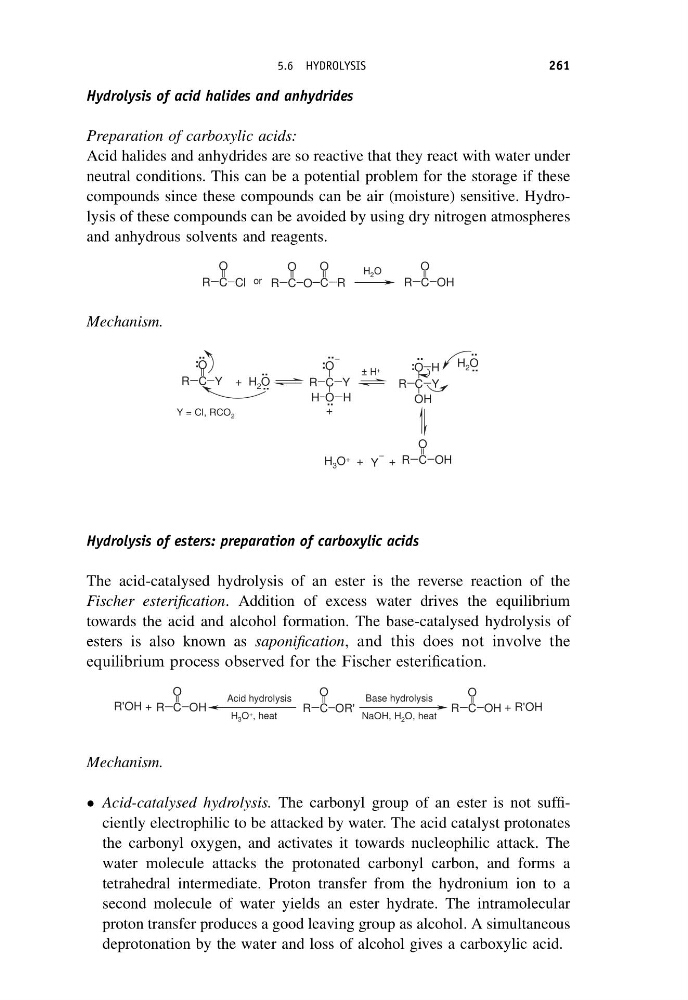
Acid halides and anhydrides are so reactive that they react with water under
neutral conditions. This can be a potential problem for the storage if these
compounds since these compounds can be air (moisture) sensitive. Hydrolysis of these compounds can be avoided by using dry nitrogen atmospheres
and anhydrous solvents and reagents.
R C Cl
O
R C OH
O
R
C
O
R C O
O
H 2 O
or
Mechanism.
R C Y
O
R C OH
O
R C
O
Y
OH
H
R C
O
Y
O H
H
Y
+ H 2 O ..
..
:
+
:
..
..
Y = Cl, RCO 2
H 2 O
..
..
H 3 O + +
± H +
+
:
..
..
Hydrolysis of esters: preparation of carboxylic acids
The acid-catalysed hydrolysis of an ester is the reverse reaction of the
Fischer esterification. Addition of excess water drives the equilibrium
towards the acid and alcohol formation. The base-catalysed hydrolysis of
esters is also known as saponification, and this does not involve the
equilibrium process observed for the Fischer esterification.
R C OR'
O
R C OH
O
R C OH
O
H 3 O + , heat
NaOH, H 2 O, heat
Acid hydrolysis
Base hydrolysis
+ R'OH
R'OH +
Mechanism.
Acid-catalysed hydrolysis. The carbonyl group of an ester is not sufficiently electrophilic to be attacked by water. The acid catalyst protonates
the carbonyl oxygen, and activates it towards nucleophilic attack. The
water molecule attacks the protonated carbonyl carbon, and forms a
tetrahedral intermediate. Proton transfer from the hydronium ion to a
second molecule of water yields an ester hydrate. The intramolecular
proton transfer produces a good leaving group as alcohol. A simultaneous
deprotonation by the water and loss of alcohol gives a carboxylic acid.
5.6 HYDROLYSIS
261
Preparation of carboxylic acids:
Acid halides and anhydrides are so reactive that they react with water under
neutral conditions. This can be a potential problem for the storage if these
compounds since these compounds can be air (moisture) sensitive. Hydrolysis of these compounds can be avoided by using dry nitrogen atmospheres
and anhydrous solvents and reagents.
R C Cl
O
R C OH
O
R
C
O
R C O
O
H 2 O
or
Mechanism.
R C Y
O
R C OH
O
R C
O
Y
OH
H
R C
O
Y
O H
H
Y
+ H 2 O ..
..
:
+
:
..
..
Y = Cl, RCO 2
H 2 O
..
..
H 3 O + +
± H +
+
:
..
..
Hydrolysis of esters: preparation of carboxylic acids
The acid-catalysed hydrolysis of an ester is the reverse reaction of the
Fischer esterification. Addition of excess water drives the equilibrium
towards the acid and alcohol formation. The base-catalysed hydrolysis of
esters is also known as saponification, and this does not involve the
equilibrium process observed for the Fischer esterification.
R C OR'
O
R C OH
O
R C OH
O
H 3 O + , heat
NaOH, H 2 O, heat
Acid hydrolysis
Base hydrolysis
+ R'OH
R'OH +
Mechanism.
Acid-catalysed hydrolysis. The carbonyl group of an ester is not sufficiently electrophilic to be attacked by water. The acid catalyst protonates
the carbonyl oxygen, and activates it towards nucleophilic attack. The
water molecule attacks the protonated carbonyl carbon, and forms a
tetrahedral intermediate. Proton transfer from the hydronium ion to a
second molecule of water yields an ester hydrate. The intramolecular
proton transfer produces a good leaving group as alcohol. A simultaneous
deprotonation by the water and loss of alcohol gives a carboxylic acid.
5.6 HYDROLYSIS
261