

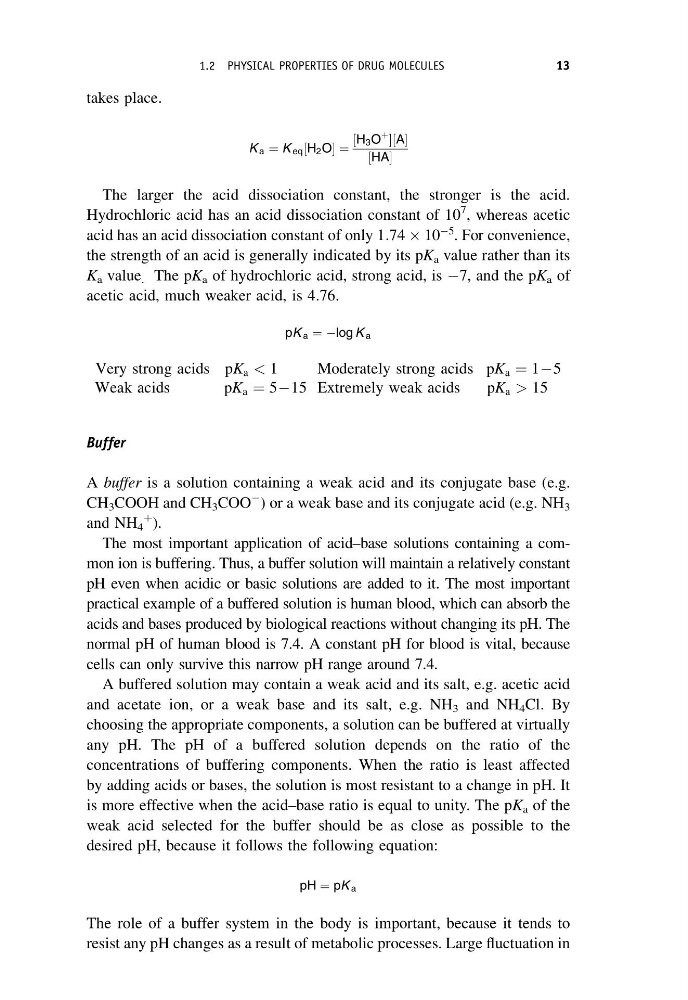
takes place.
K a ¼ K eq ½H 2 O ¼
½H 3 O
þ ½A
½HA
The larger the acid dissociation constant, the stronger is the acid.
Hydrochloric acid has an acid dissociation constant of 10
7
, whereas acetic
acid has an acid dissociation constant of only 1:74 Â 10
À5
. For convenience,
the strength of an acid is generally indicated by its pK a value rather than its
K a value . The pK a of hydrochloric acid, strong acid, is À7, and the pK a of
acetic acid, much weaker acid, is 4.76.
pK a ¼ Àlog K a
Very strong acids pK a < 1
Moderately strong acids pK a ¼ 1À5
Weak acids
pK a ¼ 5À15 Extremely weak acids
pK a > 15
Buffer
A buffer is a solution containing a weak acid and its conjugate base (e.g.
CH 3 COOH and CH 3 COO
À ) or a weak base and its conjugate acid (e.g. NH 3
and NH 4
þ ).
The most important application of acid–base solutions containing a common ion is buffering. Thus, a buffer solution will maintain a relatively constant
pH even when acidic or basic solutions are added to it. The most important
practical example of a buffered solution is human blood, which can absorb the
acids and bases produced by biological reactions without changing its pH. The
normal pH of human blood is 7.4. A constant pH for blood is vital, because
cells can only survive this narrow pH range around 7.4.
A buffered solution may contain a weak acid and its salt, e.g. acetic acid
and acetate ion, or a weak base and its salt, e.g. NH 3 and NH 4 Cl. By
choosing the appropriate components, a solution can be buffered at virtually
any pH. The pH of a buffered solution depends on the ratio of the
concentrations of buffering components. When the ratio is least affected
by adding acids or bases, the solution is most resistant to a change in pH. It
is more effective when the acid–base ratio is equal to unity. The pK a of the
weak acid selected for the buffer should be as close as possible to the
desired pH, because it follows the following equation:
pH ¼ pK a
The role of a buffer system in the body is important, because it tends to
resist any pH changes as a result of metabolic processes. Large fluctuation in
1.2 PHYSICAL PROPERTIES OF DRUG MOLECULES
13
K a ¼ K eq ½H 2 O ¼
½H 3 O
þ ½A
½HA
The larger the acid dissociation constant, the stronger is the acid.
Hydrochloric acid has an acid dissociation constant of 10
7
, whereas acetic
acid has an acid dissociation constant of only 1:74 Â 10
À5
. For convenience,
the strength of an acid is generally indicated by its pK a value rather than its
K a value . The pK a of hydrochloric acid, strong acid, is À7, and the pK a of
acetic acid, much weaker acid, is 4.76.
pK a ¼ Àlog K a
Very strong acids pK a < 1
Moderately strong acids pK a ¼ 1À5
Weak acids
pK a ¼ 5À15 Extremely weak acids
pK a > 15
Buffer
A buffer is a solution containing a weak acid and its conjugate base (e.g.
CH 3 COOH and CH 3 COO
À ) or a weak base and its conjugate acid (e.g. NH 3
and NH 4
þ ).
The most important application of acid–base solutions containing a common ion is buffering. Thus, a buffer solution will maintain a relatively constant
pH even when acidic or basic solutions are added to it. The most important
practical example of a buffered solution is human blood, which can absorb the
acids and bases produced by biological reactions without changing its pH. The
normal pH of human blood is 7.4. A constant pH for blood is vital, because
cells can only survive this narrow pH range around 7.4.
A buffered solution may contain a weak acid and its salt, e.g. acetic acid
and acetate ion, or a weak base and its salt, e.g. NH 3 and NH 4 Cl. By
choosing the appropriate components, a solution can be buffered at virtually
any pH. The pH of a buffered solution depends on the ratio of the
concentrations of buffering components. When the ratio is least affected
by adding acids or bases, the solution is most resistant to a change in pH. It
is more effective when the acid–base ratio is equal to unity. The pK a of the
weak acid selected for the buffer should be as close as possible to the
desired pH, because it follows the following equation:
pH ¼ pK a
The role of a buffer system in the body is important, because it tends to
resist any pH changes as a result of metabolic processes. Large fluctuation in
1.2 PHYSICAL PROPERTIES OF DRUG MOLECULES
13