

pH would denature most enzymes and hence interfere with the body
metabolism. Carbon dioxide from metabolism combines with water in
blood plasma to produce carbonic acid (H 2 CO 3 ). The amount of H 2 CO 3
depends on the amount of CO 2 present. The following system acts as a
buffer, since carbonic acid can neutralize any base:
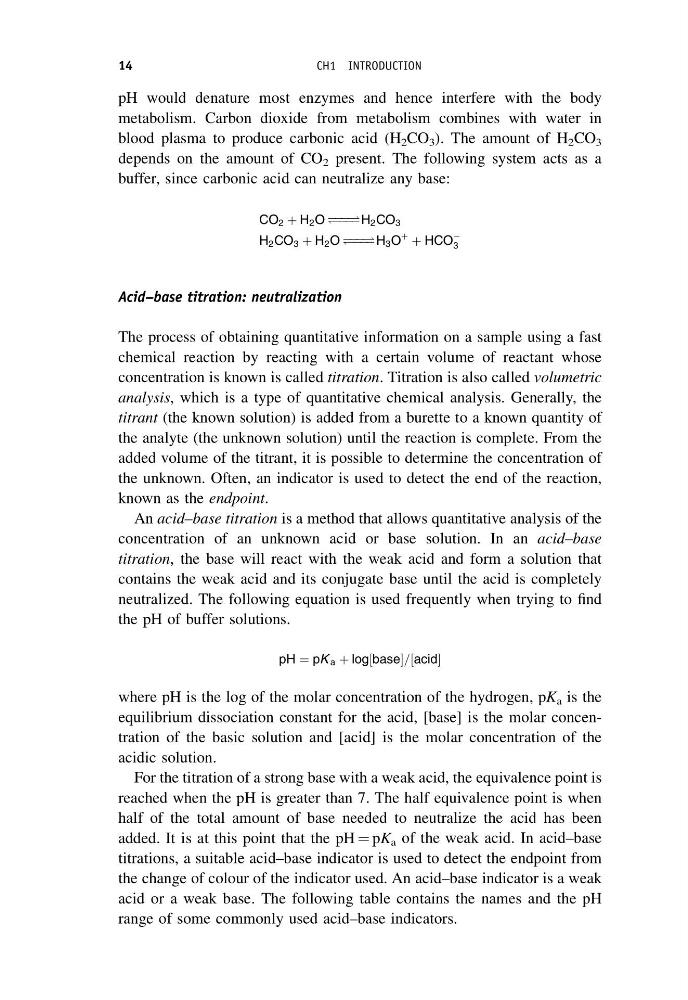
CO 2 þ H 2 O ÀÀÀ* )ÀÀÀH2CO3
H 2 CO 3 þ H 2 O ÀÀÀ* )ÀÀÀH3O
þ þ HCO
À
3
Acid–base titration: neutralization
The process of obtaining quantitative information on a sample using a fast
chemical reaction by reacting with a certain volume of reactant whose
concentration is known is called titration. Titration is also called volumetric
analysis, which is a type of quantitative chemical analysis. Generally, the
titrant (the known solution) is added from a burette to a known quantity of
the analyte (the unknown solution) until the reaction is complete. From the
added volume of the titrant, it is possible to determine the concentration of
the unknown. Often, an indicator is used to detect the end of the reaction,
known as the endpoint.
An acid–base titration is a method that allows quantitative analysis of the
concentration of an unknown acid or base solution. In an acid–base
titration, the base will react with the weak acid and form a solution that
contains the weak acid and its conjugate base until the acid is completely
neutralized. The following equation is used frequently when trying to find
the pH of buffer solutions.
pH ¼ pK a þ log½base=½acid
where pH is the log of the molar concentration of the hydrogen, pK a is the
equilibrium dissociation constant for the acid, [base] is the molar concentration of the basic solution and [acid] is the molar concentration of the
acidic solution.
For the titration of a strong base with a weak acid, the equivalence point is
reached when the pH is greater than 7. The half equivalence point is when
half of the total amount of base needed to neutralize the acid has been
added. It is at this point that the pH ¼ pK a of the weak acid. In acid–base
titrations, a suitable acid–base indicator is used to detect the endpoint from
the change of colour of the indicator used. An acid–base indicator is a weak
acid or a weak base. The following table contains the names and the pH
range of some commonly used acid–base indicators.
14
CH1 INTRODUCTION
metabolism. Carbon dioxide from metabolism combines with water in
blood plasma to produce carbonic acid (H 2 CO 3 ). The amount of H 2 CO 3
depends on the amount of CO 2 present. The following system acts as a
buffer, since carbonic acid can neutralize any base:
CO 2 þ H 2 O ÀÀÀ* )ÀÀÀH2CO3
H 2 CO 3 þ H 2 O ÀÀÀ* )ÀÀÀH3O
þ þ HCO
À
3
Acid–base titration: neutralization
The process of obtaining quantitative information on a sample using a fast
chemical reaction by reacting with a certain volume of reactant whose
concentration is known is called titration. Titration is also called volumetric
analysis, which is a type of quantitative chemical analysis. Generally, the
titrant (the known solution) is added from a burette to a known quantity of
the analyte (the unknown solution) until the reaction is complete. From the
added volume of the titrant, it is possible to determine the concentration of
the unknown. Often, an indicator is used to detect the end of the reaction,
known as the endpoint.
An acid–base titration is a method that allows quantitative analysis of the
concentration of an unknown acid or base solution. In an acid–base
titration, the base will react with the weak acid and form a solution that
contains the weak acid and its conjugate base until the acid is completely
neutralized. The following equation is used frequently when trying to find
the pH of buffer solutions.
pH ¼ pK a þ log½base=½acid
where pH is the log of the molar concentration of the hydrogen, pK a is the
equilibrium dissociation constant for the acid, [base] is the molar concentration of the basic solution and [acid] is the molar concentration of the
acidic solution.
For the titration of a strong base with a weak acid, the equivalence point is
reached when the pH is greater than 7. The half equivalence point is when
half of the total amount of base needed to neutralize the acid has been
added. It is at this point that the pH ¼ pK a of the weak acid. In acid–base
titrations, a suitable acid–base indicator is used to detect the endpoint from
the change of colour of the indicator used. An acid–base indicator is a weak
acid or a weak base. The following table contains the names and the pH
range of some commonly used acid–base indicators.
14
CH1 INTRODUCTION