

Strong acids, e.g. HCl, HBr, HI, H 2 SO 4 , HNO 3 , HClO 3 and HClO 4 ,
completely ionize in solution, and are always represented in chemical
equations in their ionized form. Similarly, strong bases, e.g. LiOH, NaOH,
KOH, RbOH, Ca(OH) 2 , Sr(OH) 2 and Ba(OH) 2 , completely ionize in solution
and are always represented in their ionized form in chemical equations. A salt
is formed when an acid and a base are mixed and the acid releases H
þ ions
while the base releases OH
À ions. This process is called hydrolysis. The
conjugate base of a strong acid is very weak and cannot undergo hydrolysis.
Similarly, the conjugate acid of a strong base is very weak and likewise does
not undergo hydrolysis.
Acidity and basicity are described in terms of equilibria. Acidity is the
measure of how easily a compound gives up a proton, and basicity is a
measure of how well a compound shares its electrons with a proton. A
strong acid is one that gives up its proton easily. This means that its
conjugate base must be weak because it has little affinity for a proton. A
weak acid gives up its proton with difficulty, indicating that its conjugate
base is strong because it has a high affinity for a proton. Thus, the stronger
the acid, the weaker is its conjugate base.
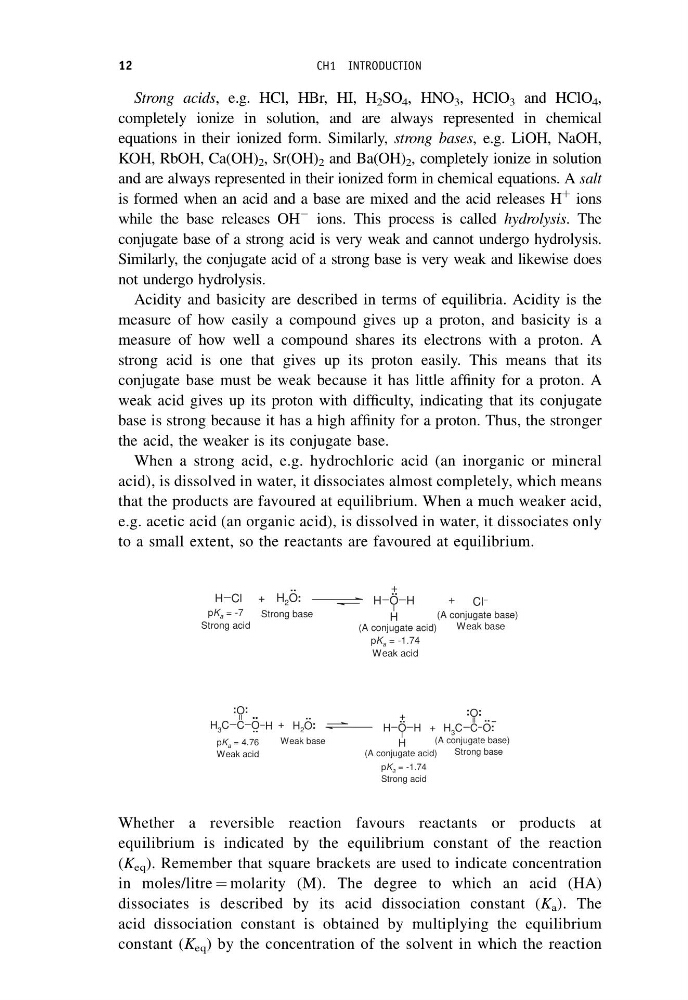
When a strong acid, e.g. hydrochloric acid (an inorganic or mineral
acid), is dissolved in water, it dissociates almost completely, which means
that the products are favoured at equilibrium. When a much weaker acid,
e.g. acetic acid (an organic acid), is dissolved in water, it dissociates only
to a small extent, so the reactants are favoured at equilibrium.
H O
H
H
H Cl + H 2 O
..
:
+ ..
+
Cl −
(A conjugate acid)
(A conjugate base)
Strong base
pK a = -1.74
Weak acid
Weak base
pK a = -7
Strong acid
C
H 3 C O
O
H
H O
H
H
C
H 3 C O
O
+
+
+ ..
:
H 2 O
..
:
: ..
:
:
: ..
..
pK a = -1.74
Strong acid
pK a = 4.76
Weak acid
Weak base
(A conjugate acid)
(A conjugate base)
Strong base
Whether a reversible reaction favours reactants or products at
equilibrium is indicated by the equilibrium constant of the reaction
(K eq ). Remember that square brackets are used to indicate concentration
in moles/litre ¼ molarity (M). The degree to which an acid (HA)
dissociates is described by its acid dissociation constant (K a ). The
acid dissociation constant is obtained by multiplying the equilibrium
constant (K eq ) by the concentration of the solvent in which the reaction
12
CH1 INTRODUCTION
completely ionize in solution, and are always represented in chemical
equations in their ionized form. Similarly, strong bases, e.g. LiOH, NaOH,
KOH, RbOH, Ca(OH) 2 , Sr(OH) 2 and Ba(OH) 2 , completely ionize in solution
and are always represented in their ionized form in chemical equations. A salt
is formed when an acid and a base are mixed and the acid releases H
þ ions
while the base releases OH
À ions. This process is called hydrolysis. The
conjugate base of a strong acid is very weak and cannot undergo hydrolysis.
Similarly, the conjugate acid of a strong base is very weak and likewise does
not undergo hydrolysis.
Acidity and basicity are described in terms of equilibria. Acidity is the
measure of how easily a compound gives up a proton, and basicity is a
measure of how well a compound shares its electrons with a proton. A
strong acid is one that gives up its proton easily. This means that its
conjugate base must be weak because it has little affinity for a proton. A
weak acid gives up its proton with difficulty, indicating that its conjugate
base is strong because it has a high affinity for a proton. Thus, the stronger
the acid, the weaker is its conjugate base.
When a strong acid, e.g. hydrochloric acid (an inorganic or mineral
acid), is dissolved in water, it dissociates almost completely, which means
that the products are favoured at equilibrium. When a much weaker acid,
e.g. acetic acid (an organic acid), is dissolved in water, it dissociates only
to a small extent, so the reactants are favoured at equilibrium.
H O
H
H
H Cl + H 2 O
..
:
+ ..
+
Cl −
(A conjugate acid)
(A conjugate base)
Strong base
pK a = -1.74
Weak acid
Weak base
pK a = -7
Strong acid
C
H 3 C O
O
H
H O
H
H
C
H 3 C O
O
+
+
+ ..
:
H 2 O
..
:
: ..
:
:
: ..
..
pK a = -1.74
Strong acid
pK a = 4.76
Weak acid
Weak base
(A conjugate acid)
(A conjugate base)
Strong base
Whether a reversible reaction favours reactants or products at
equilibrium is indicated by the equilibrium constant of the reaction
(K eq ). Remember that square brackets are used to indicate concentration
in moles/litre ¼ molarity (M). The degree to which an acid (HA)
dissociates is described by its acid dissociation constant (K a ). The
acid dissociation constant is obtained by multiplying the equilibrium
constant (K eq ) by the concentration of the solvent in which the reaction
12
CH1 INTRODUCTION