

CH 3 CH 3 ðEthaneÞ ! CH 3 NH 2 ðMethylamineÞ ! CH 3 OH ðMethanolÞ
ðIncreasing acidity of hydrogen bonded to carbon; nitrogen and oxygenÞ
CH 3 O
À ðMethoxide anionÞ ! CH 3 NH
À ðMethylamide anionÞ !
CH 3 CH
À
2 ðEthyl anionÞ
ðIncreasing basicity of the conjugate baseÞ
pH and pK a values
The pH value is defined as the negative of the logarithm to base 10 of the
concentration of the hydrogen ion. The acidity or basicity of a substance is
defined most typically by the pH value.
pH ¼ Àlog 10 ½H 3 O
þ
The acidity of an aqueous solution is determined by the concentration of
H 3 O
þ ions. Thus, the pH of a solution indicates the concentration of
hydrogen ions in the solution. The concentration of hydrogen ions can be
indicated as [H
þ ] or its solvated form in water as [H 3 O
þ ]. Because the
[H 3 O
þ ] in an aqueous solution is typically quite small, chemists have found
an equivalent way to express [H 3 O
þ
] as a positive number whose value
normally lies between 0 and 14. The lower the pH, the more acidic is the
solution. The pH of a solution can be changed simply by adding acid or base
to the solution. Do not confuse pH with pK a . The pH scale is used to
describe the acidity of a solution. The pK a is characteristic of a particular
compound, and it tells how readily the compound gives up a proton.
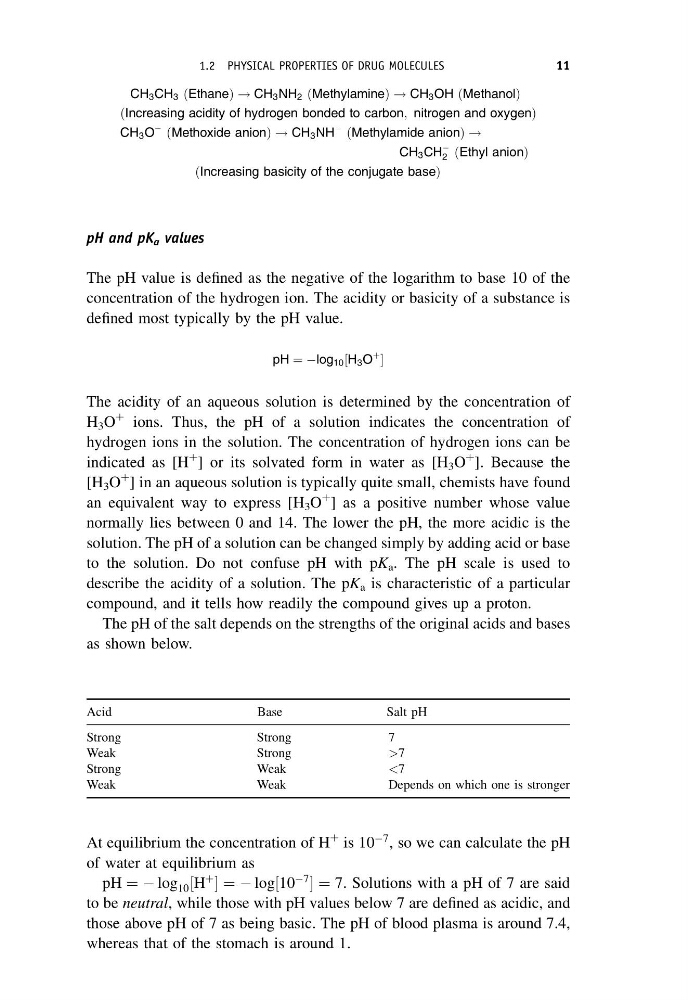
The pH of the salt depends on the strengths of the original acids and bases
as shown below.
At equilibrium the concentration of H
þ is 10
À7 , so we can calculate the pH
of water at equilibrium as
pH ¼ À log 10 ½H
þ ¼ À log½10
À7 ¼ 7. Solutions with a pH of 7 are said
to be neutral, while those with pH values below 7 are defined as acidic, and
those above pH of 7 as being basic. The pH of blood plasma is around 7.4,
whereas that of the stomach is around 1.
Acid
Base
Salt pH
Strong
Strong
7
Weak
Strong
>7
Strong
Weak
<7
Weak
Weak
Depends on which one is stronger
1.2 PHYSICAL PROPERTIES OF DRUG MOLECULES
11
ðIncreasing acidity of hydrogen bonded to carbon; nitrogen and oxygenÞ
CH 3 O
À ðMethoxide anionÞ ! CH 3 NH
À ðMethylamide anionÞ !
CH 3 CH
À
2 ðEthyl anionÞ
ðIncreasing basicity of the conjugate baseÞ
pH and pK a values
The pH value is defined as the negative of the logarithm to base 10 of the
concentration of the hydrogen ion. The acidity or basicity of a substance is
defined most typically by the pH value.
pH ¼ Àlog 10 ½H 3 O
þ
The acidity of an aqueous solution is determined by the concentration of
H 3 O
þ ions. Thus, the pH of a solution indicates the concentration of
hydrogen ions in the solution. The concentration of hydrogen ions can be
indicated as [H
þ ] or its solvated form in water as [H 3 O
þ ]. Because the
[H 3 O
þ ] in an aqueous solution is typically quite small, chemists have found
an equivalent way to express [H 3 O
þ
] as a positive number whose value
normally lies between 0 and 14. The lower the pH, the more acidic is the
solution. The pH of a solution can be changed simply by adding acid or base
to the solution. Do not confuse pH with pK a . The pH scale is used to
describe the acidity of a solution. The pK a is characteristic of a particular
compound, and it tells how readily the compound gives up a proton.
The pH of the salt depends on the strengths of the original acids and bases
as shown below.
At equilibrium the concentration of H
þ is 10
À7 , so we can calculate the pH
of water at equilibrium as
pH ¼ À log 10 ½H
þ ¼ À log½10
À7 ¼ 7. Solutions with a pH of 7 are said
to be neutral, while those with pH values below 7 are defined as acidic, and
those above pH of 7 as being basic. The pH of blood plasma is around 7.4,
whereas that of the stomach is around 1.
Acid
Base
Salt pH
Strong
Strong
7
Weak
Strong
>7
Strong
Weak
<7
Weak
Weak
Depends on which one is stronger
1.2 PHYSICAL PROPERTIES OF DRUG MOLECULES
11