

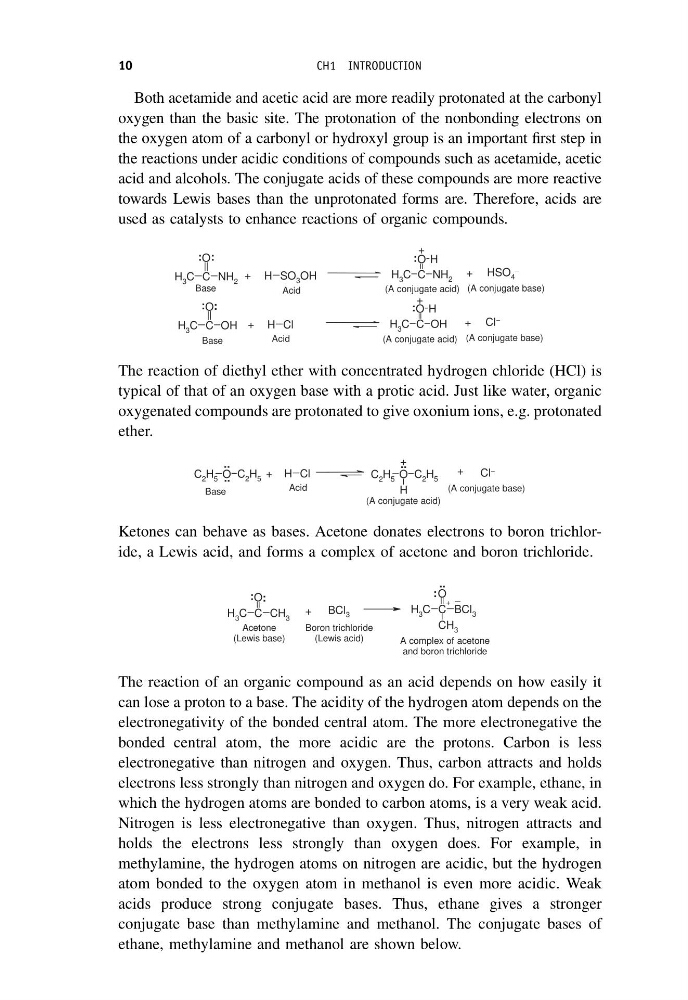
Both acetamide and acetic acid are more readily protonated at the carbonyl
oxygen than the basic site. The protonation of the nonbonding electrons on
the oxygen atom of a carbonyl or hydroxyl group is an important first step in
the reactions under acidic conditions of compounds such as acetamide, acetic
acid and alcohols. The conjugate acids of these compounds are more reactive
towards Lewis bases than the unprotonated forms are. Therefore, acids are
used as catalysts to enhance reactions of organic compounds.
C
O
C
H 3
NH 2
C
H 3 C NH 2
O H
H SO 3 OH
C
O
C
H 3
OH
C
H 3 C OH
O H
H Cl
+
: :
+
:
(A conjugate acid)
+
(A conjugate base)
Base
HSO 4
−
Acid
+
: :
+
:
(A conjugate acid)
+
(A conjugate base)
Base
Cl −
Acid
The reaction of diethyl ether with concentrated hydrogen chloride (HCl) is
typical of that of an oxygen base with a protic acid. Just like water, organic
oxygenated compounds are protonated to give oxonium ions, e.g. protonated
ether.
H Cl
C 2 H 5 O C 2 H 5
C 2 H 5 O C 2 H 5
H
+
+ Cl −
+
..
..
..
(A conjugate acid)
(A conjugate base)
Base
Acid
Ketones can behave as bases. Acetone donates electrons to boron trichloride, a Lewis acid, and forms a complex of acetone and boron trichloride.
C
+
BCl 3
CH 3
C
H 3
O
C
C
H 3
CH 3
O
A complex of acetone
and boron trichloride
:
+ BCl 3
Acetone
(Lewis base)
Boron trichloride
(Lewis acid)
_
: :
..
The reaction of an organic compound as an acid depends on how easily it
can lose a proton to a base. The acidity of the hydrogen atom depends on the
electronegativity of the bonded central atom. The more electronegative the
bonded central atom, the more acidic are the protons. Carbon is less
electronegative than nitrogen and oxygen. Thus, carbon attracts and holds
electrons less strongly than nitrogen and oxygen do. For example, ethane, in
which the hydrogen atoms are bonded to carbon atoms, is a very weak acid.
Nitrogen is less electronegative than oxygen. Thus, nitrogen attracts and
holds the electrons less strongly than oxygen does. For example, in
methylamine, the hydrogen atoms on nitrogen are acidic, but the hydrogen
atom bonded to the oxygen atom in methanol is even more acidic. Weak
acids produce strong conjugate bases. Thus, ethane gives a stronger
conjugate base than methylamine and methanol. The conjugate bases of
ethane, methylamine and methanol are shown below.
10
CH1 INTRODUCTION
oxygen than the basic site. The protonation of the nonbonding electrons on
the oxygen atom of a carbonyl or hydroxyl group is an important first step in
the reactions under acidic conditions of compounds such as acetamide, acetic
acid and alcohols. The conjugate acids of these compounds are more reactive
towards Lewis bases than the unprotonated forms are. Therefore, acids are
used as catalysts to enhance reactions of organic compounds.
C
O
C
H 3
NH 2
C
H 3 C NH 2
O H
H SO 3 OH
C
O
C
H 3
OH
C
H 3 C OH
O H
H Cl
+
: :
+
:
(A conjugate acid)
+
(A conjugate base)
Base
HSO 4
−
Acid
+
: :
+
:
(A conjugate acid)
+
(A conjugate base)
Base
Cl −
Acid
The reaction of diethyl ether with concentrated hydrogen chloride (HCl) is
typical of that of an oxygen base with a protic acid. Just like water, organic
oxygenated compounds are protonated to give oxonium ions, e.g. protonated
ether.
H Cl
C 2 H 5 O C 2 H 5
C 2 H 5 O C 2 H 5
H
+
+ Cl −
+
..
..
..
(A conjugate acid)
(A conjugate base)
Base
Acid
Ketones can behave as bases. Acetone donates electrons to boron trichloride, a Lewis acid, and forms a complex of acetone and boron trichloride.
C
+
BCl 3
CH 3
C
H 3
O
C
C
H 3
CH 3
O
A complex of acetone
and boron trichloride
:
+ BCl 3
Acetone
(Lewis base)
Boron trichloride
(Lewis acid)
_
: :
..
The reaction of an organic compound as an acid depends on how easily it
can lose a proton to a base. The acidity of the hydrogen atom depends on the
electronegativity of the bonded central atom. The more electronegative the
bonded central atom, the more acidic are the protons. Carbon is less
electronegative than nitrogen and oxygen. Thus, carbon attracts and holds
electrons less strongly than nitrogen and oxygen do. For example, ethane, in
which the hydrogen atoms are bonded to carbon atoms, is a very weak acid.
Nitrogen is less electronegative than oxygen. Thus, nitrogen attracts and
holds the electrons less strongly than oxygen does. For example, in
methylamine, the hydrogen atoms on nitrogen are acidic, but the hydrogen
atom bonded to the oxygen atom in methanol is even more acidic. Weak
acids produce strong conjugate bases. Thus, ethane gives a stronger
conjugate base than methylamine and methanol. The conjugate bases of
ethane, methylamine and methanol are shown below.
10
CH1 INTRODUCTION