

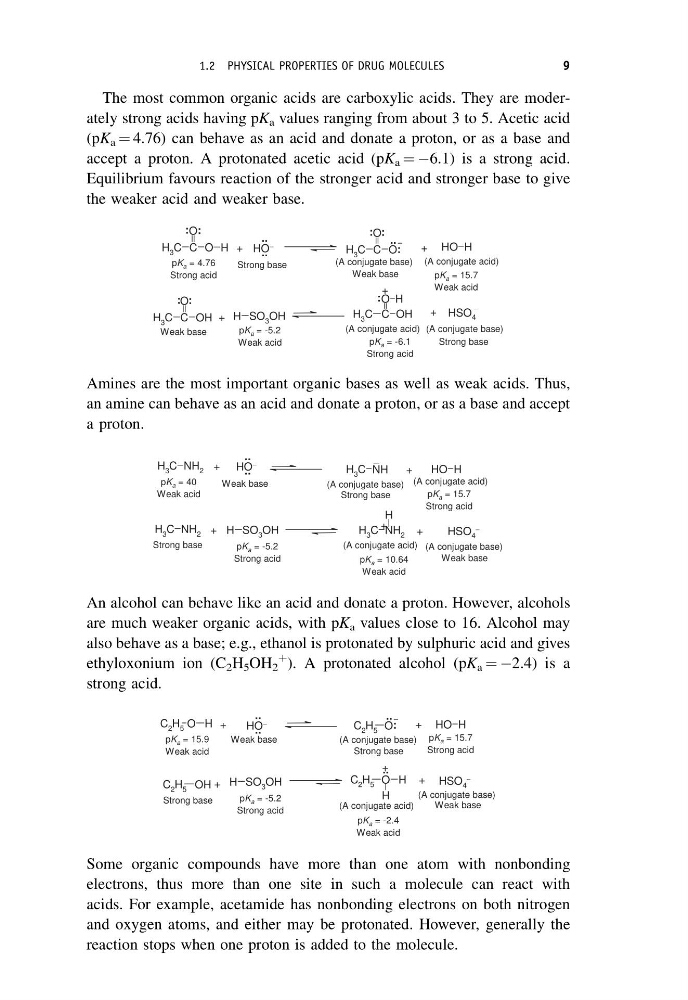
The most common organic acids are carboxylic acids. They are moderately strong acids having pK a values ranging from about 3 to 5. Acetic acid
(pK a ¼ 4.76) can behave as an acid and donate a proton, or as a base and
accept a proton. A protonated acetic acid (pK a ¼ À6.1) is a strong acid.
Equilibrium favours reaction of the stronger acid and stronger base to give
the weaker acid and weaker base.
O
H H
C
O
C
H 3
O H
C
O
C
H 3
O
C
O
C
H 3
OH
C
H 3 C OH
O H
H SO 3 OH
+ HO −
+
Strong base
(A conjugate base) (A conjugate acid)
pK a = 4.76
Strong acid
: :
: :
..
:
..
..
pK a = 15.7
Weak acid
Weak base
+
HSO 4
−
+
(A conjugate acid) (A conjugate base)
+
: :
:
Strong base
pK a = -5.2
Weak acid
Weak base
pK a = -6.1
Strong acid
Amines are the most important organic bases as well as weak acids. Thus,
an amine can behave as an acid and donate a proton, or as a base and accept
a proton.
C
H 3 NH 2
C
H 3
O
H H
H
C
H 3 NH 2
H SO 3 OH
C
H 3 NH 2
+
(A conjugate base)
NH
_
Weak base
HO −
..
..
+
(A conjugate acid)
pK a = 40
Weak acid
Strong base
pK a = 15.7
Strong acid
(A conjugate acid)
HSO 4
−
+
(A conjugate base)
+
Weak base
pK a = 10.64
Weak acid
Strong base
+
pK a = -5.2
Strong acid
An alcohol can behave like an acid and donate a proton. However, alcohols
are much weaker organic acids, with pK a values close to 16. Alcohol may
also behave as a base; e.g., ethanol is protonated by sulphuric acid and gives
ethyloxonium ion (C 2 H 5 OH 2
þ ). A protonated alcohol (pK a ¼ À2.4) is a
strong acid.
O H
C 2 H 5
H
H SO 3 OH
C 2 H 5 OH
C 2 H 5 O
O
H H
C 2 H 5 O H
(A conjugate acid)
+
+
(A conjugate base)
..
Weak base
pK a = -2.4
Weak acid
HSO 4
−
Strong base
+
pK a = -5.2
Strong acid
(A conjugate base)
+
HO −
..
..
+
:
..
Weak base
pK a = 15.9
Weak acid
Strong base
pK a = 15.7
Strong acid
Some organic compounds have more than one atom with nonbonding
electrons, thus more than one site in such a molecule can react with
acids. For example, acetamide has nonbonding electrons on both nitrogen
and oxygen atoms, and either may be protonated. However, generally the
reaction stops when one proton is added to the molecule.
1.2 PHYSICAL PROPERTIES OF DRUG MOLECULES
9
(pK a ¼ 4.76) can behave as an acid and donate a proton, or as a base and
accept a proton. A protonated acetic acid (pK a ¼ À6.1) is a strong acid.
Equilibrium favours reaction of the stronger acid and stronger base to give
the weaker acid and weaker base.
O
H H
C
O
C
H 3
O H
C
O
C
H 3
O
C
O
C
H 3
OH
C
H 3 C OH
O H
H SO 3 OH
+ HO −
+
Strong base
(A conjugate base) (A conjugate acid)
pK a = 4.76
Strong acid
: :
: :
..
:
..
..
pK a = 15.7
Weak acid
Weak base
+
HSO 4
−
+
(A conjugate acid) (A conjugate base)
+
: :
:
Strong base
pK a = -5.2
Weak acid
Weak base
pK a = -6.1
Strong acid
Amines are the most important organic bases as well as weak acids. Thus,
an amine can behave as an acid and donate a proton, or as a base and accept
a proton.
C
H 3 NH 2
C
H 3
O
H H
H
C
H 3 NH 2
H SO 3 OH
C
H 3 NH 2
+
(A conjugate base)
NH
_
Weak base
HO −
..
..
+
(A conjugate acid)
pK a = 40
Weak acid
Strong base
pK a = 15.7
Strong acid
(A conjugate acid)
HSO 4
−
+
(A conjugate base)
+
Weak base
pK a = 10.64
Weak acid
Strong base
+
pK a = -5.2
Strong acid
An alcohol can behave like an acid and donate a proton. However, alcohols
are much weaker organic acids, with pK a values close to 16. Alcohol may
also behave as a base; e.g., ethanol is protonated by sulphuric acid and gives
ethyloxonium ion (C 2 H 5 OH 2
þ ). A protonated alcohol (pK a ¼ À2.4) is a
strong acid.
O H
C 2 H 5
H
H SO 3 OH
C 2 H 5 OH
C 2 H 5 O
O
H H
C 2 H 5 O H
(A conjugate acid)
+
+
(A conjugate base)
..
Weak base
pK a = -2.4
Weak acid
HSO 4
−
Strong base
+
pK a = -5.2
Strong acid
(A conjugate base)
+
HO −
..
..
+
:
..
Weak base
pK a = 15.9
Weak acid
Strong base
pK a = 15.7
Strong acid
Some organic compounds have more than one atom with nonbonding
electrons, thus more than one site in such a molecule can react with
acids. For example, acetamide has nonbonding electrons on both nitrogen
and oxygen atoms, and either may be protonated. However, generally the
reaction stops when one proton is added to the molecule.
1.2 PHYSICAL PROPERTIES OF DRUG MOLECULES
9