

ammonium ion (
þ NH 4 ) is an acid because it donates a proton, and acetate
ion (CH 3 CO 2
À ) is a base because it accepts a proton. The curved arrows
show the flow of electrons in an acid–base reaction.
Two half-headed arrows are used for the equilibrium reactions. A longer
arrow indicates that the equilibrium favours the formation of acetate ion
(CH 3 CO 2
À ) and ammonium ion (
þ NH 4 ). Because acetic acid (CH 3 CO 2 H) is
a stronger acid than ammonium ion (
þ NH 4 ), the equilibrium lies towards the
formation of weak acid and weak base.
Lewis theory of acids and bases
The Lewis theory of acids and bases defines an acid as an electron-pair
acceptor, and a base as an electron-pair donor. Thus, a proton is only one of
a large number of species that may function as a Lewis acid. Any molecule
or ion may be an acid if it has an empty orbital to accept a pair of electrons
(see Chapter 2 for orbital and Lewis theory). Any molecule or ion with a
pair of electrons to donate can be a base.
Using this theory, a number of organic reactions can be considered as
acid–base reactions, because they do not have to occur in solution. Lewis
acids are known as aprotic acids, compounds that react with bases by
accepting pairs of electrons, not by donating protons.
Borane (BH 3 ), boron trichloride (BCl 3 ) and boron trifluoride (BF 3 ) are
known as Lewis acids, because boron has a vacant d orbital that accepts a
pair of electrons from a donor species. For example, diethyl ether acts as a
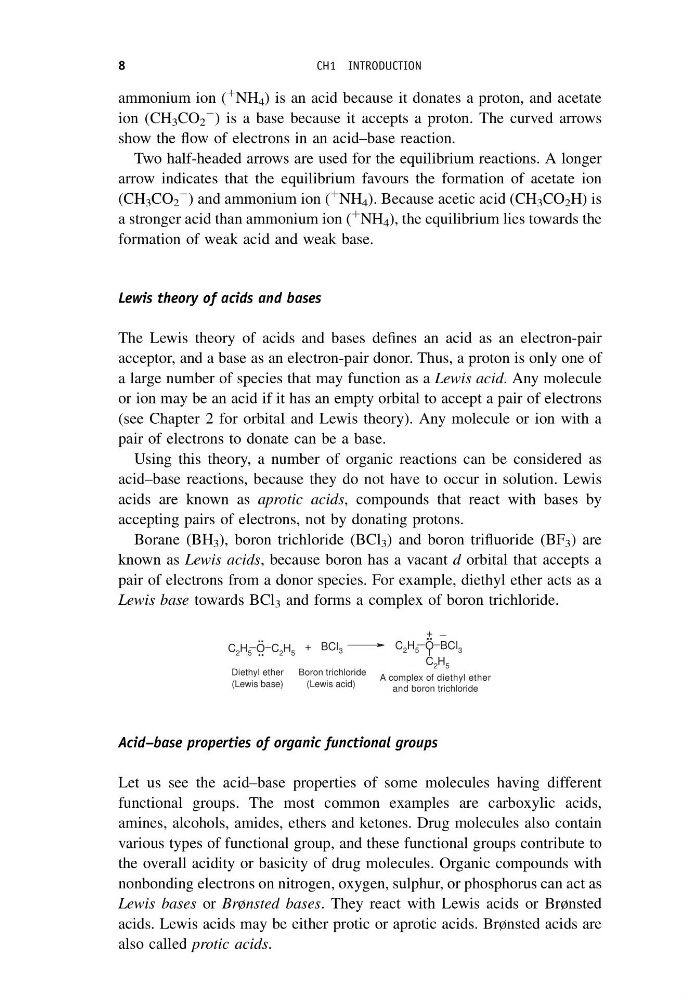
Lewis base towards BCl 3 and forms a complex of boron trichloride.
C 2 H 5 O C 2 H 5
O
C 2 H 5
BCl 3
C 2 H 5
+ BCl 3
Diethyl ether
(Lewis base)
Boron trichloride
(Lewis acid)
A complex of diethyl ether
and boron trichloride
+ _
..
..
..
Acid–base properties of organic functional groups
Let us see the acid–base properties of some molecules having different
functional groups. The most common examples are carboxylic acids,
amines, alcohols, amides, ethers and ketones. Drug molecules also contain
various types of functional group, and these functional groups contribute to
the overall acidity or basicity of drug molecules. Organic compounds with
nonbonding electrons on nitrogen, oxygen, sulphur, or phosphorus can act as
Lewis bases or Brønsted bases. They react with Lewis acids or Brønsted
acids. Lewis acids may be either protic or aprotic acids. Brønsted acids are
also called protic acids.
8
CH1 INTRODUCTION
þ NH 4 ) is an acid because it donates a proton, and acetate
ion (CH 3 CO 2
À ) is a base because it accepts a proton. The curved arrows
show the flow of electrons in an acid–base reaction.
Two half-headed arrows are used for the equilibrium reactions. A longer
arrow indicates that the equilibrium favours the formation of acetate ion
(CH 3 CO 2
À ) and ammonium ion (
þ NH 4 ). Because acetic acid (CH 3 CO 2 H) is
a stronger acid than ammonium ion (
þ NH 4 ), the equilibrium lies towards the
formation of weak acid and weak base.
Lewis theory of acids and bases
The Lewis theory of acids and bases defines an acid as an electron-pair
acceptor, and a base as an electron-pair donor. Thus, a proton is only one of
a large number of species that may function as a Lewis acid. Any molecule
or ion may be an acid if it has an empty orbital to accept a pair of electrons
(see Chapter 2 for orbital and Lewis theory). Any molecule or ion with a
pair of electrons to donate can be a base.
Using this theory, a number of organic reactions can be considered as
acid–base reactions, because they do not have to occur in solution. Lewis
acids are known as aprotic acids, compounds that react with bases by
accepting pairs of electrons, not by donating protons.
Borane (BH 3 ), boron trichloride (BCl 3 ) and boron trifluoride (BF 3 ) are
known as Lewis acids, because boron has a vacant d orbital that accepts a
pair of electrons from a donor species. For example, diethyl ether acts as a
Lewis base towards BCl 3 and forms a complex of boron trichloride.
C 2 H 5 O C 2 H 5
O
C 2 H 5
BCl 3
C 2 H 5
+ BCl 3
Diethyl ether
(Lewis base)
Boron trichloride
(Lewis acid)
A complex of diethyl ether
and boron trichloride
+ _
..
..
..
Acid–base properties of organic functional groups
Let us see the acid–base properties of some molecules having different
functional groups. The most common examples are carboxylic acids,
amines, alcohols, amides, ethers and ketones. Drug molecules also contain
various types of functional group, and these functional groups contribute to
the overall acidity or basicity of drug molecules. Organic compounds with
nonbonding electrons on nitrogen, oxygen, sulphur, or phosphorus can act as
Lewis bases or Brønsted bases. They react with Lewis acids or Brønsted
acids. Lewis acids may be either protic or aprotic acids. Brønsted acids are
also called protic acids.
8
CH1 INTRODUCTION