

Each acid has a conjugate base, and each base has a conjugate acid. These
conjugate pairs only differ by a proton. In the above example, HNO 2 is the
acid, H 2 O is the base, NO 2
À is the conjugate base, and H 3 O
þ is the
conjugate acid. Thus, a conjugate acid can lose an H
þ ion to form a base,
and a conjugate base can gain an H
þ ion to form an acid. Water can be an
acid or a base. It can gain a proton to become a hydronium ion (H 3 O
þ
), its
conjugate acid, or lose a proton to become the hydroxide ion (HO
À ), its
conjugate base.
When an acid transfers a proton to a base, it is converted to its
conjugate base. By accepting a proton, the base is converted to its
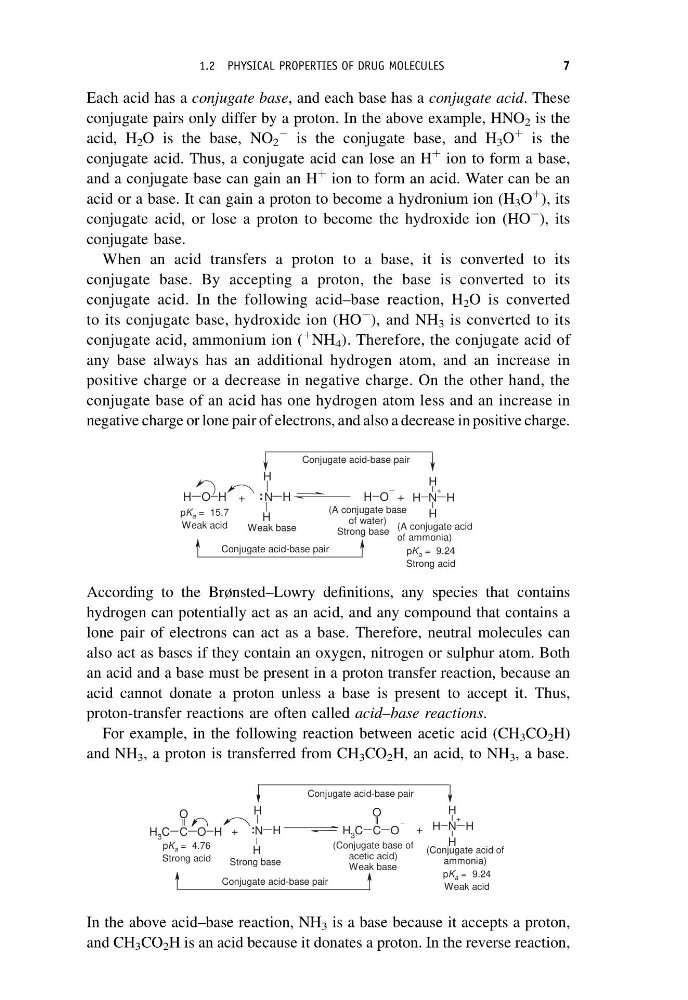
conjugate acid. In the following acid–base reaction, H 2 O is converted
to its conjugate base, hydroxide ion (HO
À ), and NH 3 is converted to its
conjugate acid, ammonium ion (
þ NH 4 ). Therefore, the conjugate acid of
any base always has an additional hydrogen atom, and an increase in
positive charge or a decrease in negative charge. On the other hand, the
conjugate base of an acid has one hydrogen atom less and an increase in
negative charge or lone pair of electrons, and also a decrease in positive charge.
H O H
H O
H N
+
H
H
H
H
H
H
Conjugate acid-base pair
Conjugate acid-base pair
N
:
Weak base
(A conjugate base
of water) (A conjugate acid
of ammonia)
Strong base
+
+
pK a = 9.24
Strong acid
pK a = 15.7
Weak acid
According to the Brønsted–Lowry definitions, any species that contains
hydrogen can potentially act as an acid, and any compound that contains a
lone pair of electrons can act as a base. Therefore, neutral molecules can
also act as bases if they contain an oxygen, nitrogen or sulphur atom. Both
an acid and a base must be present in a proton transfer reaction, because an
acid cannot donate a proton unless a base is present to accept it. Thus,
proton-transfer reactions are often called acid–base reactions.
For example, in the following reaction between acetic acid (CH 3 CO 2 H)
and NH 3 , a proton is transferred from CH 3 CO 2 H, an acid, to NH 3 , a base.
H N
+
H
H
H
H
H
H
C
H 3
C
O
O H
C
H 3
C
O
O
Conjugate acid-base pair
Conjugate acid-base pair
N
:
Strong base
(Conjugate base of
acetic acid)
(Conjugate acid of
ammonia)
Weak base
+
+
pK a = 4.76
Strong acid
pK a = 9.24
Weak acid
In the above acid–base reaction, NH 3 is a base because it accepts a proton,
and CH 3 CO 2 H is an acid because it donates a proton. In the reverse reaction,
1.2 PHYSICAL PROPERTIES OF DRUG MOLECULES
7
conjugate pairs only differ by a proton. In the above example, HNO 2 is the
acid, H 2 O is the base, NO 2
À is the conjugate base, and H 3 O
þ is the
conjugate acid. Thus, a conjugate acid can lose an H
þ ion to form a base,
and a conjugate base can gain an H
þ ion to form an acid. Water can be an
acid or a base. It can gain a proton to become a hydronium ion (H 3 O
þ
), its
conjugate acid, or lose a proton to become the hydroxide ion (HO
À ), its
conjugate base.
When an acid transfers a proton to a base, it is converted to its
conjugate base. By accepting a proton, the base is converted to its
conjugate acid. In the following acid–base reaction, H 2 O is converted
to its conjugate base, hydroxide ion (HO
À ), and NH 3 is converted to its
conjugate acid, ammonium ion (
þ NH 4 ). Therefore, the conjugate acid of
any base always has an additional hydrogen atom, and an increase in
positive charge or a decrease in negative charge. On the other hand, the
conjugate base of an acid has one hydrogen atom less and an increase in
negative charge or lone pair of electrons, and also a decrease in positive charge.
H O H
H O
H N
+
H
H
H
H
H
H
Conjugate acid-base pair
Conjugate acid-base pair
N
:
Weak base
(A conjugate base
of water) (A conjugate acid
of ammonia)
Strong base
+
+
pK a = 9.24
Strong acid
pK a = 15.7
Weak acid
According to the Brønsted–Lowry definitions, any species that contains
hydrogen can potentially act as an acid, and any compound that contains a
lone pair of electrons can act as a base. Therefore, neutral molecules can
also act as bases if they contain an oxygen, nitrogen or sulphur atom. Both
an acid and a base must be present in a proton transfer reaction, because an
acid cannot donate a proton unless a base is present to accept it. Thus,
proton-transfer reactions are often called acid–base reactions.
For example, in the following reaction between acetic acid (CH 3 CO 2 H)
and NH 3 , a proton is transferred from CH 3 CO 2 H, an acid, to NH 3 , a base.
H N
+
H
H
H
H
H
H
C
H 3
C
O
O H
C
H 3
C
O
O
Conjugate acid-base pair
Conjugate acid-base pair
N
:
Strong base
(Conjugate base of
acetic acid)
(Conjugate acid of
ammonia)
Weak base
+
+
pK a = 4.76
Strong acid
pK a = 9.24
Weak acid
In the above acid–base reaction, NH 3 is a base because it accepts a proton,
and CH 3 CO 2 H is an acid because it donates a proton. In the reverse reaction,
1.2 PHYSICAL PROPERTIES OF DRUG MOLECULES
7