

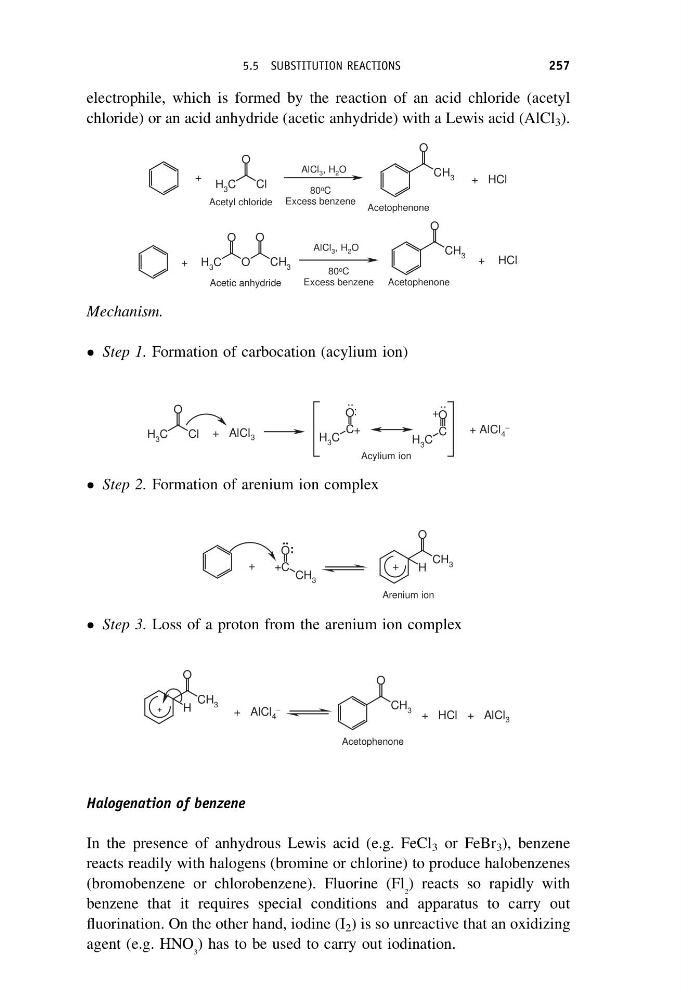
electrophile, which is formed by the reaction of an acid chloride (acetyl
chloride) or an acid anhydride (acetic anhydride) with a Lewis acid (AlCl 3 ).
CH 3
O
C
H 3
Cl
O
+
Acetyl chloride
AlCl 3 , H 2 O
+ HCl
Acetophenone
80 o C
Excess benzene
C
H 3
O
O
O
CH 3
CH 3
O
+
Acetic anhydride
AlCl 3 , H 2 O
+ HCl
Acetophenone
80 o C
Excess benzene
Mechanism.
Step 1. Formation of carbocation (acylium ion)
C
H 3
O
Cl
C
H 3
C
O
C
H 3
C
O
+ AlCl 3
+
+
+ AlCl 4
−
..
..
:
Acylium ion
Step 2. Formation of arenium ion complex
H
O
CH 3
C
O
CH 3
+
+
Arenium ion
..
:
+
Step 3. Loss of a proton from the arenium ion complex
H
O
CH 3
CH 3
O
+
+ AlCl 4
−
Acetophenone
+ HCl + AlCl 3
Halogenation of benzene
In the presence of anhydrous Lewis acid (e.g. FeCl 3 or FeBr 3 ), benzene
reacts readily with halogens (bromine or chlorine) to produce halobenzenes
(bromobenzene or chlorobenzene). Fluorine (Fl
2
) reacts so rapidly with
benzene that it requires special conditions and apparatus to carry out
fluorination. On the other hand, iodine (I 2 ) is so unreactive that an oxidizing
agent (e.g. HNO
3
) has to be used to carry out iodination.
5.5 SUBSTITUTION REACTIONS
257
chloride) or an acid anhydride (acetic anhydride) with a Lewis acid (AlCl 3 ).
CH 3
O
C
H 3
Cl
O
+
Acetyl chloride
AlCl 3 , H 2 O
+ HCl
Acetophenone
80 o C
Excess benzene
C
H 3
O
O
O
CH 3
CH 3
O
+
Acetic anhydride
AlCl 3 , H 2 O
+ HCl
Acetophenone
80 o C
Excess benzene
Mechanism.
Step 1. Formation of carbocation (acylium ion)
C
H 3
O
Cl
C
H 3
C
O
C
H 3
C
O
+ AlCl 3
+
+
+ AlCl 4
−
..
..
:
Acylium ion
Step 2. Formation of arenium ion complex
H
O
CH 3
C
O
CH 3
+
+
Arenium ion
..
:
+
Step 3. Loss of a proton from the arenium ion complex
H
O
CH 3
CH 3
O
+
+ AlCl 4
−
Acetophenone
+ HCl + AlCl 3
Halogenation of benzene
In the presence of anhydrous Lewis acid (e.g. FeCl 3 or FeBr 3 ), benzene
reacts readily with halogens (bromine or chlorine) to produce halobenzenes
(bromobenzene or chlorobenzene). Fluorine (Fl
2
) reacts so rapidly with
benzene that it requires special conditions and apparatus to carry out
fluorination. On the other hand, iodine (I 2 ) is so unreactive that an oxidizing
agent (e.g. HNO
3
) has to be used to carry out iodination.
5.5 SUBSTITUTION REACTIONS
257