

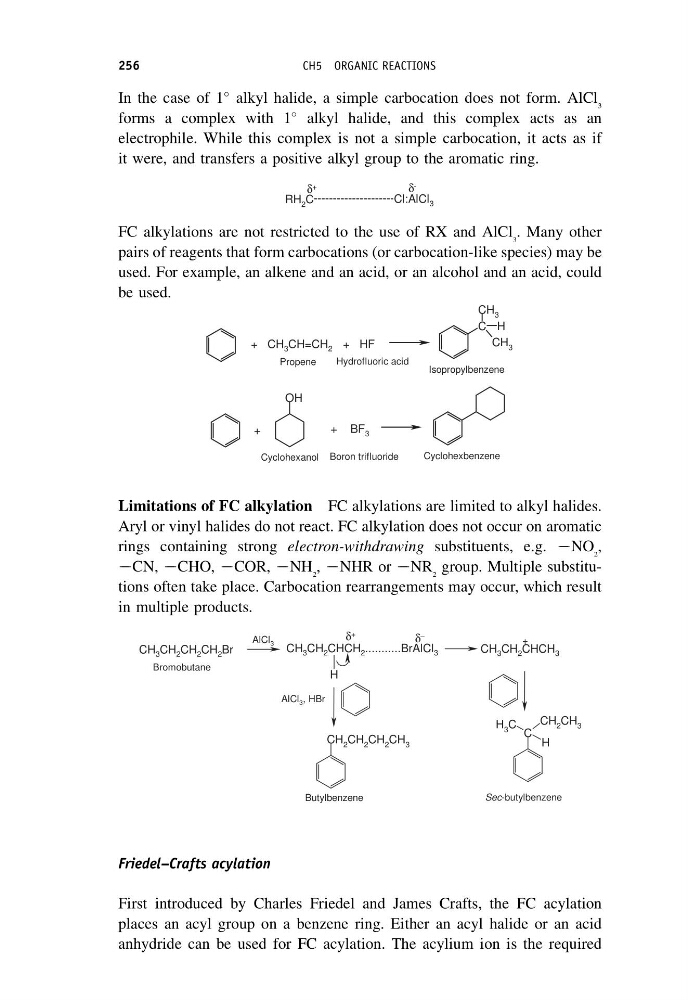
In the case of 1
alkyl halide, a simple carbocation does not form. AlCl
3
forms a complex with 1
alkyl halide, and this complex acts as an
electrophile. While this complex is not a simple carbocation, it acts as if
it were, and transfers a positive alkyl group to the aromatic ring.
RH 2 C
Cl:AlCl 3
δ +
δ -
FC alkylations are not restricted to the use of RX and AlCl
3
. Many other
pairs of reagents that form carbocations (or carbocation-like species) may be
used. For example, an alkene and an acid, or an alcohol and an acid, could
be used.
C
CH 3
CH 3
H
+ CH 3 CH=CH 2 + HF
Propene
Isopropylbenzene
Hydrofluoric acid
OH
+ BF 3
Cyclohexanol
Cyclohexbenzene
Boron trifluoride
+
Limitations of FC alkylation FC alkylations are limited to alkyl halides.
Aryl or vinyl halides do not react. FC alkylation does not occur on aromatic
rings containing strong electron-withdrawing substituents, e.g. À ÀNO
2
,
À ÀCN, À ÀCHO, À ÀCOR, À ÀNH
2
, À ÀNHR or À ÀNR
2
group. Multiple substitutions often take place. Carbocation rearrangements may occur, which result
in multiple products.
H
CH 2 CH 2 CH 2 CH 3
C
H
C
H 3
CH 2 CH 3
Bromobutane
AlCl 3 CH 3 CH 2 CHCH 2 ...........BrAlCl 3
δ +
δ −
CH 3 CH 2 CHCH 3
+
AlCl 3 , HBr
Butylbenzene
Sec-butylbenzene
CH 3 CH 2 CH 2 CH 2 Br
Friedel–Crafts acylation
First introduced by Charles Friedel and James Crafts, the FC acylation
places an acyl group on a benzene ring. Either an acyl halide or an acid
anhydride can be used for FC acylation. The acylium ion is the required
256
CH5 ORGANIC REACTIONS
alkyl halide, a simple carbocation does not form. AlCl
3
forms a complex with 1
alkyl halide, and this complex acts as an
electrophile. While this complex is not a simple carbocation, it acts as if
it were, and transfers a positive alkyl group to the aromatic ring.
RH 2 C
Cl:AlCl 3
δ +
δ -
FC alkylations are not restricted to the use of RX and AlCl
3
. Many other
pairs of reagents that form carbocations (or carbocation-like species) may be
used. For example, an alkene and an acid, or an alcohol and an acid, could
be used.
C
CH 3
CH 3
H
+ CH 3 CH=CH 2 + HF
Propene
Isopropylbenzene
Hydrofluoric acid
OH
+ BF 3
Cyclohexanol
Cyclohexbenzene
Boron trifluoride
+
Limitations of FC alkylation FC alkylations are limited to alkyl halides.
Aryl or vinyl halides do not react. FC alkylation does not occur on aromatic
rings containing strong electron-withdrawing substituents, e.g. À ÀNO
2
,
À ÀCN, À ÀCHO, À ÀCOR, À ÀNH
2
, À ÀNHR or À ÀNR
2
group. Multiple substitutions often take place. Carbocation rearrangements may occur, which result
in multiple products.
H
CH 2 CH 2 CH 2 CH 3
C
H
C
H 3
CH 2 CH 3
Bromobutane
AlCl 3 CH 3 CH 2 CHCH 2 ...........BrAlCl 3
δ +
δ −
CH 3 CH 2 CHCH 3
+
AlCl 3 , HBr
Butylbenzene
Sec-butylbenzene
CH 3 CH 2 CH 2 CH 2 Br
Friedel–Crafts acylation
First introduced by Charles Friedel and James Crafts, the FC acylation
places an acyl group on a benzene ring. Either an acyl halide or an acid
anhydride can be used for FC acylation. The acylium ion is the required
256
CH5 ORGANIC REACTIONS