

E
H
E
+
+ H +
Friedel–Crafts alkylation
First introduced by Charles Friedel and James Crafts in 1877, the FC
alkylation is an electrophilic aromatic substitution reaction where the
electrophile is a carbocation, R
+
. This carbocation is generated by AlCl 3 -
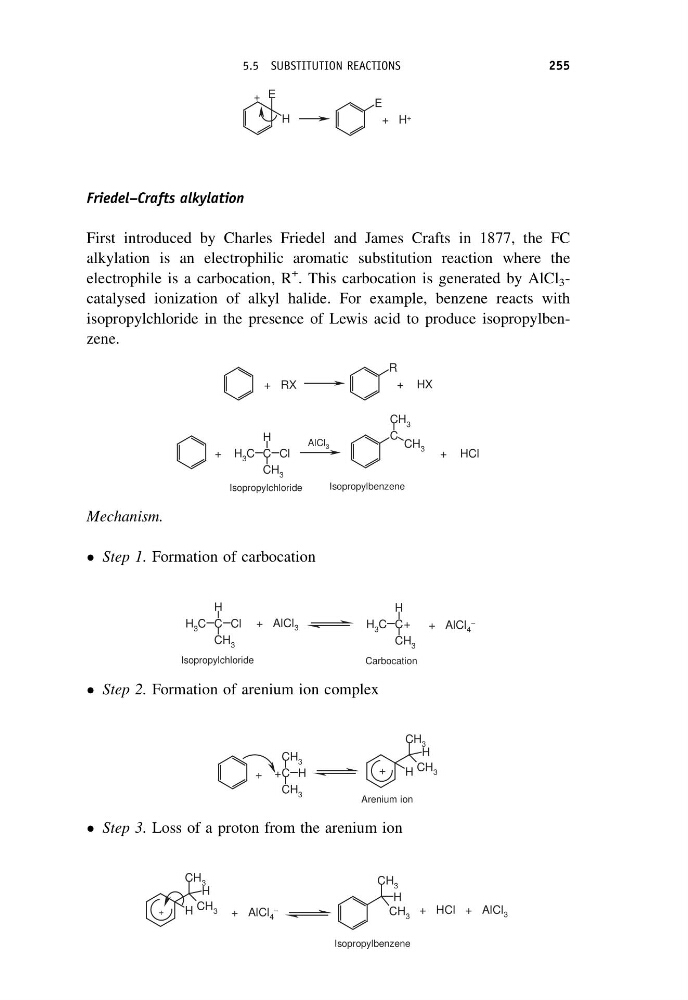
catalysed ionization of alkyl halide. For example, benzene reacts with
isopropylchloride in the presence of Lewis acid to produce isopropylbenzene.
R
+ RX
+ HX
C
CH 3
CH 3
C
H 3 C
H
CH 3
Cl
+
+ HCl
Isopropylchloride
AlCl 3
Isopropylbenzene
Mechanism.
Step 1. Formation of carbocation
C
H 3 C
H
CH 3
Cl
C
H 3 C
H
CH 3
Isopropylchloride
+ AlCl 3
+
+ AlCl 4
−
Carbocation
Step 2. Formation of arenium ion complex
C
CH 3
CH 3
H
CH 3
CH 3
H
H
+
+
+
Arenium ion
Step 3. Loss of a proton from the arenium ion
CH 3
CH 3
H
H
CH 3
CH 3
H
+
+ AlCl 4
−
Isopropylbenzene
+ HCl + AlCl 3
5.5 SUBSTITUTION REACTIONS
255
H
E
+
+ H +
Friedel–Crafts alkylation
First introduced by Charles Friedel and James Crafts in 1877, the FC
alkylation is an electrophilic aromatic substitution reaction where the
electrophile is a carbocation, R
+
. This carbocation is generated by AlCl 3 -
catalysed ionization of alkyl halide. For example, benzene reacts with
isopropylchloride in the presence of Lewis acid to produce isopropylbenzene.
R
+ RX
+ HX
C
CH 3
CH 3
C
H 3 C
H
CH 3
Cl
+
+ HCl
Isopropylchloride
AlCl 3
Isopropylbenzene
Mechanism.
Step 1. Formation of carbocation
C
H 3 C
H
CH 3
Cl
C
H 3 C
H
CH 3
Isopropylchloride
+ AlCl 3
+
+ AlCl 4
−
Carbocation
Step 2. Formation of arenium ion complex
C
CH 3
CH 3
H
CH 3
CH 3
H
H
+
+
+
Arenium ion
Step 3. Loss of a proton from the arenium ion
CH 3
CH 3
H
H
CH 3
CH 3
H
+
+ AlCl 4
−
Isopropylbenzene
+ HCl + AlCl 3
5.5 SUBSTITUTION REACTIONS
255