

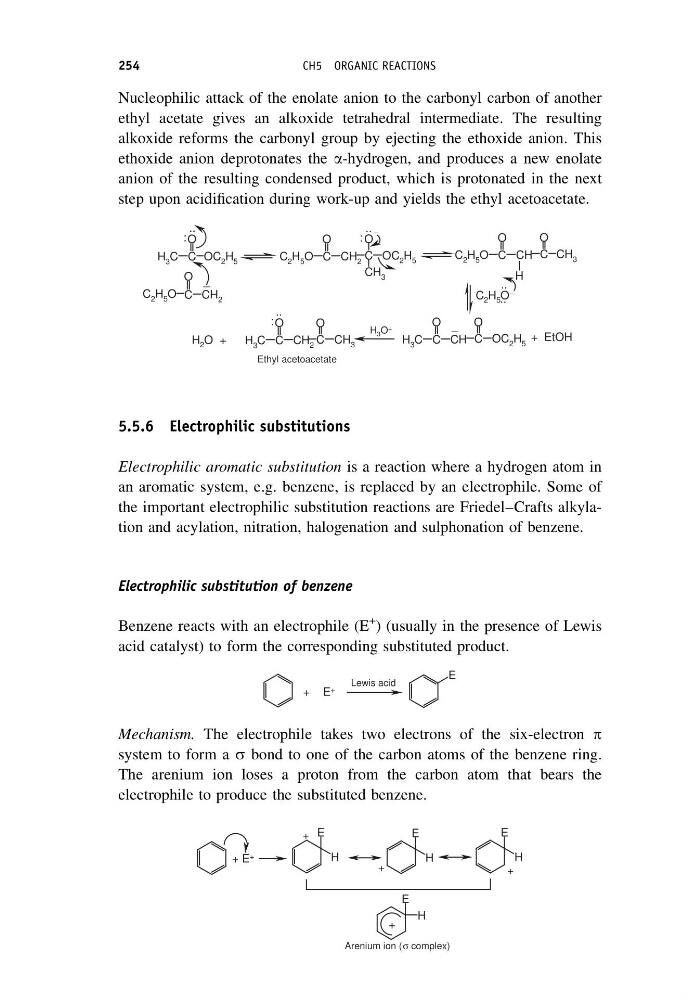
Nucleophilic attack of the enolate anion to the carbonyl carbon of another
ethyl acetate gives an alkoxide tetrahedral intermediate. The resulting
alkoxide reforms the carbonyl group by ejecting the ethoxide anion. This
ethoxide anion deprotonates the a-hydrogen, and produces a new enolate
anion of the resulting condensed product, which is protonated in the next
step upon acidification during work-up and yields the ethyl acetoacetate.
C
H 3
C
O
OC 2 H 5
CH 2
C
O
C 2 H 5 O
C 2 H 5 O C
O
CH 2
OC 2 H 5
C
O
CH 3
C
H 3
C
O
CH 2
CH 3
C
O
H
C
H 3
C
O
CH
OC 2 H 5
C
O
C 2 H 5 O C
O
CH C
O
CH 3
_
:
..
H 3 O +
:
..
Ethyl acetoacetate
H 2 O +
C 2 H 5 O −
..
..
_
..
:
+ EtOH
5.5.6 Electrophilic substitutions
Electrophilic aromatic substitution is a reaction where a hydrogen atom in
an aromatic system, e.g. benzene, is replaced by an electrophile. Some of
the important electrophilic substitution reactions are Friedel–Crafts alkylation and acylation, nitration, halogenation and sulphonation of benzene.
Electrophilic substitution of benzene
Benzene reacts with an electrophile (E
+ ) (usually in the presence of Lewis
acid catalyst) to form the corresponding substituted product.
E
+ E +
Lewis acid
Mechanism. The electrophile takes two electrons of the six-electron p
system to form a s bond to one of the carbon atoms of the benzene ring.
The arenium ion loses a proton from the carbon atom that bears the
electrophile to produce the substituted benzene.
E
H
E
H
E
H
E
H
+ E +
+
+
+
Arenium ion (σ complex)
+
254
CH5 ORGANIC REACTIONS
ethyl acetate gives an alkoxide tetrahedral intermediate. The resulting
alkoxide reforms the carbonyl group by ejecting the ethoxide anion. This
ethoxide anion deprotonates the a-hydrogen, and produces a new enolate
anion of the resulting condensed product, which is protonated in the next
step upon acidification during work-up and yields the ethyl acetoacetate.
C
H 3
C
O
OC 2 H 5
CH 2
C
O
C 2 H 5 O
C 2 H 5 O C
O
CH 2
OC 2 H 5
C
O
CH 3
C
H 3
C
O
CH 2
CH 3
C
O
H
C
H 3
C
O
CH
OC 2 H 5
C
O
C 2 H 5 O C
O
CH C
O
CH 3
_
:
..
H 3 O +
:
..
Ethyl acetoacetate
H 2 O +
C 2 H 5 O −
..
..
_
..
:
+ EtOH
5.5.6 Electrophilic substitutions
Electrophilic aromatic substitution is a reaction where a hydrogen atom in
an aromatic system, e.g. benzene, is replaced by an electrophile. Some of
the important electrophilic substitution reactions are Friedel–Crafts alkylation and acylation, nitration, halogenation and sulphonation of benzene.
Electrophilic substitution of benzene
Benzene reacts with an electrophile (E
+ ) (usually in the presence of Lewis
acid catalyst) to form the corresponding substituted product.
E
+ E +
Lewis acid
Mechanism. The electrophile takes two electrons of the six-electron p
system to form a s bond to one of the carbon atoms of the benzene ring.
The arenium ion loses a proton from the carbon atom that bears the
electrophile to produce the substituted benzene.
E
H
E
H
E
H
E
H
+ E +
+
+
+
Arenium ion (σ complex)
+
254
CH5 ORGANIC REACTIONS