

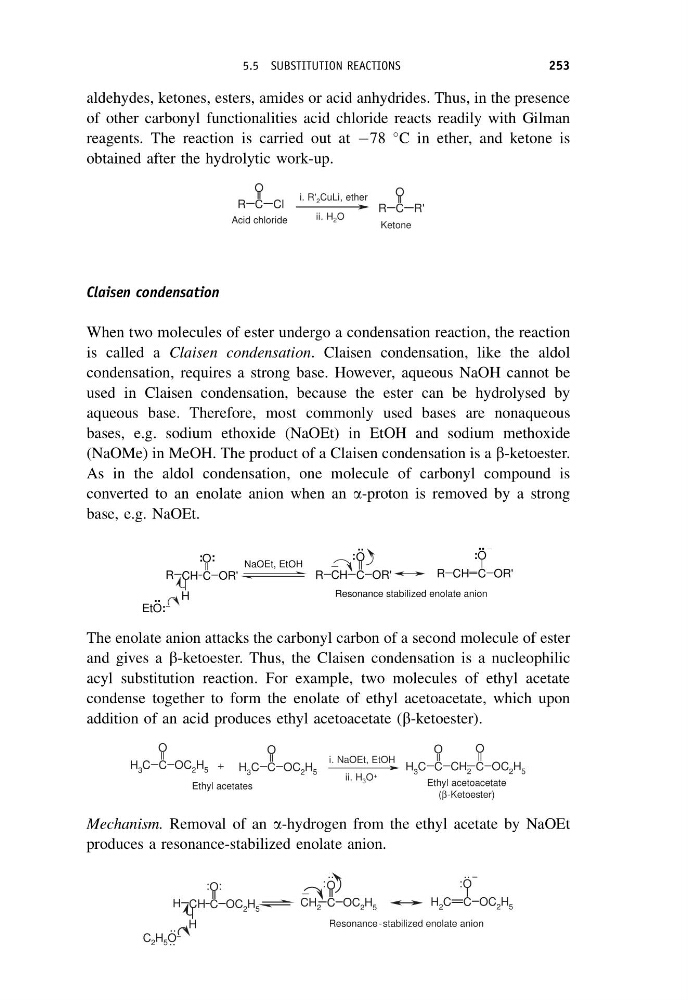
aldehydes, ketones, esters, amides or acid anhydrides. Thus, in the presence
of other carbonyl functionalities acid chloride reacts readily with Gilman
reagents. The reaction is carried out at À78
C in ether, and ketone is
obtained after the hydrolytic work-up.
R C Cl
O
R C R'
O
Acid chloride
Ketone
i. R' 2 CuLi, ether
ii. H 2 O
Claisen condensation
When two molecules of ester undergo a condensation reaction, the reaction
is called a Claisen condensation. Claisen condensation, like the aldol
condensation, requires a strong base. However, aqueous NaOH cannot be
used in Claisen condensation, because the ester can be hydrolysed by
aqueous base. Therefore, most commonly used bases are nonaqueous
bases, e.g. sodium ethoxide (NaOEt) in EtOH and sodium methoxide
(NaOMe) in MeOH. The product of a Claisen condensation is a b-ketoester.
As in the aldol condensation, one molecule of carbonyl compound is
converted to an enolate anion when an a-proton is removed by a strong
base, e.g. NaOEt.
C
O
OR'
CH C
O
OR'
CH
R
H
R
C
O
OR'
CH
R
NaOEt, EtOH
EtO: −
..
_
: :
..
..
:
:
Resonance stabilized enolate anion
The enolate anion attacks the carbonyl carbon of a second molecule of ester
and gives a b-ketoester. Thus, the Claisen condensation is a nucleophilic
acyl substitution reaction. For example, two molecules of ethyl acetate
condense together to form the enolate of ethyl acetoacetate, which upon
addition of an acid produces ethyl acetoacetate (b-ketoester).
C
O
OC 2 H 5
C
H 3 C
O
OC 2 H 5
CH 2
C
H 3 C
O
C
H 3 C
O
OC 2 H 5
Ethyl acetates
ii. H 3 O +
+
Ethyl acetoacetate
(β-Ketoester)
i. NaOEt, EtOH
Mechanism. Removal of an a-hydrogen from the ethyl acetate by NaOEt
produces a resonance-stabilized enolate anion.
CH 2 C
O
OC 2 H 5
CH C
O
OC 2 H 5
H
H
C
H 2
C
O
OC 2 H 5
C 2 H 5 O −
..
_
: :
..
..
:
:
Resonance-stabilized enolate anion
..
5.5 SUBSTITUTION REACTIONS
253
of other carbonyl functionalities acid chloride reacts readily with Gilman
reagents. The reaction is carried out at À78
C in ether, and ketone is
obtained after the hydrolytic work-up.
R C Cl
O
R C R'
O
Acid chloride
Ketone
i. R' 2 CuLi, ether
ii. H 2 O
Claisen condensation
When two molecules of ester undergo a condensation reaction, the reaction
is called a Claisen condensation. Claisen condensation, like the aldol
condensation, requires a strong base. However, aqueous NaOH cannot be
used in Claisen condensation, because the ester can be hydrolysed by
aqueous base. Therefore, most commonly used bases are nonaqueous
bases, e.g. sodium ethoxide (NaOEt) in EtOH and sodium methoxide
(NaOMe) in MeOH. The product of a Claisen condensation is a b-ketoester.
As in the aldol condensation, one molecule of carbonyl compound is
converted to an enolate anion when an a-proton is removed by a strong
base, e.g. NaOEt.
C
O
OR'
CH C
O
OR'
CH
R
H
R
C
O
OR'
CH
R
NaOEt, EtOH
EtO: −
..
_
: :
..
..
:
:
Resonance stabilized enolate anion
The enolate anion attacks the carbonyl carbon of a second molecule of ester
and gives a b-ketoester. Thus, the Claisen condensation is a nucleophilic
acyl substitution reaction. For example, two molecules of ethyl acetate
condense together to form the enolate of ethyl acetoacetate, which upon
addition of an acid produces ethyl acetoacetate (b-ketoester).
C
O
OC 2 H 5
C
H 3 C
O
OC 2 H 5
CH 2
C
H 3 C
O
C
H 3 C
O
OC 2 H 5
Ethyl acetates
ii. H 3 O +
+
Ethyl acetoacetate
(β-Ketoester)
i. NaOEt, EtOH
Mechanism. Removal of an a-hydrogen from the ethyl acetate by NaOEt
produces a resonance-stabilized enolate anion.
CH 2 C
O
OC 2 H 5
CH C
O
OC 2 H 5
H
H
C
H 2
C
O
OC 2 H 5
C 2 H 5 O −
..
_
: :
..
..
:
:
Resonance-stabilized enolate anion
..
5.5 SUBSTITUTION REACTIONS
253