

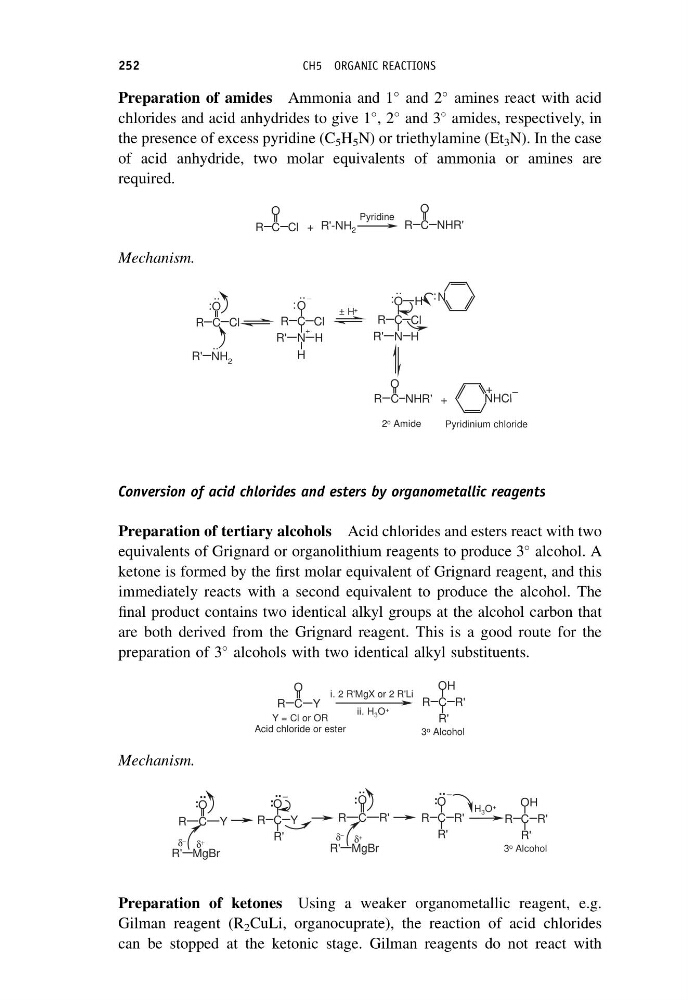
Preparation of amides Ammonia and 1
and 2
amines react with acid
chlorides and acid anhydrides to give 1
, 2
and 3
amides, respectively, in
the presence of excess pyridine (C 5 H 5 N) or triethylamine (Et 3 N). In the case
of acid anhydride, two molar equivalents of ammonia or amines are
required.
R C
O
Cl
R C
O
NHR'
R'-NH 2
+
Pyridine
Mechanism.
R C Cl
O
R' NH 2
R C NHR'
O
N
+
H
R'
H
R C
O
Cl
N
R C
O
Cl
R'
H
H N
NHCl
..
..
:
:
..
:
..
:
± H +
+
+
Pyridinium chloride
−
2 o Amide
Conversion of acid chlorides and esters by organometallic reagents
Preparation of tertiary alcohols Acid chlorides and esters react with two
equivalents of Grignard or organolithium reagents to produce 3
alcohol. A
ketone is formed by the first molar equivalent of Grignard reagent, and this
immediately reacts with a second equivalent to produce the alcohol. The
final product contains two identical alkyl groups at the alcohol carbon that
are both derived from the Grignard reagent. This is a good route for the
preparation of 3
alcohols with two identical alkyl substituents.
R C
OH
R'
R'
R C Y
O
Y = Cl or OR
Acid chloride or ester
ii. H 3 O +
3 o Alcohol
i. 2 R'MgX or 2 R'Li
Mechanism.
R' MgBr
O
C
R
Y
R'
R' MgBr
C
O
R
Y
C
O
R
R'
O
C
R
R'
R'
R C
OH
R'
R'
H 3 O +
δ − δ +
δ − δ +
:
..
..
:
:
..
..
:
3 o Alcohol
Preparation of ketones Using a weaker organometallic reagent, e.g.
Gilman reagent (R 2 CuLi, organocuprate), the reaction of acid chlorides
can be stopped at the ketonic stage. Gilman reagents do not react with
252
CH5 ORGANIC REACTIONS
and 2
amines react with acid
chlorides and acid anhydrides to give 1
, 2
and 3
amides, respectively, in
the presence of excess pyridine (C 5 H 5 N) or triethylamine (Et 3 N). In the case
of acid anhydride, two molar equivalents of ammonia or amines are
required.
R C
O
Cl
R C
O
NHR'
R'-NH 2
+
Pyridine
Mechanism.
R C Cl
O
R' NH 2
R C NHR'
O
N
+
H
R'
H
R C
O
Cl
N
R C
O
Cl
R'
H
H N
NHCl
..
..
:
:
..
:
..
:
± H +
+
+
Pyridinium chloride
−
2 o Amide
Conversion of acid chlorides and esters by organometallic reagents
Preparation of tertiary alcohols Acid chlorides and esters react with two
equivalents of Grignard or organolithium reagents to produce 3
alcohol. A
ketone is formed by the first molar equivalent of Grignard reagent, and this
immediately reacts with a second equivalent to produce the alcohol. The
final product contains two identical alkyl groups at the alcohol carbon that
are both derived from the Grignard reagent. This is a good route for the
preparation of 3
alcohols with two identical alkyl substituents.
R C
OH
R'
R'
R C Y
O
Y = Cl or OR
Acid chloride or ester
ii. H 3 O +
3 o Alcohol
i. 2 R'MgX or 2 R'Li
Mechanism.
R' MgBr
O
C
R
Y
R'
R' MgBr
C
O
R
Y
C
O
R
R'
O
C
R
R'
R'
R C
OH
R'
R'
H 3 O +
δ − δ +
δ − δ +
:
..
..
:
:
..
..
:
3 o Alcohol
Preparation of ketones Using a weaker organometallic reagent, e.g.
Gilman reagent (R 2 CuLi, organocuprate), the reaction of acid chlorides
can be stopped at the ketonic stage. Gilman reagents do not react with
252
CH5 ORGANIC REACTIONS