

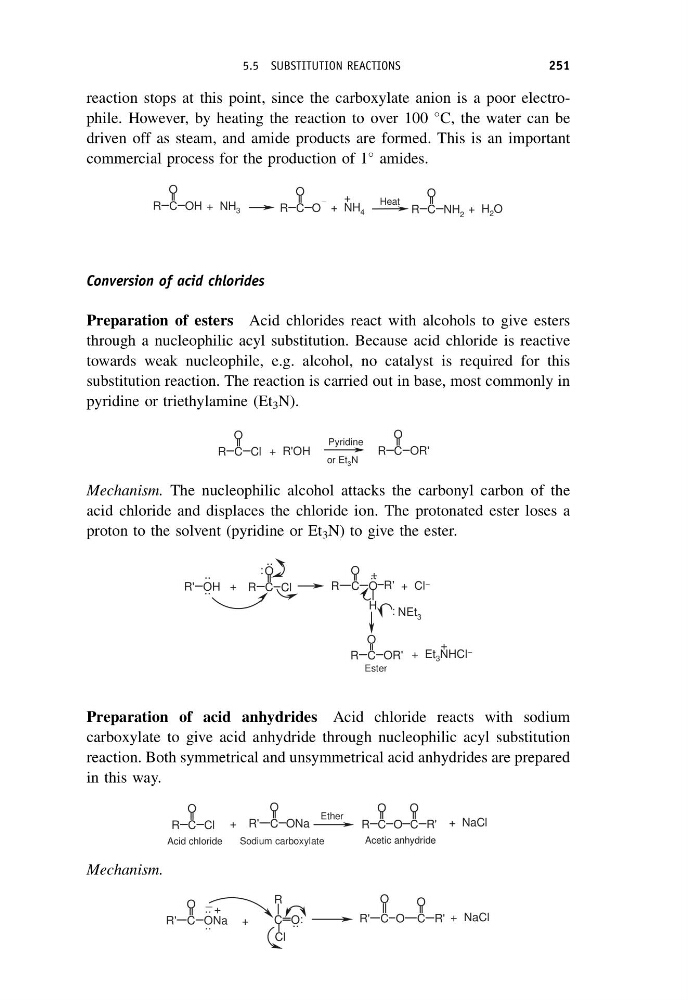
reaction stops at this point, since the carboxylate anion is a poor electrophile. However, by heating the reaction to over 100
C, the water can be
driven off as steam, and amide products are formed. This is an important
commercial process for the production of 1
amides.
R C
O
OH
R C
O
O
R C
O
NH 2
Heat
+
+ H 2 O
+ NH 3
+ NH 4
Conversion of acid chlorides
Preparation of esters Acid chlorides react with alcohols to give esters
through a nucleophilic acyl substitution. Because acid chloride is reactive
towards weak nucleophile, e.g. alcohol, no catalyst is required for this
substitution reaction. The reaction is carried out in base, most commonly in
pyridine or triethylamine (Et 3 N).
R C
O
Cl
R C
O
OR'
+ R'OH
Pyridine
or Et 3 N
Mechanism. The nucleophilic alcohol attacks the carbonyl carbon of the
acid chloride and displaces the chloride ion. The protonated ester loses a
proton to the solvent (pyridine or Et 3 N) to give the ester.
R C Cl
O
R' OH
R C O
O
H
R'
R C OR'
O
NEt 3
+
..
..
+
+ Cl −
:
..
:
Ester
+
+ Et 3 NHCl −
..
Preparation of acid anhydrides Acid chloride reacts with sodium
carboxylate to give acid anhydride through nucleophilic acyl substitution
reaction. Both symmetrical and unsymmetrical acid anhydrides are prepared
in this way.
R C
O
Cl
R'
C
O
R C
O
O
ONa
C
O
R'
+
+ NaCl
Ether
Acetic anhydride
Acid chloride
Sodium carboxylate
Mechanism.
R
C O
Cl
R' C O C R'
O
O
R' C
O
ONa ..
..
.. :
+ NaCl
+
_ +
5.5 SUBSTITUTION REACTIONS
251
C, the water can be
driven off as steam, and amide products are formed. This is an important
commercial process for the production of 1
amides.
R C
O
OH
R C
O
O
R C
O
NH 2
Heat
+
+ H 2 O
+ NH 3
+ NH 4
Conversion of acid chlorides
Preparation of esters Acid chlorides react with alcohols to give esters
through a nucleophilic acyl substitution. Because acid chloride is reactive
towards weak nucleophile, e.g. alcohol, no catalyst is required for this
substitution reaction. The reaction is carried out in base, most commonly in
pyridine or triethylamine (Et 3 N).
R C
O
Cl
R C
O
OR'
+ R'OH
Pyridine
or Et 3 N
Mechanism. The nucleophilic alcohol attacks the carbonyl carbon of the
acid chloride and displaces the chloride ion. The protonated ester loses a
proton to the solvent (pyridine or Et 3 N) to give the ester.
R C Cl
O
R' OH
R C O
O
H
R'
R C OR'
O
NEt 3
+
..
..
+
+ Cl −
:
..
:
Ester
+
+ Et 3 NHCl −
..
Preparation of acid anhydrides Acid chloride reacts with sodium
carboxylate to give acid anhydride through nucleophilic acyl substitution
reaction. Both symmetrical and unsymmetrical acid anhydrides are prepared
in this way.
R C
O
Cl
R'
C
O
R C
O
O
ONa
C
O
R'
+
+ NaCl
Ether
Acetic anhydride
Acid chloride
Sodium carboxylate
Mechanism.
R
C O
Cl
R' C O C R'
O
O
R' C
O
ONa ..
..
.. :
+ NaCl
+
_ +
5.5 SUBSTITUTION REACTIONS
251