

Conversion of carboxylic acids
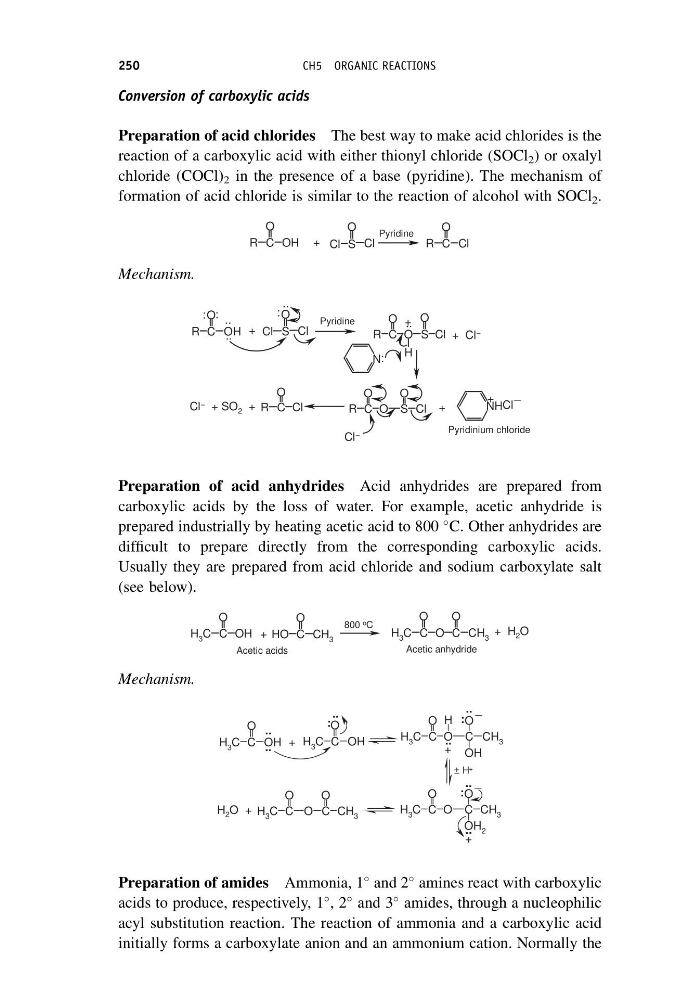
Preparation of acid chlorides The best way to make acid chlorides is the
reaction of a carboxylic acid with either thionyl chloride (SOCl 2 ) or oxalyl
chloride (COCl) 2 in the presence of a base (pyridine). The mechanism of
formation of acid chloride is similar to the reaction of alcohol with SOCl 2 .
R C
O
OH
R C
O
Cl
Cl S
O
Cl
+
Pyridine
Mechanism.
R C
O
OH
R C
O
O S
O
Cl
R C
O
Cl
Cl S
O
Cl
S Cl
O
O
R C
O
H
N
NH
+
Cl − + SO 2 +
Cl −
..
..
..
..
:
:
:
+ Cl −
:
Pyridine
+
+
_
Pyridinium chloride
Cl
+
Preparation of acid anhydrides Acid anhydrides are prepared from
carboxylic acids by the loss of water. For example, acetic anhydride is
prepared industrially by heating acetic acid to 800
C. Other anhydrides are
difficult to prepare directly from the corresponding carboxylic acids.
Usually they are prepared from acid chloride and sodium carboxylate salt
(see below).
C
H 3 C
O
OH
CH 3
C
O
C
H 3 C
O
O
CH 3
C
O
O
H
+
+ H 2 O
800 o C
Acetic anhydride
Acetic acids
Mechanism.
C
H 3 C
O
OH
C
H 3 C O
H
C
O
CH 3
O
OH
C
H 3 C
O
OH
C
H 3 C
O
O C
O
CH 3
OH 2
C
H 3 C
O
O C
O
CH 3
+
..
..
+
..
..
:
:
..
H 2 O +
:
..
+
..
± H +
_
_
Preparation of amides Ammonia, 1
and 2
amines react with carboxylic
acids to produce, respectively, 1
, 2
and 3
amides, through a nucleophilic
acyl substitution reaction. The reaction of ammonia and a carboxylic acid
initially forms a carboxylate anion and an ammonium cation. Normally the
250
CH5 ORGANIC REACTIONS
Preparation of acid chlorides The best way to make acid chlorides is the
reaction of a carboxylic acid with either thionyl chloride (SOCl 2 ) or oxalyl
chloride (COCl) 2 in the presence of a base (pyridine). The mechanism of
formation of acid chloride is similar to the reaction of alcohol with SOCl 2 .
R C
O
OH
R C
O
Cl
Cl S
O
Cl
+
Pyridine
Mechanism.
R C
O
OH
R C
O
O S
O
Cl
R C
O
Cl
Cl S
O
Cl
S Cl
O
O
R C
O
H
N
NH
+
Cl − + SO 2 +
Cl −
..
..
..
..
:
:
:
+ Cl −
:
Pyridine
+
+
_
Pyridinium chloride
Cl
+
Preparation of acid anhydrides Acid anhydrides are prepared from
carboxylic acids by the loss of water. For example, acetic anhydride is
prepared industrially by heating acetic acid to 800
C. Other anhydrides are
difficult to prepare directly from the corresponding carboxylic acids.
Usually they are prepared from acid chloride and sodium carboxylate salt
(see below).
C
H 3 C
O
OH
CH 3
C
O
C
H 3 C
O
O
CH 3
C
O
O
H
+
+ H 2 O
800 o C
Acetic anhydride
Acetic acids
Mechanism.
C
H 3 C
O
OH
C
H 3 C O
H
C
O
CH 3
O
OH
C
H 3 C
O
OH
C
H 3 C
O
O C
O
CH 3
OH 2
C
H 3 C
O
O C
O
CH 3
+
..
..
+
..
..
:
:
..
H 2 O +
:
..
+
..
± H +
_
_
Preparation of amides Ammonia, 1
and 2
amines react with carboxylic
acids to produce, respectively, 1
, 2
and 3
amides, through a nucleophilic
acyl substitution reaction. The reaction of ammonia and a carboxylic acid
initially forms a carboxylate anion and an ammonium cation. Normally the
250
CH5 ORGANIC REACTIONS