

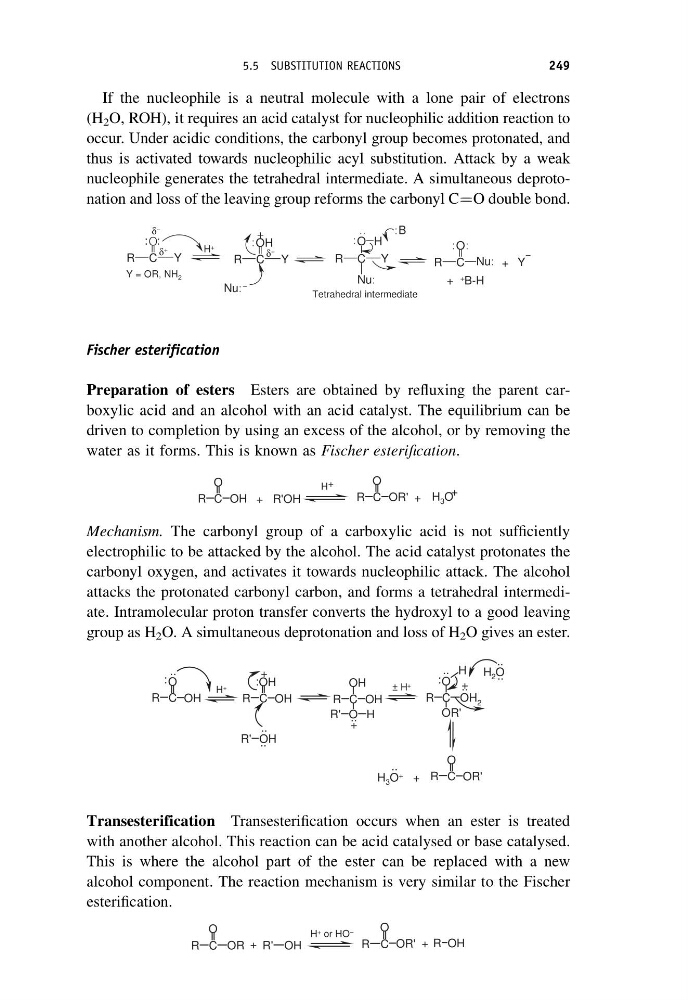
If the nucleophile is a neutral molecule with a lone pair of electrons
(H 2 O, ROH), it requires an acid catalyst for nucleophilic addition reaction to
occur. Under acidic conditions, the carbonyl group becomes protonated, and
thus is activated towards nucleophilic acyl substitution. Attack by a weak
nucleophile generates the tetrahedral intermediate. A simultaneous deprotonation and loss of the leaving group reforms the carbonyl C À À
À À O double bond.
R C Y
OH
R C Y
O
R C
O
Y
R C Y
O H
δ +
:
Nu: −
δ +
δ −
: :
H +
+
Y = OR, NH 2
Tetrahedral intermediate
+
: :
Nu:
:B
+ + B-H
:
Nu:
..
Fischer esterification
Preparation of esters Esters are obtained by refluxing the parent carboxylic acid and an alcohol with an acid catalyst. The equilibrium can be
driven to completion by using an excess of the alcohol, or by removing the
water as it forms. This is known as Fischer esterification.
R C
O
OH
R C
O
OR' +
+ R'OH
H 3 O
H +
+
Mechanism. The carbonyl group of a carboxylic acid is not sufficiently
electrophilic to be attacked by the alcohol. The acid catalyst protonates the
carbonyl oxygen, and activates it towards nucleophilic attack. The alcohol
attacks the protonated carbonyl carbon, and forms a tetrahedral intermediate. Intramolecular proton transfer converts the hydroxyl to a good leaving
group as H 2 O. A simultaneous deprotonation and loss of H 2 O gives an ester.
R C OH
OH
R' OH
R C
OH
OH
O H
R'
R C OH
O
R C
O
OH 2
OR'
H
R C OR'
O
..
..
+
:
..
H +
:
+
H 3 O + +
..
..
± H +
+
:
..
..
H 2 O
..
..
Transesterification Transesterification occurs when an ester is treated
with another alcohol. This reaction can be acid catalysed or base catalysed.
This is where the alcohol part of the ester can be replaced with a new
alcohol component. The reaction mechanism is very similar to the Fischer
esterification.
R C OR
O
R' OH
R C OR'
O
R OH
+
+
H + or HO −
5.5 SUBSTITUTION REACTIONS
249
(H 2 O, ROH), it requires an acid catalyst for nucleophilic addition reaction to
occur. Under acidic conditions, the carbonyl group becomes protonated, and
thus is activated towards nucleophilic acyl substitution. Attack by a weak
nucleophile generates the tetrahedral intermediate. A simultaneous deprotonation and loss of the leaving group reforms the carbonyl C À À
À À O double bond.
R C Y
OH
R C Y
O
R C
O
Y
R C Y
O H
δ +
:
Nu: −
δ +
δ −
: :
H +
+
Y = OR, NH 2
Tetrahedral intermediate
+
: :
Nu:
:B
+ + B-H
:
Nu:
..
Fischer esterification
Preparation of esters Esters are obtained by refluxing the parent carboxylic acid and an alcohol with an acid catalyst. The equilibrium can be
driven to completion by using an excess of the alcohol, or by removing the
water as it forms. This is known as Fischer esterification.
R C
O
OH
R C
O
OR' +
+ R'OH
H 3 O
H +
+
Mechanism. The carbonyl group of a carboxylic acid is not sufficiently
electrophilic to be attacked by the alcohol. The acid catalyst protonates the
carbonyl oxygen, and activates it towards nucleophilic attack. The alcohol
attacks the protonated carbonyl carbon, and forms a tetrahedral intermediate. Intramolecular proton transfer converts the hydroxyl to a good leaving
group as H 2 O. A simultaneous deprotonation and loss of H 2 O gives an ester.
R C OH
OH
R' OH
R C
OH
OH
O H
R'
R C OH
O
R C
O
OH 2
OR'
H
R C OR'
O
..
..
+
:
..
H +
:
+
H 3 O + +
..
..
± H +
+
:
..
..
H 2 O
..
..
Transesterification Transesterification occurs when an ester is treated
with another alcohol. This reaction can be acid catalysed or base catalysed.
This is where the alcohol part of the ester can be replaced with a new
alcohol component. The reaction mechanism is very similar to the Fischer
esterification.
R C OR
O
R' OH
R C OR'
O
R OH
+
+
H + or HO −
5.5 SUBSTITUTION REACTIONS
249