

OH
O
CH 2
C
C
H 3
H
CH 3 CHCH 2 CH 3
2-Butanol
ii. H 3 O +
Propylene oxide
Epoxide
i. CH 3 MgBr, ether
Mechanism.
O
OH
O
CH 2
C
C
H 3
H
C
H 3 MgBr
CH 3 CHCH 2 CH 3
CH 3 CHCH 2 CH 3
2-Butanol
:
..
H 3 O +
..
:
δ − δ +
MgBr
+
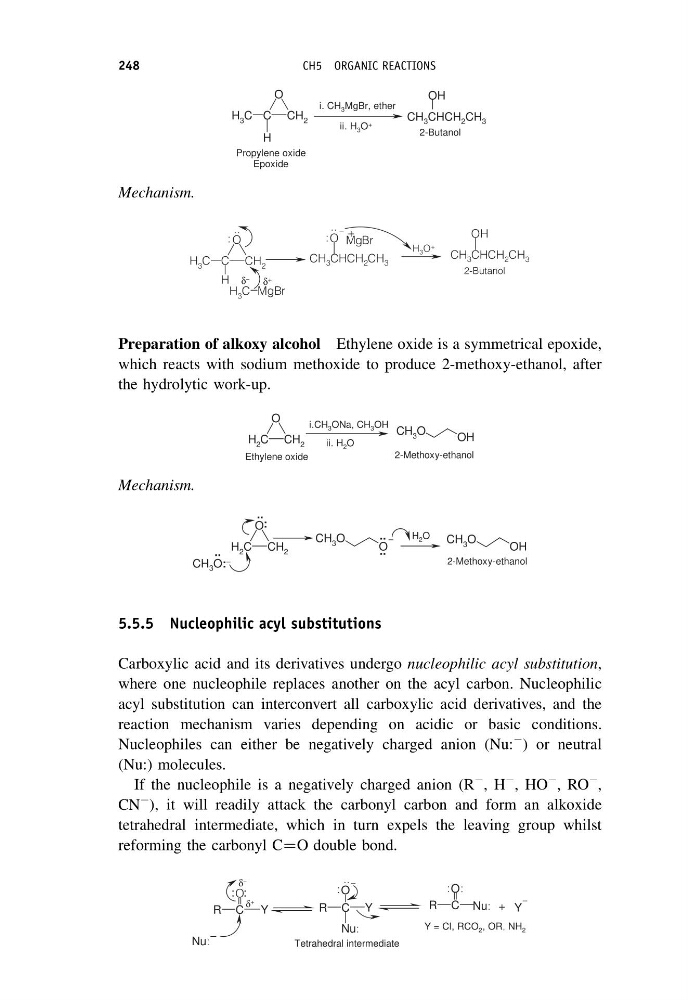
Preparation of alkoxy alcohol Ethylene oxide is a symmetrical epoxide,
which reacts with sodium methoxide to produce 2-methoxy-ethanol, after
the hydrolytic work-up.
CH 3 O
OH
O
CH 2
C
H 2
i.CH 3 ONa, CH 3 OH
ii. H 2 O
Ethylene oxide
2-Methoxy-ethanol
Mechanism.
CH 3 O
O
CH 3 O
OH
O
CH 2
C
H 2
H 2 O
..
:
..
CH 3 O: −
..
..
2-Methoxy-ethanol
5.5.5 Nucleophilic acyl substitutions
Carboxylic acid and its derivatives undergo nucleophilic acyl substitution,
where one nucleophile replaces another on the acyl carbon. Nucleophilic
acyl substitution can interconvert all carboxylic acid derivatives, and the
reaction mechanism varies depending on acidic or basic conditions.
Nucleophiles can either be negatively charged anion (Nu:
À ) or neutral
(Nu:) molecules.
If the nucleophile is a negatively charged anion (R
À , H
À , HO
À , RO
À
,
CN
À ), it will readily attack the carbonyl carbon and form an alkoxide
tetrahedral intermediate, which in turn expels the leaving group whilst
reforming the carbonyl C À À
À À O double bond.
R C Y
O
R C
O
R C Y
O
Y
δ +
δ −
: :
Nu:
_
Y = Cl, RCO 2 , OR, NH 2
Tetrahedral intermediate
+
: :
:
Nu:
..
Nu:
248
CH5 ORGANIC REACTIONS
O
CH 2
C
C
H 3
H
CH 3 CHCH 2 CH 3
2-Butanol
ii. H 3 O +
Propylene oxide
Epoxide
i. CH 3 MgBr, ether
Mechanism.
O
OH
O
CH 2
C
C
H 3
H
C
H 3 MgBr
CH 3 CHCH 2 CH 3
CH 3 CHCH 2 CH 3
2-Butanol
:
..
H 3 O +
..
:
δ − δ +
MgBr
+
Preparation of alkoxy alcohol Ethylene oxide is a symmetrical epoxide,
which reacts with sodium methoxide to produce 2-methoxy-ethanol, after
the hydrolytic work-up.
CH 3 O
OH
O
CH 2
C
H 2
i.CH 3 ONa, CH 3 OH
ii. H 2 O
Ethylene oxide
2-Methoxy-ethanol
Mechanism.
CH 3 O
O
CH 3 O
OH
O
CH 2
C
H 2
H 2 O
..
:
..
CH 3 O: −
..
..
2-Methoxy-ethanol
5.5.5 Nucleophilic acyl substitutions
Carboxylic acid and its derivatives undergo nucleophilic acyl substitution,
where one nucleophile replaces another on the acyl carbon. Nucleophilic
acyl substitution can interconvert all carboxylic acid derivatives, and the
reaction mechanism varies depending on acidic or basic conditions.
Nucleophiles can either be negatively charged anion (Nu:
À ) or neutral
(Nu:) molecules.
If the nucleophile is a negatively charged anion (R
À , H
À , HO
À , RO
À
,
CN
À ), it will readily attack the carbonyl carbon and form an alkoxide
tetrahedral intermediate, which in turn expels the leaving group whilst
reforming the carbonyl C À À
À À O double bond.
R C Y
O
R C
O
R C Y
O
Y
δ +
δ −
: :
Nu:
_
Y = Cl, RCO 2 , OR, NH 2
Tetrahedral intermediate
+
: :
:
Nu:
..
Nu:
248
CH5 ORGANIC REACTIONS