

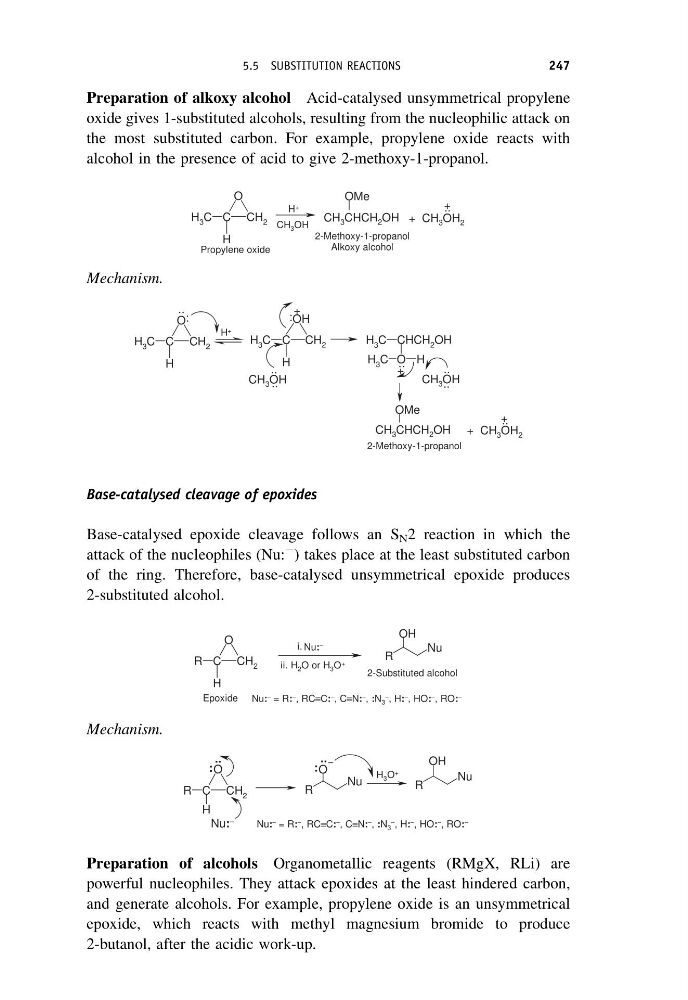
Preparation of alkoxy alcohol Acid-catalysed unsymmetrical propylene
oxide gives 1-substituted alcohols, resulting from the nucleophilic attack on
the most substituted carbon. For example, propylene oxide reacts with
alcohol in the presence of acid to give 2-methoxy-1-propanol.
OMe
O
CH 2
C
C
H 3
H
H +
CH 3 OH
CH 3 CHCH 2 OH
2-Methoxy-1-propanol
Alkoxy alcohol
Propylene oxide
+ CH 3 OH 2
+ ..
Mechanism.
CHCH 2 OH
C
H 3
O H
C
H 3
OMe
O
CH 2
C
C
H 3
H
CH 2
C
C
H 3
H
OH
CH 3 CHCH 2 OH
H +
+
CH 3 OH
..
..
+
2-Methoxy-1-propanol
..
:
..
:
CH 3 OH ..
..
+ CH 3 OH 2
+ ..
Base-catalysed cleavage of epoxides
Base-catalysed epoxide cleavage follows an S N 2 reaction in which the
attack of the nucleophiles (Nu:
À
) takes place at the least substituted carbon
of the ring. Therefore, base-catalysed unsymmetrical epoxide produces
2-substituted alcohol.
R
Nu
OH
O
CH 2
C
R
H
ii. H 2 O or H 3 O +
2-Substituted alcohol
Nu: −
i.
Epoxide Nu: − = R: − , RC≡C: − , C≡N: − , :N 3
− , H: − , HO: − , RO: −
Mechanism.
R
Nu
O
R
Nu
OH
O
CH 2
C
R
H
Nu: −
:
..
H 3 O +
Nu: − = R: − , RC≡C: − , C≡N: − , :N 3
− , H: − , HO: − , RO: −
..
:
Preparation of alcohols Organometallic reagents (RMgX, RLi) are
powerful nucleophiles. They attack epoxides at the least hindered carbon,
and generate alcohols. For example, propylene oxide is an unsymmetrical
epoxide, which reacts with methyl magnesium bromide to produce
2-butanol, after the acidic work-up.
5.5 SUBSTITUTION REACTIONS
247
oxide gives 1-substituted alcohols, resulting from the nucleophilic attack on
the most substituted carbon. For example, propylene oxide reacts with
alcohol in the presence of acid to give 2-methoxy-1-propanol.
OMe
O
CH 2
C
C
H 3
H
H +
CH 3 OH
CH 3 CHCH 2 OH
2-Methoxy-1-propanol
Alkoxy alcohol
Propylene oxide
+ CH 3 OH 2
+ ..
Mechanism.
CHCH 2 OH
C
H 3
O H
C
H 3
OMe
O
CH 2
C
C
H 3
H
CH 2
C
C
H 3
H
OH
CH 3 CHCH 2 OH
H +
+
CH 3 OH
..
..
+
2-Methoxy-1-propanol
..
:
..
:
CH 3 OH ..
..
+ CH 3 OH 2
+ ..
Base-catalysed cleavage of epoxides
Base-catalysed epoxide cleavage follows an S N 2 reaction in which the
attack of the nucleophiles (Nu:
À
) takes place at the least substituted carbon
of the ring. Therefore, base-catalysed unsymmetrical epoxide produces
2-substituted alcohol.
R
Nu
OH
O
CH 2
C
R
H
ii. H 2 O or H 3 O +
2-Substituted alcohol
Nu: −
i.
Epoxide Nu: − = R: − , RC≡C: − , C≡N: − , :N 3
− , H: − , HO: − , RO: −
Mechanism.
R
Nu
O
R
Nu
OH
O
CH 2
C
R
H
Nu: −
:
..
H 3 O +
Nu: − = R: − , RC≡C: − , C≡N: − , :N 3
− , H: − , HO: − , RO: −
..
:
Preparation of alcohols Organometallic reagents (RMgX, RLi) are
powerful nucleophiles. They attack epoxides at the least hindered carbon,
and generate alcohols. For example, propylene oxide is an unsymmetrical
epoxide, which reacts with methyl magnesium bromide to produce
2-butanol, after the acidic work-up.
5.5 SUBSTITUTION REACTIONS
247