

Cl
Br
Cl 2 , FeCl 3
25 o C
+ HCl
∆
+ HBr
Br 2 , FeBr 3
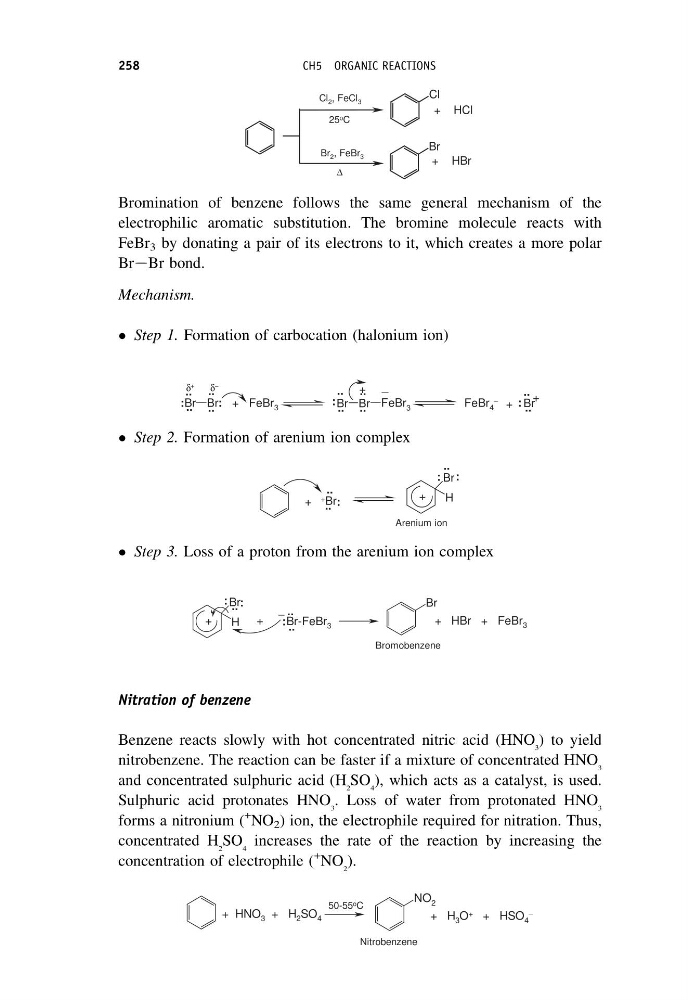
Bromination of benzene follows the same general mechanism of the
electrophilic aromatic substitution. The bromine molecule reacts with
FeBr 3 by donating a pair of its electrons to it, which creates a more polar
BrÀ ÀBr bond.
Mechanism.
Step 1. Formation of carbocation (halonium ion)
Br Br
Br Br FeBr 3
: Br ..
..
FeBr 4
− +
+ FeBr 3
..
:
..
..
..
:
δ +
δ −
..
..
..
..
:
+ _
+
Step 2. Formation of arenium ion complex
Br
H
+
:
+ Br
..
..
+
Arenium ion
:
:
..
Step 3. Loss of a proton from the arenium ion complex
Br
H
Br
+
:Br-FeBr 3
..
..
+
.. :
:
−
+ HBr + FeBr 3
Bromobenzene
Nitration of benzene
Benzene reacts slowly with hot concentrated nitric acid (HNO
3
) to yield
nitrobenzene. The reaction can be faster if a mixture of concentrated HNO
3
and concentrated sulphuric acid (H
2
SO
4
), which acts as a catalyst, is used.
Sulphuric acid protonates HNO
3
. Loss of water from protonated HNO
3
forms a nitronium (
+ NO 2 ) ion, the electrophile required for nitration. Thus,
concentrated H
2
SO
4
increases the rate of the reaction by increasing the
concentration of electrophile (
+ NO
2
).
NO 2
+ HNO 3 + H 2 SO 4
50-55 o C
+ H 3 O + + HSO 4
−
Nitrobenzene
258
CH5 ORGANIC REACTIONS
Br
Cl 2 , FeCl 3
25 o C
+ HCl
∆
+ HBr
Br 2 , FeBr 3
Bromination of benzene follows the same general mechanism of the
electrophilic aromatic substitution. The bromine molecule reacts with
FeBr 3 by donating a pair of its electrons to it, which creates a more polar
BrÀ ÀBr bond.
Mechanism.
Step 1. Formation of carbocation (halonium ion)
Br Br
Br Br FeBr 3
: Br ..
..
FeBr 4
− +
+ FeBr 3
..
:
..
..
..
:
δ +
δ −
..
..
..
..
:
+ _
+
Step 2. Formation of arenium ion complex
Br
H
+
:
+ Br
..
..
+
Arenium ion
:
:
..
Step 3. Loss of a proton from the arenium ion complex
Br
H
Br
+
:Br-FeBr 3
..
..
+
.. :
:
−
+ HBr + FeBr 3
Bromobenzene
Nitration of benzene
Benzene reacts slowly with hot concentrated nitric acid (HNO
3
) to yield
nitrobenzene. The reaction can be faster if a mixture of concentrated HNO
3
and concentrated sulphuric acid (H
2
SO
4
), which acts as a catalyst, is used.
Sulphuric acid protonates HNO
3
. Loss of water from protonated HNO
3
forms a nitronium (
+ NO 2 ) ion, the electrophile required for nitration. Thus,
concentrated H
2
SO
4
increases the rate of the reaction by increasing the
concentration of electrophile (
+ NO
2
).
NO 2
+ HNO 3 + H 2 SO 4
50-55 o C
+ H 3 O + + HSO 4
−
Nitrobenzene
258
CH5 ORGANIC REACTIONS