

Conversion of alcohols by sulphonyl chlorides: preparation of alkyl tosylates
or tosylate esters
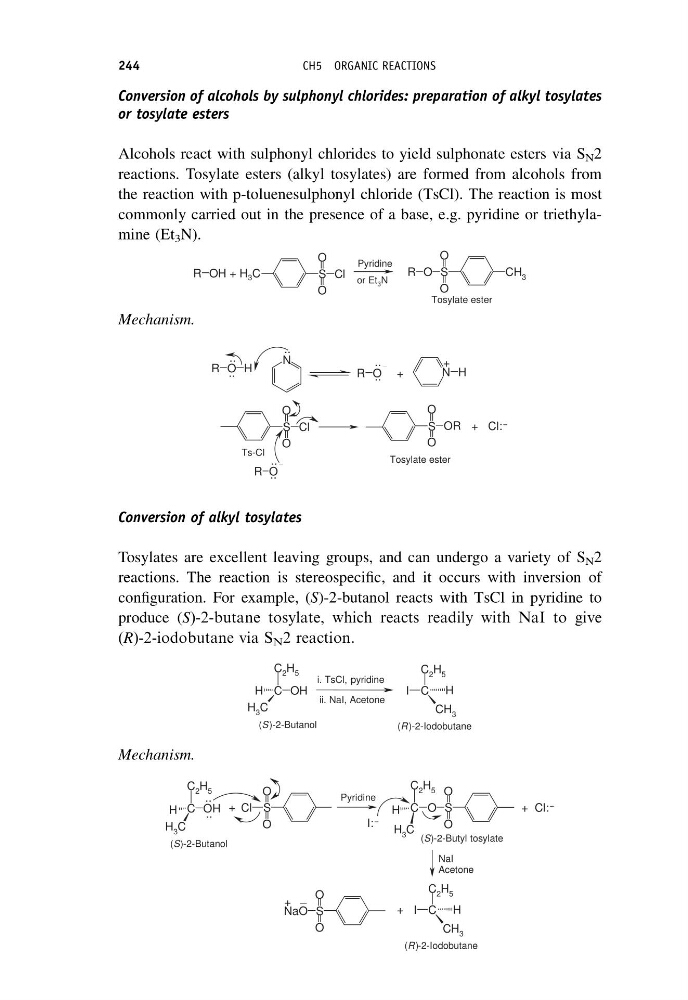
Alcohols react with sulphonyl chlorides to yield sulphonate esters via S N 2
reactions. Tosylate esters (alkyl tosylates) are formed from alcohols from
the reaction with p-toluenesulphonyl chloride (TsCl). The reaction is most
commonly carried out in the presence of a base, e.g. pyridine or triethylamine (Et 3 N).
R OH + H 3 C
S
O
O
Cl
S
C H 3
O
O
O
R
Tosylate ester
Pyridine
or Et 3 N
Mechanism.
R O
S
O
O
Cl
S
O
O
OR
Ts-Cl
O
R
H
N
N H
R O
Tosylate ester
..
..
..
+
+
..
..
..
..
+ Cl: −
Conversion of alkyl tosylates
Tosylates are excellent leaving groups, and can undergo a variety of S N 2
reactions. The reaction is stereospecific, and it occurs with inversion of
configuration. For example, (S)-2-butanol reacts with TsCl in pyridine to
produce (S)-2-butane tosylate, which reacts readily with NaI to give
(R)-2-iodobutane via S N 2 reaction.
OH
C 2 H 5
C
C
H 3
H
C 2 H 5
C
I
CH 3
H
i. TsCl, pyridine
ii. NaI, Acetone
(S )-2-Butanol
(R)-2-Iodobutane
Mechanism.
C 2 H 5
C
I
CH 3
H
S
O
O
O
C 2 H 5
C
C
H 3
H
S
O
O
NaO
OH
C 2 H 5
C
C
H 3
H
S
O
O
Cl
NaI
Acetone
+
_
+
(R)-2-Iodobutane
..
..
+ Cl: −
(S)-2-Butanol
(S)-2-Butyl tosylate
Pyridine
+
I: −
244
CH5 ORGANIC REACTIONS
or tosylate esters
Alcohols react with sulphonyl chlorides to yield sulphonate esters via S N 2
reactions. Tosylate esters (alkyl tosylates) are formed from alcohols from
the reaction with p-toluenesulphonyl chloride (TsCl). The reaction is most
commonly carried out in the presence of a base, e.g. pyridine or triethylamine (Et 3 N).
R OH + H 3 C
S
O
O
Cl
S
C H 3
O
O
O
R
Tosylate ester
Pyridine
or Et 3 N
Mechanism.
R O
S
O
O
Cl
S
O
O
OR
Ts-Cl
O
R
H
N
N H
R O
Tosylate ester
..
..
..
+
+
..
..
..
..
+ Cl: −
Conversion of alkyl tosylates
Tosylates are excellent leaving groups, and can undergo a variety of S N 2
reactions. The reaction is stereospecific, and it occurs with inversion of
configuration. For example, (S)-2-butanol reacts with TsCl in pyridine to
produce (S)-2-butane tosylate, which reacts readily with NaI to give
(R)-2-iodobutane via S N 2 reaction.
OH
C 2 H 5
C
C
H 3
H
C 2 H 5
C
I
CH 3
H
i. TsCl, pyridine
ii. NaI, Acetone
(S )-2-Butanol
(R)-2-Iodobutane
Mechanism.
C 2 H 5
C
I
CH 3
H
S
O
O
O
C 2 H 5
C
C
H 3
H
S
O
O
NaO
OH
C 2 H 5
C
C
H 3
H
S
O
O
Cl
NaI
Acetone
+
_
+
(R)-2-Iodobutane
..
..
+ Cl: −
(S)-2-Butanol
(S)-2-Butyl tosylate
Pyridine
+
I: −
244
CH5 ORGANIC REACTIONS