

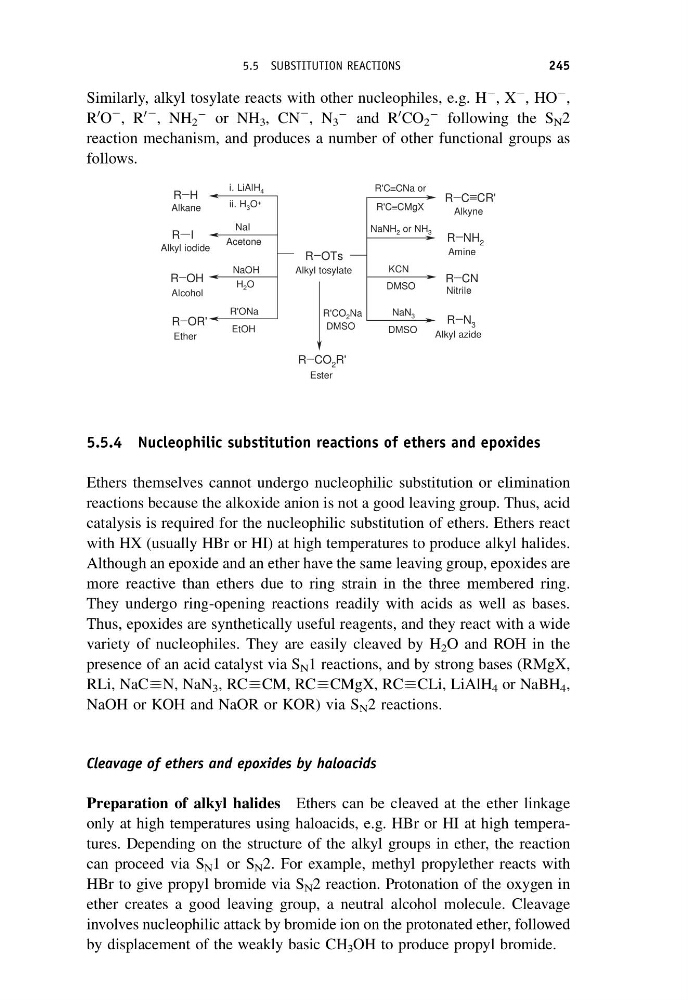
Similarly, alkyl tosylate reacts with other nucleophiles, e.g. H
À
, X
À , HO
À ,
R
0 O
À , R
0À , NH 2
À or NH 3 , CN
À , N 3
À and R
0 CO 2
À following the S N 2
reaction mechanism, and produces a number of other functional groups as
follows.
R OTs
R OH
R OR'
R NH 2
R H
R I
R CO 2 R'
R N 3
R CN
C CR'
R
Alcohol
Nitrile
Alkyl iodide
R'ONa
Ether
NaNH 2 or NH 3
Amine
Alkane
NaOH
KCN
NaI
i. LiAlH 4
ii. H 3 O +
R'CO 2 Na
Ester
NaN 3
Alkyl azide
R'C≡CMgX
R'C≡CNa or
Alkyne
Acetone
DMSO
DMSO
DMSO
EtOH
H 2 O
Alkyl tosylate
5.5.4 Nucleophilic substitution reactions of ethers and epoxides
Ethers themselves cannot undergo nucleophilic substitution or elimination
reactions because the alkoxide anion is not a good leaving group. Thus, acid
catalysis is required for the nucleophilic substitution of ethers. Ethers react
with HX (usually HBr or HI) at high temperatures to produce alkyl halides.
Although an epoxide and an ether have the same leaving group, epoxides are
more reactive than ethers due to ring strain in the three membered ring.
They undergo ring-opening reactions readily with acids as well as bases.
Thus, epoxides are synthetically useful reagents, and they react with a wide
variety of nucleophiles. They are easily cleaved by H 2 O and ROH in the
presence of an acid catalyst via S N 1 reactions, and by strong bases (RMgX,
RLi, NaC À À
À À
À À N, NaN 3 , RC À À
À À
À À CM, RC À À
À À
À À CMgX, RC À À
À À
À À CLi, LiAlH 4 or NaBH 4 ,
NaOH or KOH and NaOR or KOR) via S N 2 reactions.
Cleavage of ethers and epoxides by haloacids
Preparation of alkyl halides Ethers can be cleaved at the ether linkage
only at high temperatures using haloacids, e.g. HBr or HI at high temperatures. Depending on the structure of the alkyl groups in ether, the reaction
can proceed via S N 1 or S N 2. For example, methyl propylether reacts with
HBr to give propyl bromide via S N 2 reaction. Protonation of the oxygen in
ether creates a good leaving group, a neutral alcohol molecule. Cleavage
involves nucleophilic attack by bromide ion on the protonated ether, followed
by displacement of the weakly basic CH 3 OH to produce propyl bromide.
5.5 SUBSTITUTION REACTIONS
245
À
, X
À , HO
À ,
R
0 O
À , R
0À , NH 2
À or NH 3 , CN
À , N 3
À and R
0 CO 2
À following the S N 2
reaction mechanism, and produces a number of other functional groups as
follows.
R OTs
R OH
R OR'
R NH 2
R H
R I
R CO 2 R'
R N 3
R CN
C CR'
R
Alcohol
Nitrile
Alkyl iodide
R'ONa
Ether
NaNH 2 or NH 3
Amine
Alkane
NaOH
KCN
NaI
i. LiAlH 4
ii. H 3 O +
R'CO 2 Na
Ester
NaN 3
Alkyl azide
R'C≡CMgX
R'C≡CNa or
Alkyne
Acetone
DMSO
DMSO
DMSO
EtOH
H 2 O
Alkyl tosylate
5.5.4 Nucleophilic substitution reactions of ethers and epoxides
Ethers themselves cannot undergo nucleophilic substitution or elimination
reactions because the alkoxide anion is not a good leaving group. Thus, acid
catalysis is required for the nucleophilic substitution of ethers. Ethers react
with HX (usually HBr or HI) at high temperatures to produce alkyl halides.
Although an epoxide and an ether have the same leaving group, epoxides are
more reactive than ethers due to ring strain in the three membered ring.
They undergo ring-opening reactions readily with acids as well as bases.
Thus, epoxides are synthetically useful reagents, and they react with a wide
variety of nucleophiles. They are easily cleaved by H 2 O and ROH in the
presence of an acid catalyst via S N 1 reactions, and by strong bases (RMgX,
RLi, NaC À À
À À
À À N, NaN 3 , RC À À
À À
À À CM, RC À À
À À
À À CMgX, RC À À
À À
À À CLi, LiAlH 4 or NaBH 4 ,
NaOH or KOH and NaOR or KOR) via S N 2 reactions.
Cleavage of ethers and epoxides by haloacids
Preparation of alkyl halides Ethers can be cleaved at the ether linkage
only at high temperatures using haloacids, e.g. HBr or HI at high temperatures. Depending on the structure of the alkyl groups in ether, the reaction
can proceed via S N 1 or S N 2. For example, methyl propylether reacts with
HBr to give propyl bromide via S N 2 reaction. Protonation of the oxygen in
ether creates a good leaving group, a neutral alcohol molecule. Cleavage
involves nucleophilic attack by bromide ion on the protonated ether, followed
by displacement of the weakly basic CH 3 OH to produce propyl bromide.
5.5 SUBSTITUTION REACTIONS
245