

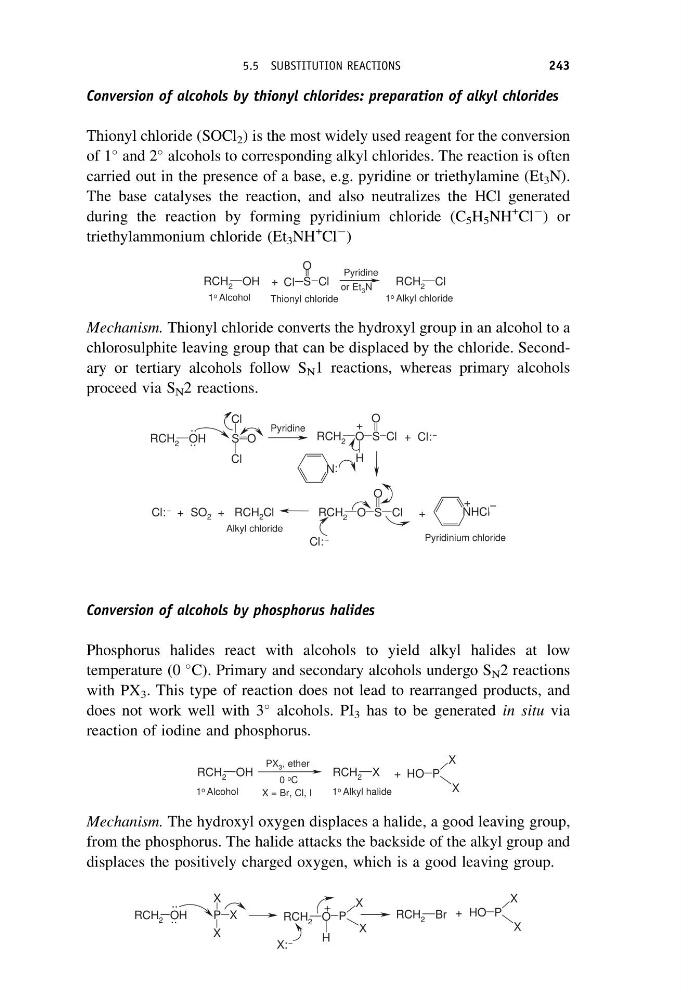
Conversion of alcohols by thionyl chlorides: preparation of alkyl chlorides
Thionyl chloride (SOCl 2 ) is the most widely used reagent for the conversion
of 1
and 2
alcohols to corresponding alkyl chlorides. The reaction is often
carried out in the presence of a base, e.g. pyridine or triethylamine (Et 3 N).
The base catalyses the reaction, and also neutralizes the HCl generated
during the reaction by forming pyridinium chloride (C 5 H 5 NH
+
Cl
À ) or
triethylammonium chloride (Et 3 NH
+
Cl
À )
RCH 2 OH
Cl
Cl S
O
RCH 2 Cl
+
1 o Alcohol
1 o Alkyl chloride
Pyridine
or Et 3 N
Thionyl chloride
Mechanism. Thionyl chloride converts the hydroxyl group in an alcohol to a
chlorosulphite leaving group that can be displaced by the chloride. Secondary or tertiary alcohols follow S N 1 reactions, whereas primary alcohols
proceed via S N 2 reactions.
RCH 2 OH
Cl
S O
Cl
RCH 2 O
H
S Cl
O
RCH 2 O S Cl
O
N
NHCl
..
..
+
Cl: − + SO 2 + RCH 2 Cl
:
Pyridine
+
+
Pyridinium chloride
−
+ Cl: −
Cl: −
Alkyl chloride
Conversion of alcohols by phosphorus halides
Phosphorus halides react with alcohols to yield alkyl halides at low
temperature (0
C). Primary and secondary alcohols undergo S N 2 reactions
with PX 3 . This type of reaction does not lead to rearranged products, and
does not work well with 3
alcohols. PI 3 has to be generated in situ via
reaction of iodine and phosphorus.
RCH 2 OH
RCH 2 X
P
X
X
HO
PX 3 , ether
X = Br, Cl, I
1 o Alcohol
1 o Alkyl halide
+
0 o C
Mechanism. The hydroxyl oxygen displaces a halide, a good leaving group,
from the phosphorus. The halide attacks the backside of the alkyl group and
displaces the positively charged oxygen, which is a good leaving group.
RCH 2 OH
X
P X
X
RCH 2 O
H
P
X
X
RCH 2 Br
P
X
X
O
H
..
+
..
+
X: −
5.5 SUBSTITUTION REACTIONS
243
Thionyl chloride (SOCl 2 ) is the most widely used reagent for the conversion
of 1
and 2
alcohols to corresponding alkyl chlorides. The reaction is often
carried out in the presence of a base, e.g. pyridine or triethylamine (Et 3 N).
The base catalyses the reaction, and also neutralizes the HCl generated
during the reaction by forming pyridinium chloride (C 5 H 5 NH
+
Cl
À ) or
triethylammonium chloride (Et 3 NH
+
Cl
À )
RCH 2 OH
Cl
Cl S
O
RCH 2 Cl
+
1 o Alcohol
1 o Alkyl chloride
Pyridine
or Et 3 N
Thionyl chloride
Mechanism. Thionyl chloride converts the hydroxyl group in an alcohol to a
chlorosulphite leaving group that can be displaced by the chloride. Secondary or tertiary alcohols follow S N 1 reactions, whereas primary alcohols
proceed via S N 2 reactions.
RCH 2 OH
Cl
S O
Cl
RCH 2 O
H
S Cl
O
RCH 2 O S Cl
O
N
NHCl
..
..
+
Cl: − + SO 2 + RCH 2 Cl
:
Pyridine
+
+
Pyridinium chloride
−
+ Cl: −
Cl: −
Alkyl chloride
Conversion of alcohols by phosphorus halides
Phosphorus halides react with alcohols to yield alkyl halides at low
temperature (0
C). Primary and secondary alcohols undergo S N 2 reactions
with PX 3 . This type of reaction does not lead to rearranged products, and
does not work well with 3
alcohols. PI 3 has to be generated in situ via
reaction of iodine and phosphorus.
RCH 2 OH
RCH 2 X
P
X
X
HO
PX 3 , ether
X = Br, Cl, I
1 o Alcohol
1 o Alkyl halide
+
0 o C
Mechanism. The hydroxyl oxygen displaces a halide, a good leaving group,
from the phosphorus. The halide attacks the backside of the alkyl group and
displaces the positively charged oxygen, which is a good leaving group.
RCH 2 OH
X
P X
X
RCH 2 O
H
P
X
X
RCH 2 Br
P
X
X
O
H
..
+
..
+
X: −
5.5 SUBSTITUTION REACTIONS
243