

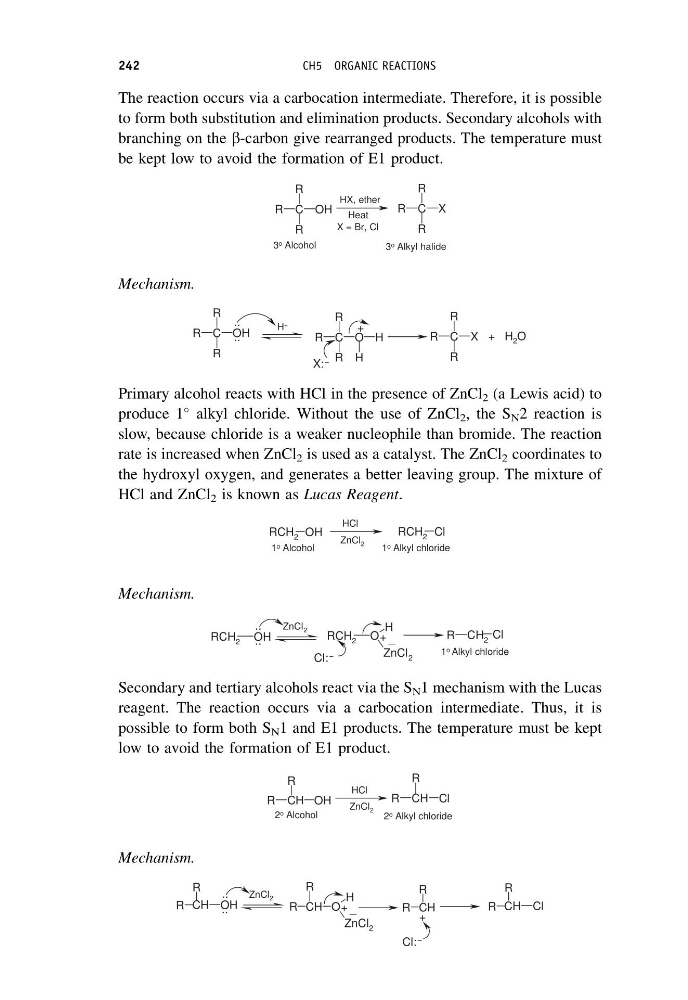
The reaction occurs via a carbocation intermediate. Therefore, it is possible
to form both substitution and elimination products. Secondary alcohols with
branching on the b-carbon give rearranged products. The temperature must
be kept low to avoid the formation of E1 product.
C OH
R
R
R
C X
R
R
R
3 o Alcohol
3 o Alkyl halide
HX, ether
X = Br, Cl
Heat
Mechanism.
OH
C
R
R
R
O
C
R
R
R
H
H
X
C
R
R
R
H +
+ H 2 O
..
..
+
X: −
Primary alcohol reacts with HCl in the presence of ZnCl 2 (a Lewis acid) to
produce 1
alkyl chloride. Without the use of ZnCl 2 , the S N 2 reaction is
slow, because chloride is a weaker nucleophile than bromide. The reaction
rate is increased when ZnCl 2 is used as a catalyst. The ZnCl 2 coordinates to
the hydroxyl oxygen, and generates a better leaving group. The mixture of
HCl and ZnCl 2 is known as Lucas Reagent.
RCH 2 OH
RCH 2 Cl
HCl
1 o Alcohol
1 o Alkyl chloride
ZnCl 2
Mechanism.
RCH 2 OH
RCH 2 O
H
ZnCl 2
CH 2
R
Cl
_
ZnCl 2
..
..
+
1 o Alkyl chloride
Cl: −
Secondary and tertiary alcohols react via the S N 1 mechanism with the Lucas
reagent. The reaction occurs via a carbocation intermediate. Thus, it is
possible to form both S N 1 and E1 products. The temperature must be kept
low to avoid the formation of E1 product.
CH OH
R
R
CH Cl
R
R
HCl
2 o Alcohol
2 o Alkyl chloride
ZnCl 2
Mechanism.
CH OH
CH O
H
ZnCl 2
R
R
R
R
R
CH
R
CH Cl
R
R
+
_
ZnCl 2
..
..
+
Cl: −
242
CH5 ORGANIC REACTIONS
to form both substitution and elimination products. Secondary alcohols with
branching on the b-carbon give rearranged products. The temperature must
be kept low to avoid the formation of E1 product.
C OH
R
R
R
C X
R
R
R
3 o Alcohol
3 o Alkyl halide
HX, ether
X = Br, Cl
Heat
Mechanism.
OH
C
R
R
R
O
C
R
R
R
H
H
X
C
R
R
R
H +
+ H 2 O
..
..
+
X: −
Primary alcohol reacts with HCl in the presence of ZnCl 2 (a Lewis acid) to
produce 1
alkyl chloride. Without the use of ZnCl 2 , the S N 2 reaction is
slow, because chloride is a weaker nucleophile than bromide. The reaction
rate is increased when ZnCl 2 is used as a catalyst. The ZnCl 2 coordinates to
the hydroxyl oxygen, and generates a better leaving group. The mixture of
HCl and ZnCl 2 is known as Lucas Reagent.
RCH 2 OH
RCH 2 Cl
HCl
1 o Alcohol
1 o Alkyl chloride
ZnCl 2
Mechanism.
RCH 2 OH
RCH 2 O
H
ZnCl 2
CH 2
R
Cl
_
ZnCl 2
..
..
+
1 o Alkyl chloride
Cl: −
Secondary and tertiary alcohols react via the S N 1 mechanism with the Lucas
reagent. The reaction occurs via a carbocation intermediate. Thus, it is
possible to form both S N 1 and E1 products. The temperature must be kept
low to avoid the formation of E1 product.
CH OH
R
R
CH Cl
R
R
HCl
2 o Alcohol
2 o Alkyl chloride
ZnCl 2
Mechanism.
CH OH
CH O
H
ZnCl 2
R
R
R
R
R
CH
R
CH Cl
R
R
+
_
ZnCl 2
..
..
+
Cl: −
242
CH5 ORGANIC REACTIONS