

better leaving group, and reacts with nucleophiles without the need for an
acid.
Acid-catalysed condensation of alcohols: preparation of ethers
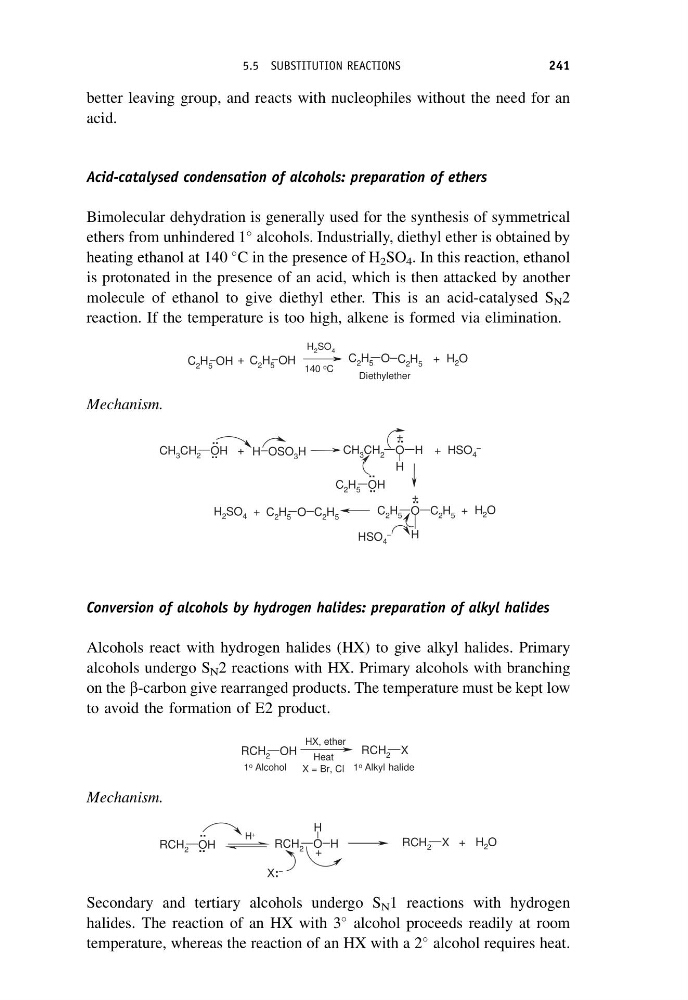
Bimolecular dehydration is generally used for the synthesis of symmetrical
ethers from unhindered 1
alcohols. Industrially, diethyl ether is obtained by
heating ethanol at 140
C in the presence of H 2 SO 4 . In this reaction, ethanol
is protonated in the presence of an acid, which is then attacked by another
molecule of ethanol to give diethyl ether. This is an acid-catalysed S N 2
reaction. If the temperature is too high, alkene is formed via elimination.
C 2 H 5 O C 2 H 5
C 2 H 5 OH
H 2 SO 4
C 2 H 5 OH
+ H 2 O
Diethylether
140 o C
+
Mechanism.
CH 3 CH 2 OH
CH 3 CH 2 O
H
H
C 2 H 5 O C 2 H 5
C 2 H 5 OH
C 2 H 5 O
H
C 2 H 5
H OSO 3 H
..
..
+ ..
..
..
+ ..
+
+ HSO 4
−
H 2 SO 4 +
HSO 4
−
+ H 2 O
Conversion of alcohols by hydrogen halides: preparation of alkyl halides
Alcohols react with hydrogen halides (HX) to give alkyl halides. Primary
alcohols undergo S N 2 reactions with HX. Primary alcohols with branching
on the b-carbon give rearranged products. The temperature must be kept low
to avoid the formation of E2 product.
RCH 2 OH
RCH 2 X
HX, ether
1 o Alcohol
1 o Alkyl halide
X = Br, Cl
Heat
Mechanism.
RCH 2 OH
RCH 2 O
H
H
RCH 2 X
H +
+ H 2 O
..
..
+
X: −
Secondary and tertiary alcohols undergo S N 1 reactions with hydrogen
halides. The reaction of an HX with 3
alcohol proceeds readily at room
temperature, whereas the reaction of an HX with a 2
alcohol requires heat.
5.5 SUBSTITUTION REACTIONS
241
acid.
Acid-catalysed condensation of alcohols: preparation of ethers
Bimolecular dehydration is generally used for the synthesis of symmetrical
ethers from unhindered 1
alcohols. Industrially, diethyl ether is obtained by
heating ethanol at 140
C in the presence of H 2 SO 4 . In this reaction, ethanol
is protonated in the presence of an acid, which is then attacked by another
molecule of ethanol to give diethyl ether. This is an acid-catalysed S N 2
reaction. If the temperature is too high, alkene is formed via elimination.
C 2 H 5 O C 2 H 5
C 2 H 5 OH
H 2 SO 4
C 2 H 5 OH
+ H 2 O
Diethylether
140 o C
+
Mechanism.
CH 3 CH 2 OH
CH 3 CH 2 O
H
H
C 2 H 5 O C 2 H 5
C 2 H 5 OH
C 2 H 5 O
H
C 2 H 5
H OSO 3 H
..
..
+ ..
..
..
+ ..
+
+ HSO 4
−
H 2 SO 4 +
HSO 4
−
+ H 2 O
Conversion of alcohols by hydrogen halides: preparation of alkyl halides
Alcohols react with hydrogen halides (HX) to give alkyl halides. Primary
alcohols undergo S N 2 reactions with HX. Primary alcohols with branching
on the b-carbon give rearranged products. The temperature must be kept low
to avoid the formation of E2 product.
RCH 2 OH
RCH 2 X
HX, ether
1 o Alcohol
1 o Alkyl halide
X = Br, Cl
Heat
Mechanism.
RCH 2 OH
RCH 2 O
H
H
RCH 2 X
H +
+ H 2 O
..
..
+
X: −
Secondary and tertiary alcohols undergo S N 1 reactions with hydrogen
halides. The reaction of an HX with 3
alcohol proceeds readily at room
temperature, whereas the reaction of an HX with a 2
alcohol requires heat.
5.5 SUBSTITUTION REACTIONS
241