

RCH 2 X
C CR'
RCH 2
R'C≡CMgX
R'C≡CNa or
Alkyl halide
Alkyne
Mechanism.
R
C X
H
H
RCH 2 C CR'
R'C C
δ + δ −
:
+ X: −
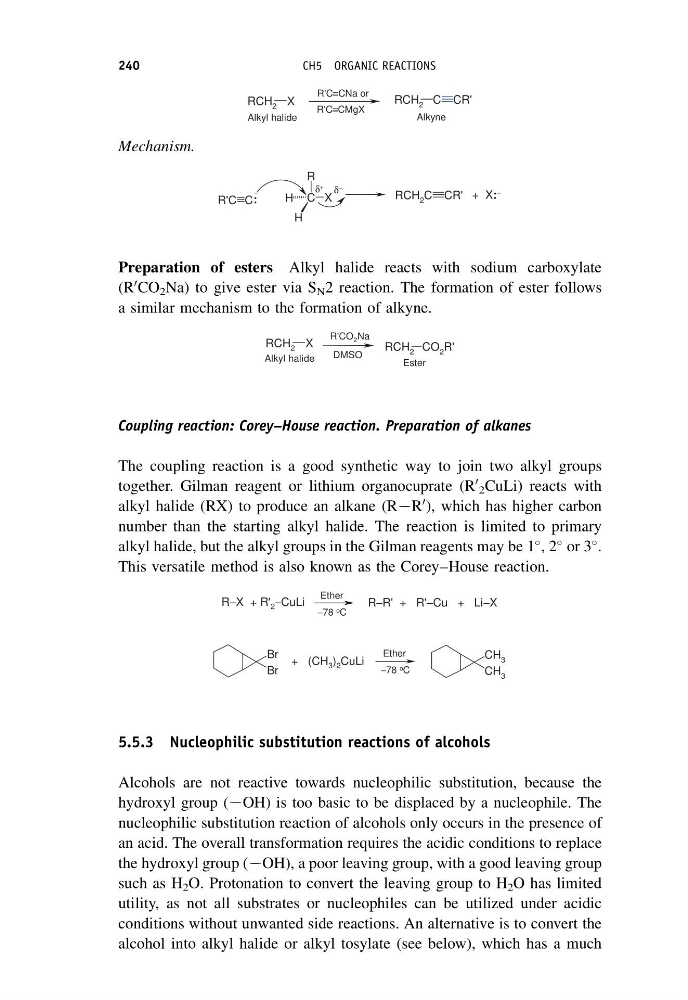
Preparation of esters Alkyl halide reacts with sodium carboxylate
(R
0 CO 2 Na) to give ester via S N 2 reaction. The formation of ester follows
a similar mechanism to the formation of alkyne.
RCH 2 X
RCH 2 CO 2 R'
R'CO 2 Na
Ester
Alkyl halide
DMSO
Coupling reaction: Corey–House reaction. Preparation of alkanes
The coupling reaction is a good synthetic way to join two alkyl groups
together. Gilman reagent or lithium organocuprate (R
0
2 CuLi) reacts with
alkyl halide (RX) to produce an alkane (RÀ ÀR 0 ), which has higher carbon
number than the starting alkyl halide. The reaction is limited to primary
alkyl halide, but the alkyl groups in the Gilman reagents may be 1
, 2
or 3
.
This versatile method is also known as the Corey–House reaction.
R−X + R' 2 −CuLi
R−R' + R'−Cu + Li−X
Ether
−78 o C
Br
Br
CH 3
CH 3
+ (CH 3 ) 2 CuLi
Ether
−78 o C
5.5.3 Nucleophilic substitution reactions of alcohols
Alcohols are not reactive towards nucleophilic substitution, because the
hydroxyl group (À ÀOH) is too basic to be displaced by a nucleophile. The
nucleophilic substitution reaction of alcohols only occurs in the presence of
an acid. The overall transformation requires the acidic conditions to replace
the hydroxyl group (À ÀOH), a poor leaving group, with a good leaving group
such as H 2 O. Protonation to convert the leaving group to H 2 O has limited
utility, as not all substrates or nucleophiles can be utilized under acidic
conditions without unwanted side reactions. An alternative is to convert the
alcohol into alkyl halide or alkyl tosylate (see below), which has a much
240
CH5 ORGANIC REACTIONS
C CR'
RCH 2
R'C≡CMgX
R'C≡CNa or
Alkyl halide
Alkyne
Mechanism.
R
C X
H
H
RCH 2 C CR'
R'C C
δ + δ −
:
+ X: −
Preparation of esters Alkyl halide reacts with sodium carboxylate
(R
0 CO 2 Na) to give ester via S N 2 reaction. The formation of ester follows
a similar mechanism to the formation of alkyne.
RCH 2 X
RCH 2 CO 2 R'
R'CO 2 Na
Ester
Alkyl halide
DMSO
Coupling reaction: Corey–House reaction. Preparation of alkanes
The coupling reaction is a good synthetic way to join two alkyl groups
together. Gilman reagent or lithium organocuprate (R
0
2 CuLi) reacts with
alkyl halide (RX) to produce an alkane (RÀ ÀR 0 ), which has higher carbon
number than the starting alkyl halide. The reaction is limited to primary
alkyl halide, but the alkyl groups in the Gilman reagents may be 1
, 2
or 3
.
This versatile method is also known as the Corey–House reaction.
R−X + R' 2 −CuLi
R−R' + R'−Cu + Li−X
Ether
−78 o C
Br
Br
CH 3
CH 3
+ (CH 3 ) 2 CuLi
Ether
−78 o C
5.5.3 Nucleophilic substitution reactions of alcohols
Alcohols are not reactive towards nucleophilic substitution, because the
hydroxyl group (À ÀOH) is too basic to be displaced by a nucleophile. The
nucleophilic substitution reaction of alcohols only occurs in the presence of
an acid. The overall transformation requires the acidic conditions to replace
the hydroxyl group (À ÀOH), a poor leaving group, with a good leaving group
such as H 2 O. Protonation to convert the leaving group to H 2 O has limited
utility, as not all substrates or nucleophiles can be utilized under acidic
conditions without unwanted side reactions. An alternative is to convert the
alcohol into alkyl halide or alkyl tosylate (see below), which has a much
240
CH5 ORGANIC REACTIONS