

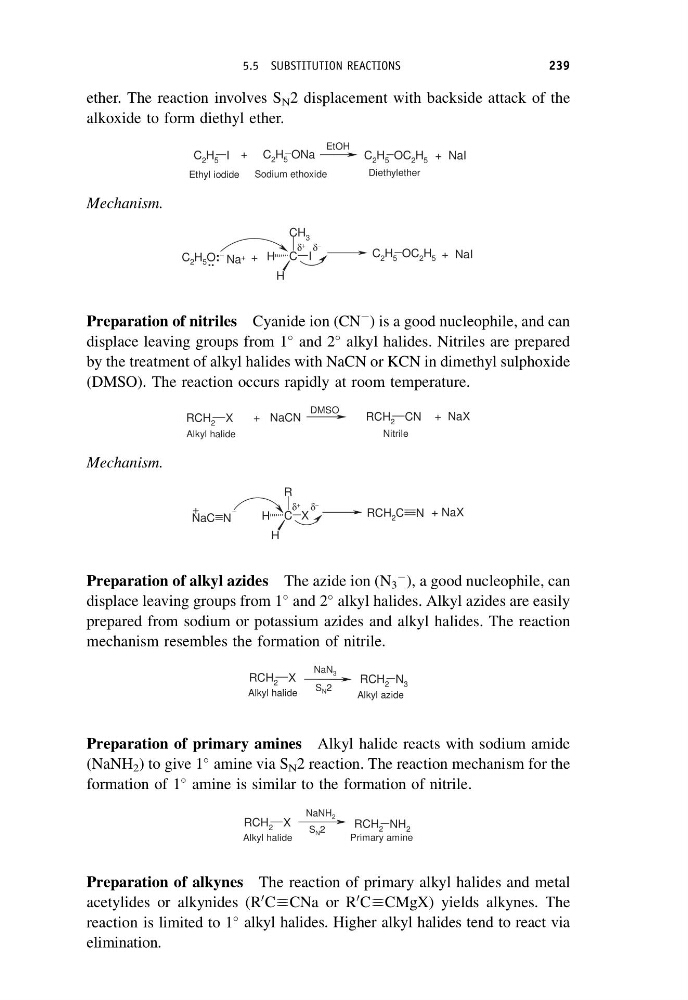
ether. The reaction involves S N 2 displacement with backside attack of the
alkoxide to form diethyl ether.
C 2 H 5 I
ONa
C 2 H 5
C 2 H 5 OC 2 H 5 + NaI
Diethylether
Ethyl iodide
Sodium ethoxide
+
EtOH
Mechanism.
C 2 H 5 OC 2 H 5
CH 3
C I
H
H
δ + δ −
Na + +
+ NaI
..
C 2 H 5 O: −
Preparation of nitriles Cyanide ion (CN
À
) is a good nucleophile, and can
displace leaving groups from 1
and 2
alkyl halides. Nitriles are prepared
by the treatment of alkyl halides with NaCN or KCN in dimethyl sulphoxide
(DMSO). The reaction occurs rapidly at room temperature.
RCH 2 CN
RCH 2 X
+ NaX
Nitrile
+ NaCN
Alkyl halide
DMSO
Mechanism.
R
C X
H
H
RCH 2 C N
NaC N
δ + δ −
+ NaX
+
Preparation of alkyl azides The azide ion (N 3
À ), a good nucleophile, can
displace leaving groups from 1
and 2
alkyl halides. Alkyl azides are easily
prepared from sodium or potassium azides and alkyl halides. The reaction
mechanism resembles the formation of nitrile.
RCH 2 X
RCH 2 N 3
Alkyl halide
Alkyl azide
NaN 3
S N 2
Preparation of primary amines Alkyl halide reacts with sodium amide
(NaNH 2 ) to give 1
amine via S N 2 reaction. The reaction mechanism for the
formation of 1
amine is similar to the formation of nitrile.
RCH 2 NH 2
RCH 2 X
NaNH 2
Primary amine
Alkyl halide
S N 2
Preparation of alkynes The reaction of primary alkyl halides and metal
acetylides or alkynides (R
0 C À À
À À
À À CNa or R
0 C À À
À À
À À CMgX) yields alkynes. The
reaction is limited to 1
alkyl halides. Higher alkyl halides tend to react via
elimination.
5.5 SUBSTITUTION REACTIONS
239
alkoxide to form diethyl ether.
C 2 H 5 I
ONa
C 2 H 5
C 2 H 5 OC 2 H 5 + NaI
Diethylether
Ethyl iodide
Sodium ethoxide
+
EtOH
Mechanism.
C 2 H 5 OC 2 H 5
CH 3
C I
H
H
δ + δ −
Na + +
+ NaI
..
C 2 H 5 O: −
Preparation of nitriles Cyanide ion (CN
À
) is a good nucleophile, and can
displace leaving groups from 1
and 2
alkyl halides. Nitriles are prepared
by the treatment of alkyl halides with NaCN or KCN in dimethyl sulphoxide
(DMSO). The reaction occurs rapidly at room temperature.
RCH 2 CN
RCH 2 X
+ NaX
Nitrile
+ NaCN
Alkyl halide
DMSO
Mechanism.
R
C X
H
H
RCH 2 C N
NaC N
δ + δ −
+ NaX
+
Preparation of alkyl azides The azide ion (N 3
À ), a good nucleophile, can
displace leaving groups from 1
and 2
alkyl halides. Alkyl azides are easily
prepared from sodium or potassium azides and alkyl halides. The reaction
mechanism resembles the formation of nitrile.
RCH 2 X
RCH 2 N 3
Alkyl halide
Alkyl azide
NaN 3
S N 2
Preparation of primary amines Alkyl halide reacts with sodium amide
(NaNH 2 ) to give 1
amine via S N 2 reaction. The reaction mechanism for the
formation of 1
amine is similar to the formation of nitrile.
RCH 2 NH 2
RCH 2 X
NaNH 2
Primary amine
Alkyl halide
S N 2
Preparation of alkynes The reaction of primary alkyl halides and metal
acetylides or alkynides (R
0 C À À
À À
À À CNa or R
0 C À À
À À
À À CMgX) yields alkynes. The
reaction is limited to 1
alkyl halides. Higher alkyl halides tend to react via
elimination.
5.5 SUBSTITUTION REACTIONS
239