

the base, the better it is as a leaving group. Good leaving groups are
essential for both S N 1 and S N 2 reactions.
Steric effects of the substrate Large groups on the electrophile hinder the
approach of the nucleophile. Generally, one alkyl group slows the reaction,
two alkyl groups make it difficult and three alkyl groups make it close to
impossible.
Relative rates for S N 2 :
methyl halides > 1
> 2
> 3
alkyl halides:
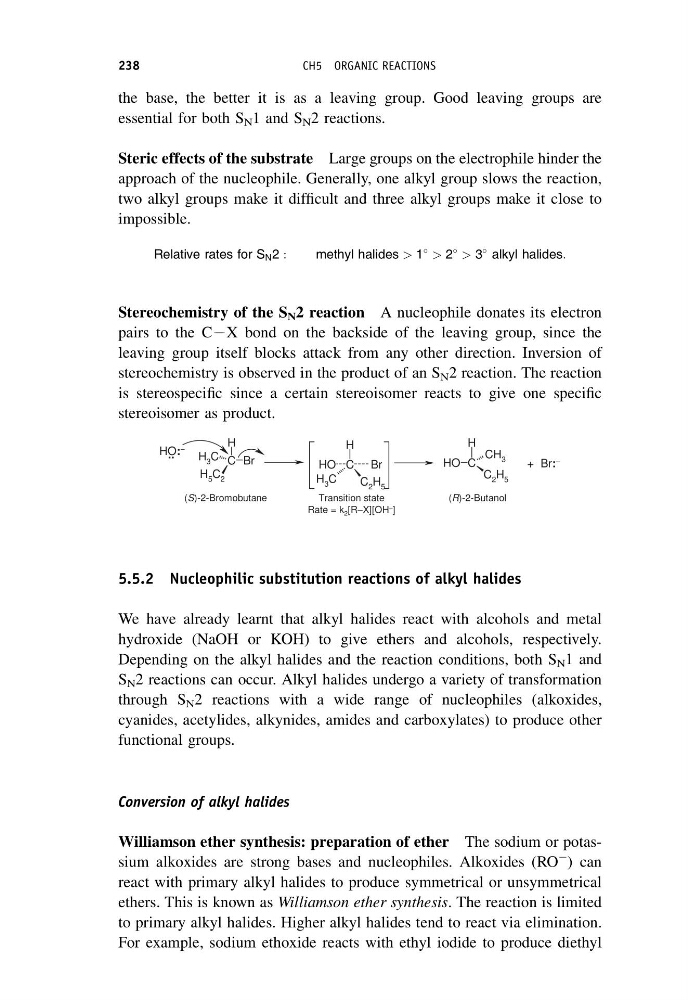
Stereochemistry of the S N 2 reaction A nucleophile donates its electron
pairs to the CÀ ÀX bond on the backside of the leaving group, since the
leaving group itself blocks attack from any other direction. Inversion of
stereochemistry is observed in the product of an S N 2 reaction. The reaction
is stereospecific since a certain stereoisomer reacts to give one specific
stereoisomer as product.
H
C Br
H 5 C 2
C
H 3
H
C
C 2 H 5
Br
O
H
C
H 3
H
C
O
H
C 2 H 5
CH 3
(S
(
e
n
a
t
u
b
o
m
o
r
B
-
2
-
)
R)-2-Butanol
Transition state
Rate = k 2 [R−X][OH − ]
..
+ Br: −
HO: −
5.5.2 Nucleophilic substitution reactions of alkyl halides
We have already learnt that alkyl halides react with alcohols and metal
hydroxide (NaOH or KOH) to give ethers and alcohols, respectively.
Depending on the alkyl halides and the reaction conditions, both S N 1 and
S N 2 reactions can occur. Alkyl halides undergo a variety of transformation
through S N 2 reactions with a wide range of nucleophiles (alkoxides,
cyanides, acetylides, alkynides, amides and carboxylates) to produce other
functional groups.
Conversion of alkyl halides
Williamson ether synthesis: preparation of ether The sodium or potassium alkoxides are strong bases and nucleophiles. Alkoxides (RO
À ) can
react with primary alkyl halides to produce symmetrical or unsymmetrical
ethers. This is known as Williamson ether synthesis. The reaction is limited
to primary alkyl halides. Higher alkyl halides tend to react via elimination.
For example, sodium ethoxide reacts with ethyl iodide to produce diethyl
238
CH5 ORGANIC REACTIONS
essential for both S N 1 and S N 2 reactions.
Steric effects of the substrate Large groups on the electrophile hinder the
approach of the nucleophile. Generally, one alkyl group slows the reaction,
two alkyl groups make it difficult and three alkyl groups make it close to
impossible.
Relative rates for S N 2 :
methyl halides > 1
> 2
> 3
alkyl halides:
Stereochemistry of the S N 2 reaction A nucleophile donates its electron
pairs to the CÀ ÀX bond on the backside of the leaving group, since the
leaving group itself blocks attack from any other direction. Inversion of
stereochemistry is observed in the product of an S N 2 reaction. The reaction
is stereospecific since a certain stereoisomer reacts to give one specific
stereoisomer as product.
H
C Br
H 5 C 2
C
H 3
H
C
C 2 H 5
Br
O
H
C
H 3
H
C
O
H
C 2 H 5
CH 3
(S
(
e
n
a
t
u
b
o
m
o
r
B
-
2
-
)
R)-2-Butanol
Transition state
Rate = k 2 [R−X][OH − ]
..
+ Br: −
HO: −
5.5.2 Nucleophilic substitution reactions of alkyl halides
We have already learnt that alkyl halides react with alcohols and metal
hydroxide (NaOH or KOH) to give ethers and alcohols, respectively.
Depending on the alkyl halides and the reaction conditions, both S N 1 and
S N 2 reactions can occur. Alkyl halides undergo a variety of transformation
through S N 2 reactions with a wide range of nucleophiles (alkoxides,
cyanides, acetylides, alkynides, amides and carboxylates) to produce other
functional groups.
Conversion of alkyl halides
Williamson ether synthesis: preparation of ether The sodium or potassium alkoxides are strong bases and nucleophiles. Alkoxides (RO
À ) can
react with primary alkyl halides to produce symmetrical or unsymmetrical
ethers. This is known as Williamson ether synthesis. The reaction is limited
to primary alkyl halides. Higher alkyl halides tend to react via elimination.
For example, sodium ethoxide reacts with ethyl iodide to produce diethyl
238
CH5 ORGANIC REACTIONS