

Nucleophilicity increases down the periodic table with the increase in
polarizability and size of the elements.
I
À > Br
À > Cl
À > F
À
HSe
À > HS
À > HO
À
ðC 2 H 5 Þ 3 P > ðC 2 H 5 Þ 3 N
As the size of an atom increases, its outer electrons move further away from
the attractive force of the nucleus. The electrons are held less tightly and are
said to be more polarizable. Fluoride is a nucleophile having hard or low
polarizability, with its electrons held close to the nucleus, and it must
approach the carbon nucleus closely before orbital overlap can occur. The
outer shell of the soft iodide has loosely held electrons, and these can easily
shift and overlap with the carbon atom at a relatively long distance.
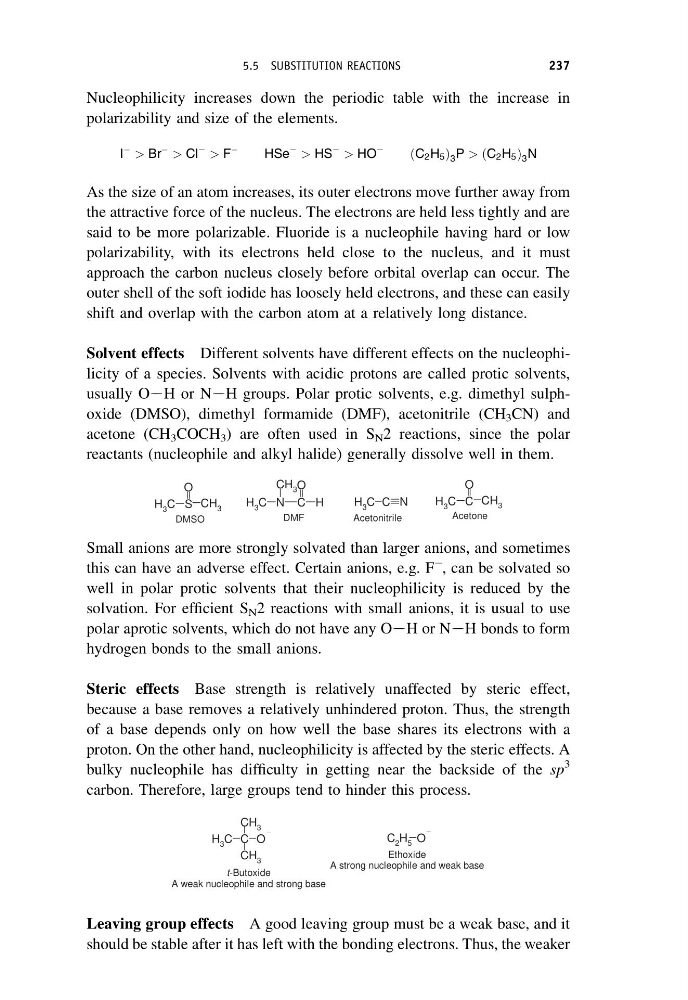
Solvent effects Different solvents have different effects on the nucleophilicity of a species. Solvents with acidic protons are called protic solvents,
usually OÀ ÀH or NÀ ÀH groups. Polar protic solvents, e.g. dimethyl sulphoxide (DMSO), dimethyl formamide (DMF), acetonitrile (CH 3 CN) and
acetone (CH 3 COCH 3 ) are often used in S N 2 reactions, since the polar
reactants (nucleophile and alkyl halide) generally dissolve well in them.
C
H 3 C N
C
H 3
N
CH 3
C
O
H
C
H 3 C
O
CH 3
C
H 3
S
O
CH 3
Acetonitrile
Acetone
DMSO
DMF
Small anions are more strongly solvated than larger anions, and sometimes
this can have an adverse effect. Certain anions, e.g. F
À
, can be solvated so
well in polar protic solvents that their nucleophilicity is reduced by the
solvation. For efficient S N 2 reactions with small anions, it is usual to use
polar aprotic solvents, which do not have any OÀ ÀH or NÀ ÀH bonds to form
hydrogen bonds to the small anions.
Steric effects Base strength is relatively unaffected by steric effect,
because a base removes a relatively unhindered proton. Thus, the strength
of a base depends only on how well the base shares its electrons with a
proton. On the other hand, nucleophilicity is affected by the steric effects. A
bulky nucleophile has difficulty in getting near the backside of the sp
3
carbon. Therefore, large groups tend to hinder this process.
C
H 3 C
CH 3
CH 3
O
C 2 H 5 O
t-Butoxide
A weak nucleophile and strong base
Ethoxide
A strong nucleophile and weak base
Leaving group effects A good leaving group must be a weak base, and it
should be stable after it has left with the bonding electrons. Thus, the weaker
5.5 SUBSTITUTION REACTIONS
237
polarizability and size of the elements.
I
À > Br
À > Cl
À > F
À
HSe
À > HS
À > HO
À
ðC 2 H 5 Þ 3 P > ðC 2 H 5 Þ 3 N
As the size of an atom increases, its outer electrons move further away from
the attractive force of the nucleus. The electrons are held less tightly and are
said to be more polarizable. Fluoride is a nucleophile having hard or low
polarizability, with its electrons held close to the nucleus, and it must
approach the carbon nucleus closely before orbital overlap can occur. The
outer shell of the soft iodide has loosely held electrons, and these can easily
shift and overlap with the carbon atom at a relatively long distance.
Solvent effects Different solvents have different effects on the nucleophilicity of a species. Solvents with acidic protons are called protic solvents,
usually OÀ ÀH or NÀ ÀH groups. Polar protic solvents, e.g. dimethyl sulphoxide (DMSO), dimethyl formamide (DMF), acetonitrile (CH 3 CN) and
acetone (CH 3 COCH 3 ) are often used in S N 2 reactions, since the polar
reactants (nucleophile and alkyl halide) generally dissolve well in them.
C
H 3 C N
C
H 3
N
CH 3
C
O
H
C
H 3 C
O
CH 3
C
H 3
S
O
CH 3
Acetonitrile
Acetone
DMSO
DMF
Small anions are more strongly solvated than larger anions, and sometimes
this can have an adverse effect. Certain anions, e.g. F
À
, can be solvated so
well in polar protic solvents that their nucleophilicity is reduced by the
solvation. For efficient S N 2 reactions with small anions, it is usual to use
polar aprotic solvents, which do not have any OÀ ÀH or NÀ ÀH bonds to form
hydrogen bonds to the small anions.
Steric effects Base strength is relatively unaffected by steric effect,
because a base removes a relatively unhindered proton. Thus, the strength
of a base depends only on how well the base shares its electrons with a
proton. On the other hand, nucleophilicity is affected by the steric effects. A
bulky nucleophile has difficulty in getting near the backside of the sp
3
carbon. Therefore, large groups tend to hinder this process.
C
H 3 C
CH 3
CH 3
O
C 2 H 5 O
t-Butoxide
A weak nucleophile and strong base
Ethoxide
A strong nucleophile and weak base
Leaving group effects A good leaving group must be a weak base, and it
should be stable after it has left with the bonding electrons. Thus, the weaker
5.5 SUBSTITUTION REACTIONS
237