

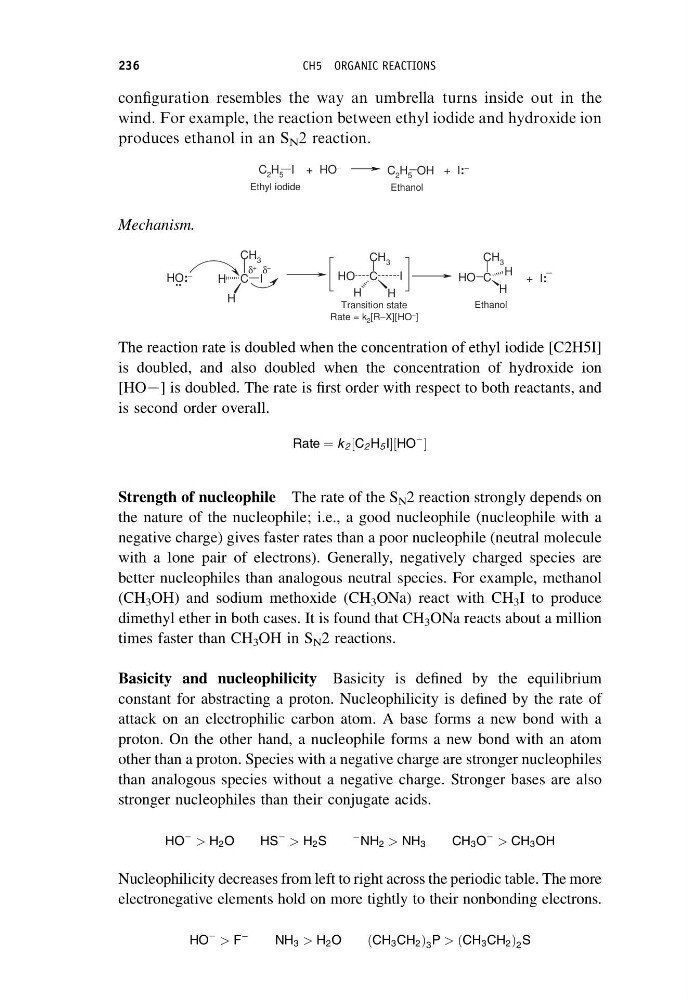
configuration resembles the way an umbrella turns inside out in the
wind. For example, the reaction between ethyl iodide and hydroxide ion
produces ethanol in an S N 2 reaction.
C 2 H 5 I
C 2 H 5 OH
Ethyl iodide
+ HO −
Ethanol
+ I: −
Mechanism.
CH 3
C I
H
H
CH 3
C
H
H
I
O
H
CH 3
C
O
H
H
H
δ + δ −
Transition state
Rate = k 2 [R−X][HO − ]
Ethanol
..
HO: −
+ I:
−
The reaction rate is doubled when the concentration of ethyl iodide [C2H5I]
is doubled, and also doubled when the concentration of hydroxide ion
[HOÀ À] is doubled. The rate is first order with respect to both reactants, and
is second order overall.
Rate ¼ k 2 ½C 2 H 5 I½HO
À
Strength of nucleophile The rate of the S N 2 reaction strongly depends on
the nature of the nucleophile; i.e., a good nucleophile (nucleophile with a
negative charge) gives faster rates than a poor nucleophile (neutral molecule
with a lone pair of electrons). Generally, negatively charged species are
better nucleophiles than analogous neutral species. For example, methanol
(CH 3 OH) and sodium methoxide (CH 3 ONa) react with CH 3 I to produce
dimethyl ether in both cases. It is found that CH 3 ONa reacts about a million
times faster than CH 3 OH in S N 2 reactions.
Basicity and nucleophilicity Basicity is defined by the equilibrium
constant for abstracting a proton. Nucleophilicity is defined by the rate of
attack on an electrophilic carbon atom. A base forms a new bond with a
proton. On the other hand, a nucleophile forms a new bond with an atom
other than a proton. Species with a negative charge are stronger nucleophiles
than analogous species without a negative charge. Stronger bases are also
stronger nucleophiles than their conjugate acids.
HO
À > H 2 O
HS
À > H 2 S
À NH 2 > NH 3
CH 3 O
À > CH 3 OH
Nucleophilicity decreases from left to right across the periodic table. The more
electronegative elements hold on more tightly to their nonbonding electrons.
HO
À > F
À
NH 3 > H 2 O
ðCH 3 CH 2 Þ 3 P > ðCH 3 CH 2 Þ 2 S
236
CH5 ORGANIC REACTIONS
wind. For example, the reaction between ethyl iodide and hydroxide ion
produces ethanol in an S N 2 reaction.
C 2 H 5 I
C 2 H 5 OH
Ethyl iodide
+ HO −
Ethanol
+ I: −
Mechanism.
CH 3
C I
H
H
CH 3
C
H
H
I
O
H
CH 3
C
O
H
H
H
δ + δ −
Transition state
Rate = k 2 [R−X][HO − ]
Ethanol
..
HO: −
+ I:
−
The reaction rate is doubled when the concentration of ethyl iodide [C2H5I]
is doubled, and also doubled when the concentration of hydroxide ion
[HOÀ À] is doubled. The rate is first order with respect to both reactants, and
is second order overall.
Rate ¼ k 2 ½C 2 H 5 I½HO
À
Strength of nucleophile The rate of the S N 2 reaction strongly depends on
the nature of the nucleophile; i.e., a good nucleophile (nucleophile with a
negative charge) gives faster rates than a poor nucleophile (neutral molecule
with a lone pair of electrons). Generally, negatively charged species are
better nucleophiles than analogous neutral species. For example, methanol
(CH 3 OH) and sodium methoxide (CH 3 ONa) react with CH 3 I to produce
dimethyl ether in both cases. It is found that CH 3 ONa reacts about a million
times faster than CH 3 OH in S N 2 reactions.
Basicity and nucleophilicity Basicity is defined by the equilibrium
constant for abstracting a proton. Nucleophilicity is defined by the rate of
attack on an electrophilic carbon atom. A base forms a new bond with a
proton. On the other hand, a nucleophile forms a new bond with an atom
other than a proton. Species with a negative charge are stronger nucleophiles
than analogous species without a negative charge. Stronger bases are also
stronger nucleophiles than their conjugate acids.
HO
À > H 2 O
HS
À > H 2 S
À NH 2 > NH 3
CH 3 O
À > CH 3 OH
Nucleophilicity decreases from left to right across the periodic table. The more
electronegative elements hold on more tightly to their nonbonding electrons.
HO
À > F
À
NH 3 > H 2 O
ðCH 3 CH 2 Þ 3 P > ðCH 3 CH 2 Þ 2 S
236
CH5 ORGANIC REACTIONS