

less stable secondary cation. Rearrangements occur when a more stable
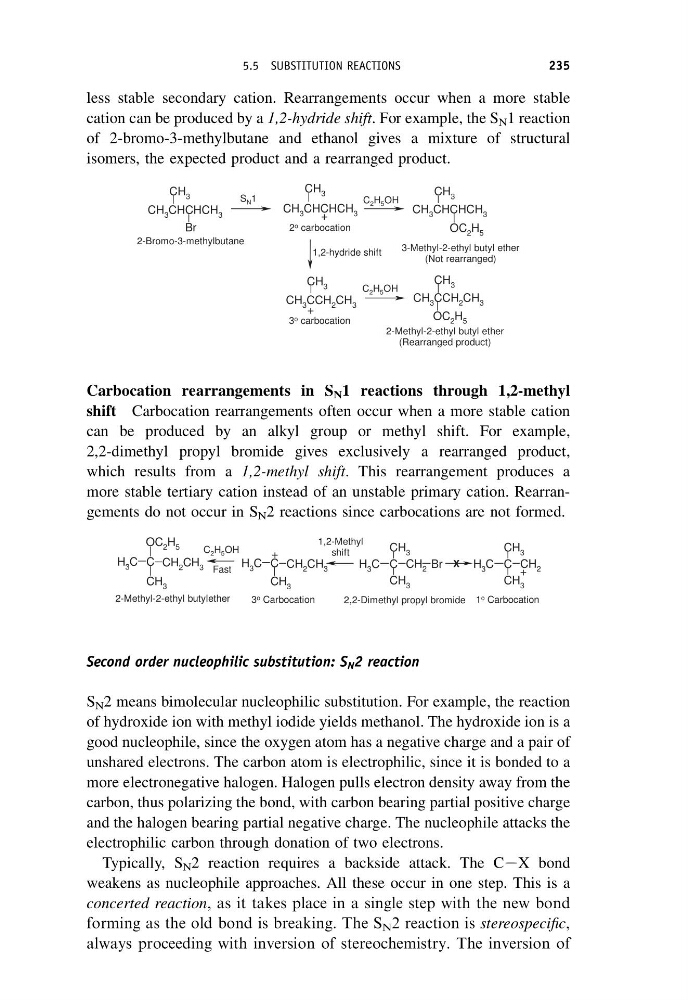
cation can be produced by a 1,2-hydride shift. For example, the S N 1 reaction
of 2-bromo-3-methylbutane and ethanol gives a mixture of structural
isomers, the expected product and a rearranged product.
CH 3 CHCHCH 3
CH 3
Br
CH 3 CHCHCH 3
CH 3
CH 3 CCH 2 CH 3
CH 3
CH 3 CCH 2 CH 3
CH 3
OC 2 H 5
CH 3 CHCHCH 3
CH 3
OC 2 H 5
2-Bromo-3-methylbutane
S N 1
2 o carbocation
1,2-hydride shift
3 o carbocation
2-Methyl-2-ethyl butyl ether
(Rearranged product)
C 2 H 5 OH
C 2 H 5 OH
3-Methyl-2-ethyl butyl ether
(Not rearranged)
+
+
Carbocation rearrangements in S N 1 reactions through 1,2-methyl
shift Carbocation rearrangements often occur when a more stable cation
can be produced by an alkyl group or methyl shift. For example,
2,2-dimethyl propyl bromide gives exclusively a rearranged product,
which results from a 1,2-methyl shift. This rearrangement produces a
more stable tertiary cation instead of an unstable primary cation. Rearrangements do not occur in S N 2 reactions since carbocations are not formed.
C
H 3
C
CH 3
CH 3
CH 2
X
C
H 3 C
CH 3
CH 2 CH 3
C
H 3
C
CH 3
CH 3
CH 2
C
H 3 C
CH 3
CH 2 CH 3
OC 2 H 5
Br
1,2-Methyl
shift
3 o Carbocation
C 2 H 5 OH
Fast
1 o Carbocation
2-Methyl-2-ethyl butylether
2,2-Dimethyl propyl bromide
+
+
Second order nucleophilic substitution: S N 2 reaction
S N 2 means bimolecular nucleophilic substitution. For example, the reaction
of hydroxide ion with methyl iodide yields methanol. The hydroxide ion is a
good nucleophile, since the oxygen atom has a negative charge and a pair of
unshared electrons. The carbon atom is electrophilic, since it is bonded to a
more electronegative halogen. Halogen pulls electron density away from the
carbon, thus polarizing the bond, with carbon bearing partial positive charge
and the halogen bearing partial negative charge. The nucleophile attacks the
electrophilic carbon through donation of two electrons.
Typically, S N 2 reaction requires a backside attack. The CÀ ÀX bond
weakens as nucleophile approaches. All these occur in one step. This is a
concerted reaction, as it takes place in a single step with the new bond
forming as the old bond is breaking. The S N 2 reaction is stereospecific,
always proceeding with inversion of stereochemistry. The inversion of
5.5 SUBSTITUTION REACTIONS
235
cation can be produced by a 1,2-hydride shift. For example, the S N 1 reaction
of 2-bromo-3-methylbutane and ethanol gives a mixture of structural
isomers, the expected product and a rearranged product.
CH 3 CHCHCH 3
CH 3
Br
CH 3 CHCHCH 3
CH 3
CH 3 CCH 2 CH 3
CH 3
CH 3 CCH 2 CH 3
CH 3
OC 2 H 5
CH 3 CHCHCH 3
CH 3
OC 2 H 5
2-Bromo-3-methylbutane
S N 1
2 o carbocation
1,2-hydride shift
3 o carbocation
2-Methyl-2-ethyl butyl ether
(Rearranged product)
C 2 H 5 OH
C 2 H 5 OH
3-Methyl-2-ethyl butyl ether
(Not rearranged)
+
+
Carbocation rearrangements in S N 1 reactions through 1,2-methyl
shift Carbocation rearrangements often occur when a more stable cation
can be produced by an alkyl group or methyl shift. For example,
2,2-dimethyl propyl bromide gives exclusively a rearranged product,
which results from a 1,2-methyl shift. This rearrangement produces a
more stable tertiary cation instead of an unstable primary cation. Rearrangements do not occur in S N 2 reactions since carbocations are not formed.
C
H 3
C
CH 3
CH 3
CH 2
X
C
H 3 C
CH 3
CH 2 CH 3
C
H 3
C
CH 3
CH 3
CH 2
C
H 3 C
CH 3
CH 2 CH 3
OC 2 H 5
Br
1,2-Methyl
shift
3 o Carbocation
C 2 H 5 OH
Fast
1 o Carbocation
2-Methyl-2-ethyl butylether
2,2-Dimethyl propyl bromide
+
+
Second order nucleophilic substitution: S N 2 reaction
S N 2 means bimolecular nucleophilic substitution. For example, the reaction
of hydroxide ion with methyl iodide yields methanol. The hydroxide ion is a
good nucleophile, since the oxygen atom has a negative charge and a pair of
unshared electrons. The carbon atom is electrophilic, since it is bonded to a
more electronegative halogen. Halogen pulls electron density away from the
carbon, thus polarizing the bond, with carbon bearing partial positive charge
and the halogen bearing partial negative charge. The nucleophile attacks the
electrophilic carbon through donation of two electrons.
Typically, S N 2 reaction requires a backside attack. The CÀ ÀX bond
weakens as nucleophile approaches. All these occur in one step. This is a
concerted reaction, as it takes place in a single step with the new bond
forming as the old bond is breaking. The S N 2 reaction is stereospecific,
always proceeding with inversion of stereochemistry. The inversion of
5.5 SUBSTITUTION REACTIONS
235