

solvent is the nucleophile, e.g. water and alcohol. When the solvent is the
nucleophile, the reaction is called solvolysis.
Leaving group effects Good leaving groups are essential for S N 1 reactions. In the S N 1 reaction, a highly polarizable leaving group helps to
stabilize the negative charge through partial bonding as it leaves. The
leaving group should be stable after it has left with the bonding electrons,
and also be a weak base. The leaving group starts to take on partial negative
charge as the cation starts to form. The most common leaving groups are
anions,: Cl
À , Br
À
, I
À , RSO 3
À (sulphonate), RSO 4
À (sulphate), RPO 4
À
(phosphate)
neutral species: H 2 O, ROH, R 3 N, R 3 P.
Solvent effects Protic solvents are especially useful since the hydrogen
bonding stabilizes the anionic leaving group after ionization. Ionization
requires the stabilization of both positive and negative charges. Solvents
with higher dielectric constant (e), which is a measure of a solvent’s
polarity, have faster rates for S N 1 reactions.
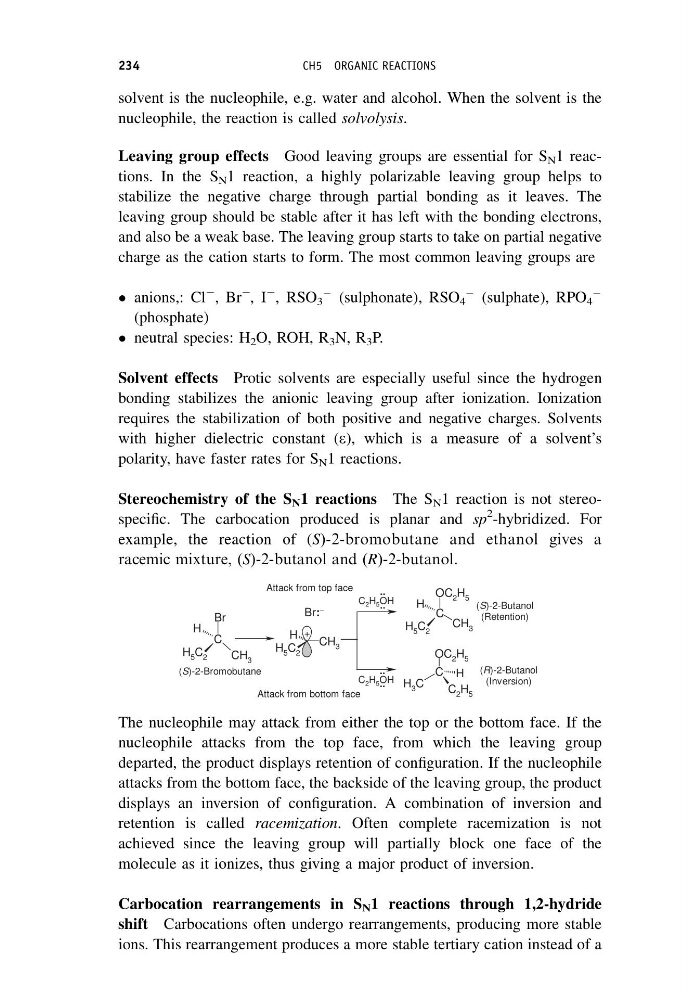
Stereochemistry of the S N 1 reactions The S N 1 reaction is not stereospecific. The carbocation produced is planar and sp
2
-hybridized. For
example, the reaction of (S)-2-bromobutane and ethanol gives a
racemic mixture, (S)-2-butanol and (R)-2-butanol.
Br
C
CH 3
H
H 5 C 2
CH 3
H 5 C 2
H
OC 2 H 5
C
CH 3
H 5 C 2
H
OC 2 H 5
C
C
H 3
C 2 H 5
H
(S)-2-Bromobutane
(S)-2-Butanol
(Retention)
(R)-2-Butanol
(Inversion)
+
C 2 H 5 OH
C 2 H 5 OH
..
..
..
..
Attack from top face
Attack from bottom face
Br: −
The nucleophile may attack from either the top or the bottom face. If the
nucleophile attacks from the top face, from which the leaving group
departed, the product displays retention of configuration. If the nucleophile
attacks from the bottom face, the backside of the leaving group, the product
displays an inversion of configuration. A combination of inversion and
retention is called racemization. Often complete racemization is not
achieved since the leaving group will partially block one face of the
molecule as it ionizes, thus giving a major product of inversion.
Carbocation rearrangements in S N 1 reactions through 1,2-hydride
shift Carbocations often undergo rearrangements, producing more stable
ions. This rearrangement produces a more stable tertiary cation instead of a
234
CH5 ORGANIC REACTIONS
nucleophile, the reaction is called solvolysis.
Leaving group effects Good leaving groups are essential for S N 1 reactions. In the S N 1 reaction, a highly polarizable leaving group helps to
stabilize the negative charge through partial bonding as it leaves. The
leaving group should be stable after it has left with the bonding electrons,
and also be a weak base. The leaving group starts to take on partial negative
charge as the cation starts to form. The most common leaving groups are
anions,: Cl
À , Br
À
, I
À , RSO 3
À (sulphonate), RSO 4
À (sulphate), RPO 4
À
(phosphate)
neutral species: H 2 O, ROH, R 3 N, R 3 P.
Solvent effects Protic solvents are especially useful since the hydrogen
bonding stabilizes the anionic leaving group after ionization. Ionization
requires the stabilization of both positive and negative charges. Solvents
with higher dielectric constant (e), which is a measure of a solvent’s
polarity, have faster rates for S N 1 reactions.
Stereochemistry of the S N 1 reactions The S N 1 reaction is not stereospecific. The carbocation produced is planar and sp
2
-hybridized. For
example, the reaction of (S)-2-bromobutane and ethanol gives a
racemic mixture, (S)-2-butanol and (R)-2-butanol.
Br
C
CH 3
H
H 5 C 2
CH 3
H 5 C 2
H
OC 2 H 5
C
CH 3
H 5 C 2
H
OC 2 H 5
C
C
H 3
C 2 H 5
H
(S)-2-Bromobutane
(S)-2-Butanol
(Retention)
(R)-2-Butanol
(Inversion)
+
C 2 H 5 OH
C 2 H 5 OH
..
..
..
..
Attack from top face
Attack from bottom face
Br: −
The nucleophile may attack from either the top or the bottom face. If the
nucleophile attacks from the top face, from which the leaving group
departed, the product displays retention of configuration. If the nucleophile
attacks from the bottom face, the backside of the leaving group, the product
displays an inversion of configuration. A combination of inversion and
retention is called racemization. Often complete racemization is not
achieved since the leaving group will partially block one face of the
molecule as it ionizes, thus giving a major product of inversion.
Carbocation rearrangements in S N 1 reactions through 1,2-hydride
shift Carbocations often undergo rearrangements, producing more stable
ions. This rearrangement produces a more stable tertiary cation instead of a
234
CH5 ORGANIC REACTIONS