

First order nucleophilic substitution: S N 1 reaction
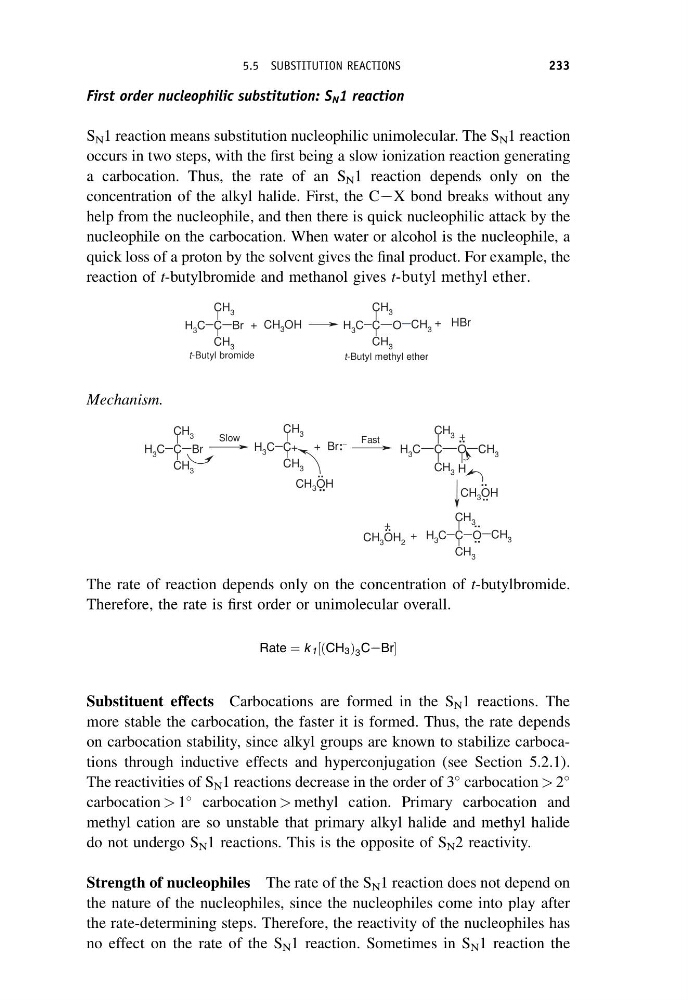
S N 1 reaction means substitution nucleophilic unimolecular. The S N 1 reaction
occurs in two steps, with the first being a slow ionization reaction generating
a carbocation. Thus, the rate of an S N 1 reaction depends only on the
concentration of the alkyl halide. First, the CÀ ÀX bond breaks without any
help from the nucleophile, and then there is quick nucleophilic attack by the
nucleophile on the carbocation. When water or alcohol is the nucleophile, a
quick loss of a proton by the solvent gives the final product. For example, the
reaction of t-butylbromide and methanol gives t-butyl methyl ether.
C O CH 3
CH 3
CH 3
C
H 3
C
CH 3
CH 3
Br
C
H 3
t-Butyl bromide
+ CH 3 OH
+ HBr
t-Butyl methyl ether
Mechanism.
C
CH 3
CH 3
Br
C
H 3
C
CH 3
CH 3
C
H 3
C
CH 3
CH 3
C
H 3
O CH 3
C
CH 3
CH 3
C
H 3
O CH 3
H
CH 3 OH 2
Slow
CH 3 OH
Fast
CH 3 OH
..
+
..
..
+
+
+
..
..
..
..
..
+ Br: −
The rate of reaction depends only on the concentration of t-butylbromide.
Therefore, the rate is first order or unimolecular overall.
Rate ¼ k 1 ½ðCH 3 Þ 3 CÀ ÀBr
Substituent effects Carbocations are formed in the S N 1 reactions. The
more stable the carbocation, the faster it is formed. Thus, the rate depends
on carbocation stability, since alkyl groups are known to stabilize carbocations through inductive effects and hyperconjugation (see Section 5.2.1).
The reactivities of S N 1 reactions decrease in the order of 3
carbocation > 2
carbocation > 1
carbocation > methyl cation. Primary carbocation and
methyl cation are so unstable that primary alkyl halide and methyl halide
do not undergo S N 1 reactions. This is the opposite of S N 2 reactivity.
Strength of nucleophiles The rate of the S N 1 reaction does not depend on
the nature of the nucleophiles, since the nucleophiles come into play after
the rate-determining steps. Therefore, the reactivity of the nucleophiles has
no effect on the rate of the S N 1 reaction. Sometimes in S N 1 reaction the
5.5 SUBSTITUTION REACTIONS
233
S N 1 reaction means substitution nucleophilic unimolecular. The S N 1 reaction
occurs in two steps, with the first being a slow ionization reaction generating
a carbocation. Thus, the rate of an S N 1 reaction depends only on the
concentration of the alkyl halide. First, the CÀ ÀX bond breaks without any
help from the nucleophile, and then there is quick nucleophilic attack by the
nucleophile on the carbocation. When water or alcohol is the nucleophile, a
quick loss of a proton by the solvent gives the final product. For example, the
reaction of t-butylbromide and methanol gives t-butyl methyl ether.
C O CH 3
CH 3
CH 3
C
H 3
C
CH 3
CH 3
Br
C
H 3
t-Butyl bromide
+ CH 3 OH
+ HBr
t-Butyl methyl ether
Mechanism.
C
CH 3
CH 3
Br
C
H 3
C
CH 3
CH 3
C
H 3
C
CH 3
CH 3
C
H 3
O CH 3
C
CH 3
CH 3
C
H 3
O CH 3
H
CH 3 OH 2
Slow
CH 3 OH
Fast
CH 3 OH
..
+
..
..
+
+
+
..
..
..
..
..
+ Br: −
The rate of reaction depends only on the concentration of t-butylbromide.
Therefore, the rate is first order or unimolecular overall.
Rate ¼ k 1 ½ðCH 3 Þ 3 CÀ ÀBr
Substituent effects Carbocations are formed in the S N 1 reactions. The
more stable the carbocation, the faster it is formed. Thus, the rate depends
on carbocation stability, since alkyl groups are known to stabilize carbocations through inductive effects and hyperconjugation (see Section 5.2.1).
The reactivities of S N 1 reactions decrease in the order of 3
carbocation > 2
carbocation > 1
carbocation > methyl cation. Primary carbocation and
methyl cation are so unstable that primary alkyl halide and methyl halide
do not undergo S N 1 reactions. This is the opposite of S N 2 reactivity.
Strength of nucleophiles The rate of the S N 1 reaction does not depend on
the nature of the nucleophiles, since the nucleophiles come into play after
the rate-determining steps. Therefore, the reactivity of the nucleophiles has
no effect on the rate of the S N 1 reaction. Sometimes in S N 1 reaction the
5.5 SUBSTITUTION REACTIONS
233