

E1 versus E2 mechanism
Criteria
E1
E2
Substrate
Tertiary > secondary > primary
Primary > secondary > tertiary
Rate of reaction
Depends only on the substrate
Depends on both substrate and base
Carbocation
More stable carbocation
Less stable carbocation
Rearrangement
Rearrangements are common
No rearrangements
Geometry
No special geometry required
anti-coplanarity required
Leaving group
Good leaving group
Poor leaving group
Base strength
Weak base
Strong and more concentrated base
5.5 Substitution reactions
The word substitution implies the replacement of one atom or group by
another. Two types of substitution reaction can occur: nucleophilic substitution and electrophilic substitution.
A nucleophile is an electron rich species that reacts with an electrophile.
The term electrophile literally means ‘electron-loving’, and is an electrondeficient species that can accept an electron pair. A number of nucleophilic substitution reactions can occur with alkyl halides, alcohols and
epoxides. However, it can also take place with carboxylic acid derivatives, and is called nucleophilic acyl substitution.
Electrophilic substitution reactions are those where an electrophile displaces another group, usually a hydrogen. Electrophilic substitution occurs
in aromatic compounds.
5.5.1 Nucleophilic substitutions
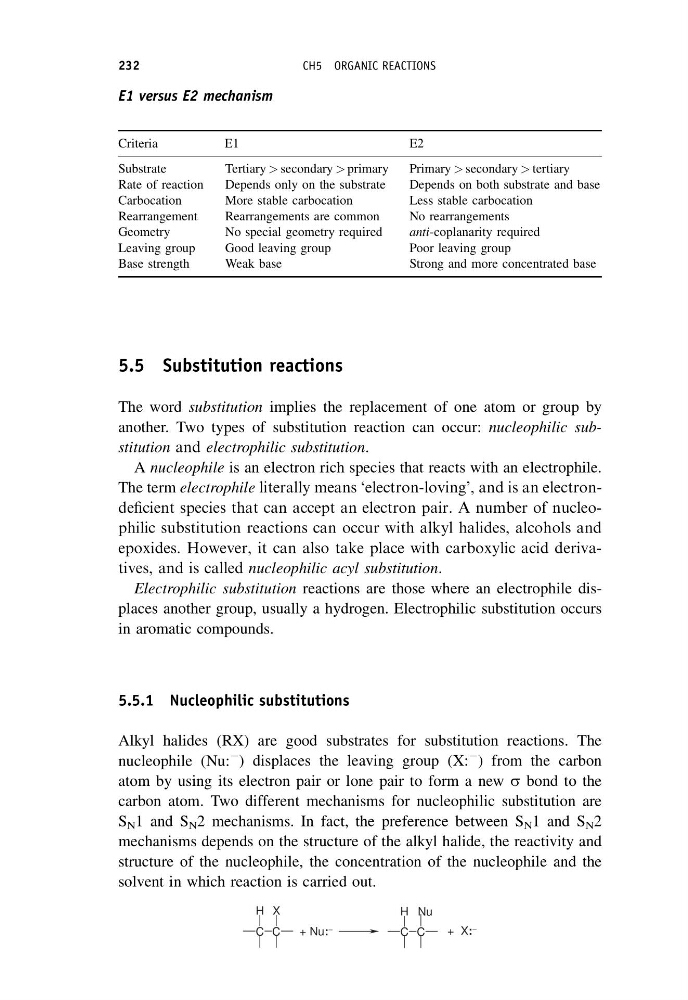
Alkyl halides (RX) are good substrates for substitution reactions. The
nucleophile (Nu:
À ) displaces the leaving group (X:
À
) from the carbon
atom by using its electron pair or lone pair to form a new s bond to the
carbon atom. Two different mechanisms for nucleophilic substitution are
S N 1 and S N 2 mechanisms. In fact, the preference between S N 1 and S N 2
mechanisms depends on the structure of the alkyl halide, the reactivity and
structure of the nucleophile, the concentration of the nucleophile and the
solvent in which reaction is carried out.
C
H
C
X
C
H
C
+ Nu: −
+ X: −
Nu
232
CH5 ORGANIC REACTIONS
Criteria
E1
E2
Substrate
Tertiary > secondary > primary
Primary > secondary > tertiary
Rate of reaction
Depends only on the substrate
Depends on both substrate and base
Carbocation
More stable carbocation
Less stable carbocation
Rearrangement
Rearrangements are common
No rearrangements
Geometry
No special geometry required
anti-coplanarity required
Leaving group
Good leaving group
Poor leaving group
Base strength
Weak base
Strong and more concentrated base
5.5 Substitution reactions
The word substitution implies the replacement of one atom or group by
another. Two types of substitution reaction can occur: nucleophilic substitution and electrophilic substitution.
A nucleophile is an electron rich species that reacts with an electrophile.
The term electrophile literally means ‘electron-loving’, and is an electrondeficient species that can accept an electron pair. A number of nucleophilic substitution reactions can occur with alkyl halides, alcohols and
epoxides. However, it can also take place with carboxylic acid derivatives, and is called nucleophilic acyl substitution.
Electrophilic substitution reactions are those where an electrophile displaces another group, usually a hydrogen. Electrophilic substitution occurs
in aromatic compounds.
5.5.1 Nucleophilic substitutions
Alkyl halides (RX) are good substrates for substitution reactions. The
nucleophile (Nu:
À ) displaces the leaving group (X:
À
) from the carbon
atom by using its electron pair or lone pair to form a new s bond to the
carbon atom. Two different mechanisms for nucleophilic substitution are
S N 1 and S N 2 mechanisms. In fact, the preference between S N 1 and S N 2
mechanisms depends on the structure of the alkyl halide, the reactivity and
structure of the nucleophile, the concentration of the nucleophile and the
solvent in which reaction is carried out.
C
H
C
X
C
H
C
+ Nu: −
+ X: −
Nu
232
CH5 ORGANIC REACTIONS