

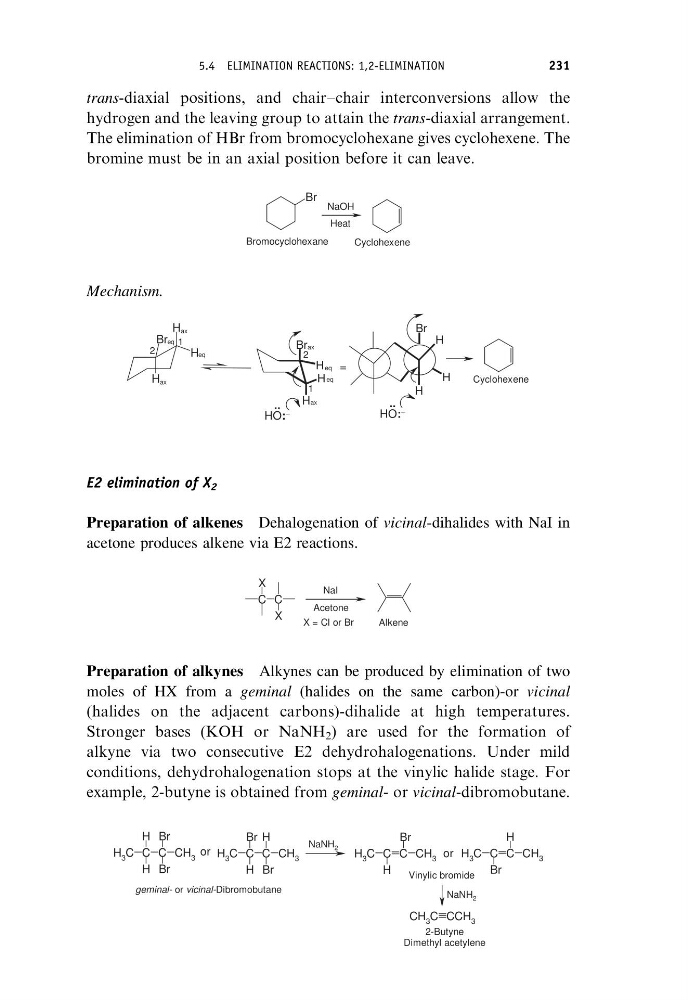
trans-diaxial positions, and chair–chair interconversions allow the
hydrogen and the leaving group to attain the trans-diaxial arrangement.
The elimination of HBr from bromocyclohexane gives cyclohexene. The
bromine must be in an axial position before it can leave.
Br
NaOH
Heat
Bromocyclohexane
Cyclohexene
Mechanism.
H
H
Br
H
Br
H
H
H
H
H
Br
H
=
eq
eq
ax
ax
eq
eq
1
2
2
1
ax
ax
Cyclohexene
..
HO: −
..
HO: −
E2 elimination of X 2
Preparation of alkenes Dehalogenation of vicinal-dihalides with NaI in
acetone produces alkene via E2 reactions.
C
X
C
X
X = Cl or Br
Alkene
NaI
Acetone
Preparation of alkynes Alkynes can be produced by elimination of two
moles of HX from a geminal (halides on the same carbon)-or vicinal
(halides on the adjacent carbons)-dihalide at high temperatures.
Stronger bases (KOH or NaNH 2 ) are used for the formation of
alkyne via two consecutive E2 dehydrohalogenations. Under mild
conditions, dehydrohalogenation stops at the vinylic halide stage. For
example, 2-butyne is obtained from geminal- or vicinal-dibromobutane.
C
H 3 C
H
H
C
Br
Br
CH 3
C
H 3 C
Br
H
C
H
Br
CH 3
CH 3 C CCH 3
C C
Br
CH 3
H
C
H 3
C C
H
CH 3
Br
C
H 3
or
NaNH 2
2-Butyne
Dimethyl acetylene
Vinylic bromide
or
geminal- or vicinal-Dibromobutane
NaNH 2
5.4 ELIMINATION REACTIONS: 1,2-ELIMINATION
231
hydrogen and the leaving group to attain the trans-diaxial arrangement.
The elimination of HBr from bromocyclohexane gives cyclohexene. The
bromine must be in an axial position before it can leave.
Br
NaOH
Heat
Bromocyclohexane
Cyclohexene
Mechanism.
H
H
Br
H
Br
H
H
H
H
H
Br
H
=
eq
eq
ax
ax
eq
eq
1
2
2
1
ax
ax
Cyclohexene
..
HO: −
..
HO: −
E2 elimination of X 2
Preparation of alkenes Dehalogenation of vicinal-dihalides with NaI in
acetone produces alkene via E2 reactions.
C
X
C
X
X = Cl or Br
Alkene
NaI
Acetone
Preparation of alkynes Alkynes can be produced by elimination of two
moles of HX from a geminal (halides on the same carbon)-or vicinal
(halides on the adjacent carbons)-dihalide at high temperatures.
Stronger bases (KOH or NaNH 2 ) are used for the formation of
alkyne via two consecutive E2 dehydrohalogenations. Under mild
conditions, dehydrohalogenation stops at the vinylic halide stage. For
example, 2-butyne is obtained from geminal- or vicinal-dibromobutane.
C
H 3 C
H
H
C
Br
Br
CH 3
C
H 3 C
Br
H
C
H
Br
CH 3
CH 3 C CCH 3
C C
Br
CH 3
H
C
H 3
C C
H
CH 3
Br
C
H 3
or
NaNH 2
2-Butyne
Dimethyl acetylene
Vinylic bromide
or
geminal- or vicinal-Dibromobutane
NaNH 2
5.4 ELIMINATION REACTIONS: 1,2-ELIMINATION
231